The Ministry of Waqfs and Religious Affairs released a detailed report detailing an intensification of Israeli violations targeting Muslim holy sites during the month of July.
According to the document, 27 incursions were recorded inside the Al-Aqsa Mosque precinct, while the call to prayer was prohibited 155 times at the Al-Ibrahimi Mosque in Hebron. The ministry says these measures fit within a growing policy that undermines freedom of worship and the status of holy sites.
Talmudic Prayers and Ritual Prostrations inside the Al-Aqsa Compound
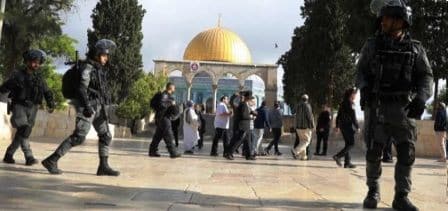
The report indicates that the Al-Aqsa Mosque has been the scene of numerous incursions led by groups of Israeli settlers, who entered through the Moroccan Gate under heavy police protection.
Among the participants were, according to the same source, the Israeli Minister of National Security Itamar Ben-Gvir, as well as members of the Knesset and officials from organizations linked to the Temple Movement.
The ministry says it documented the performance of Talmudic prayers, ritual prostrations, the wearing of tefillin and the deployment of Israeli flags inside the mosque compound.
The report also notes the introduction of stones onto the esplanades and the installation of a permanent canopy in the eastern part of the site to serve the groups taking part in the incursions. It would be, according to the ministry, a precedent dating back to 1967.
A Betrothal Ceremony Organized on the Esplanades
The esplanades of the Al-Aqsa Mosque would also have been the site of conduct described as unprecedented by the ministry.
In particular, an Israeli settler reportedly organized a betrothal ceremony accompanied by rites in Hebrew.
These events occurred alongside a tightening of restrictions imposed on Muslim worshippers and on staff of the Waqfs department, notably on Fridays.
The measures reportedly included incursions near the Al-Qibli Prayer Hall and the Dome of the Rock, as well as the detention for several hours of the mosque’s preacher and Jerusalem’s mufti, Sheikh Mohammed Hussein, before his release.
Restrictions Inside the Ibrahimi Mosque
In Hebron, Israeli authorities continued to restrict movement inside the Ibrahimi Mosque.
According to the report, the call to prayer was banned there 155 times during July for reasons described as security-related.
At least 195 Israeli soldiers would have also entered the sanctuary’s precinct, while the closure of the eastern gate and incursions into the Al-Ashraf Zawiya have continued since the start of 2025.
Three Mosques Burned
The report also records attacks on several mosques in the West Bank.
Three religious buildings are said to have been set on fire: the Al-Taqwa Mosque in Masafer Yatta, the old Al-Kur Mosque in Tulkarm, and the Qusra Mosque in the Nablus Governorate.
These attacks reportedly caused significant material damage.
The Omar Ibn Al-Khattab Mosque facilities, located in Beit Ummar, were also targeted and vandalized.
Call for International Intervention
In its conclusions, the Ministry of Waqfs warns against policies that, in its view, aim to impose a new reality inside holy sites.
It calls on the international community as well as human rights organizations and humanitarian institutions to assume their legal and moral responsibilities.
The ministry finally calls for immediate intervention to end the violations and to preserve the historical and legal status quo of the holy sites.