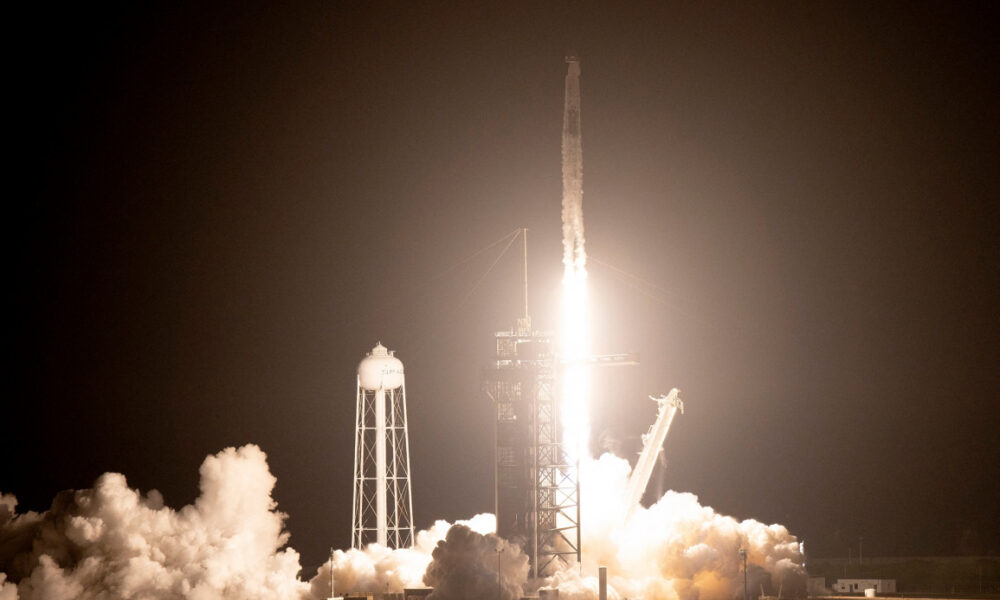
Wednesday evening, the upper stage of a SpaceX rocket crashed onto the Moon, scientists confirmed on Wednesday based on observations made with a telescope in Chile that captured evidence of a cloud of debris.
The collision, which was not intentional, should have created a crater on the lunar surface that space agencies including NASA hope to document.
Scientists estimated that the upper stage of the Falcon 9 rocket, bus-sized, would strike the Moon’s surface at approximately 06:35 GMT on Wednesday. What happened indeed occurred.
The European Southern Observatory’s Very Large Telescope (ESO), located in Chile, “detected spectral lines,” the observatory announced in a post on social media: “chemical footprints” of “sodium and lithium in the impact plume, which lasted five to ten minutes after the collision.”
“The sodium probably comes from the lunar soil, while the lithium could come from the rocket itself,” the ESO explained.
Benjamin Fernando, a researcher at the Los Alamos National Laboratory, in New Mexico (southwest United States) and the lead author of a recent study devoted to this anticipated collision, also confirmed to AFP that the impact had occurred.
Assuming that all the fuel had been expended, the study authors estimated that the craft weighed about four tonnes and, at a speed of 8,690 km/h, would crash near the Einstein crater, in the Moon’s northern hemisphere.
NASA and its Lunar Reconnaissance Orbiter have planned to capture images of the impact site, as has South Korea with its Pathfinder Lunar Orbiter. But information could take several days to reach us.
Before the crash, NASA had stated that there was “no danger to Earth.”
“NASA scientists plan to collect lunar data from this event to refine space object-tracking techniques,” the agency also said.
– Space junk –
The Falcon 9 rocket, built by Elon Musk’s SpaceX, launched in January 2025 with two lunar landers on board.
The booster returned to Earth, while the upper stage, long regarded as space debris, remained in space to continue transporting the two craft.
“A mix of solar activity and gravitational forces ultimately placed it on a trajectory toward the Moon,” said Julianna Scheiman, a SpaceX official, at a NASA press conference on Monday.
The collision should allow the study of dust plumes and better assess the risks posed by artificial space debris, issues all the more important as NASA hopes to establish a sustainable human presence on the Moon.
The Moon is regularly struck by space debris, notably meteoroids. Collisions with artificial objects are, however, much rarer.
In the 1970s, NASA deliberately induced impacts during its Apollo program to collect seismic data.
According to the European Space Agency, more than 46,000 space debris fragments, weighing a total of 17,000 tonnes, are currently in orbit, the agency said at the end of July.