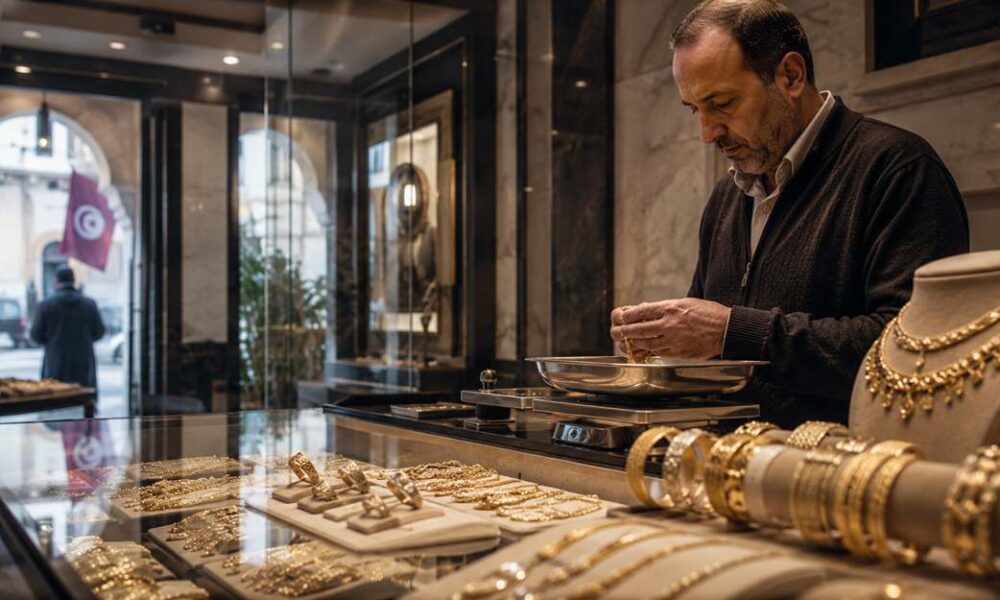
On August 4, 2026, the Tunisian gold market presents a peculiar situation: while the international price of the yellow metal has risen again, the prices charged by jewelers remain, for now, close to those observed in recent weeks.
The price per gram of 18-karat gold continues to trade generally between 360 and 370 dinars, while the ounce of gold has reached around $4,160, against nearly $4,034 the previous week.
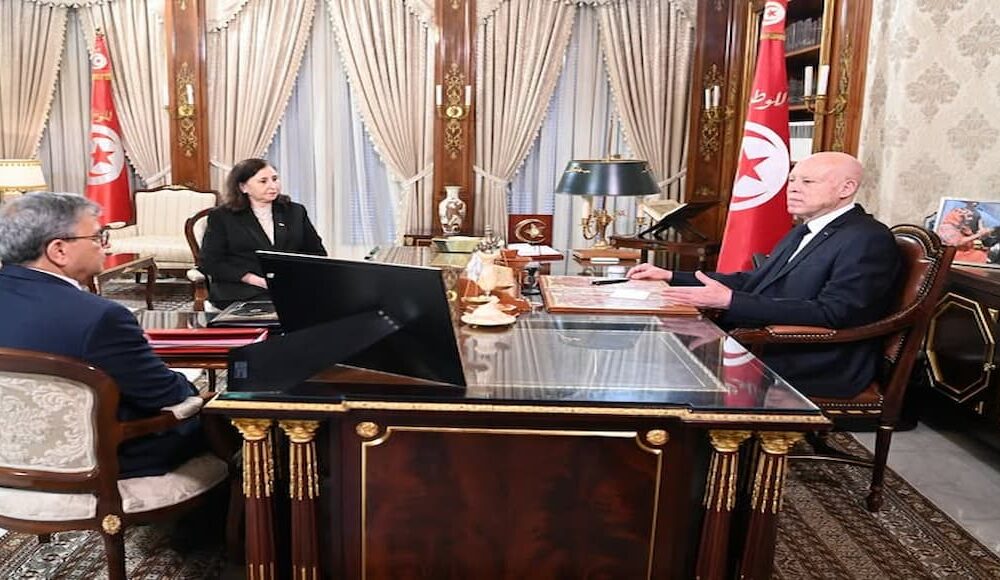
For Wajih Mesfar, president of the Sfax Chamber of Goldsmiths, this gap could however be temporary. In a statement given to Tunisie Numérique, he estimates that a price increase in Tunisia could be possible in the coming days if the world price remains at its current level.
The question for the Tunisian buyer is therefore simple: will the international rise eventually show up in the shop windows?
As of August 4, Tunisian prices still resist
Despite the rise of gold on international markets, Wajih Mesfar notes that local prices have remained broadly stable compared with the last few weeks.
For 18-karat gold, the reference range remains between 360 and 370 dinars per gram.
This level is all the more notable as it corresponds to what was observed in previous Tunisie Numérique scans. After fluctuating around 350 to 360 dinars, the per-gram price rose by about ten dinars before stabilizing in its current range.
For the consumer, this stability does not mean that all jewelry should be sold at 360 to 370 dinars per gram.
According to Wajih Mesfar, certain pieces can reach 420 dinars per gram, particularly depending on weight, model, and manufacturing work.
Why can the same gram of 18-karat cost 370 or 420 dinars?
This is one of the most important distinctions for understanding the prices displayed in jewelry stores.
The price of a piece of jewelry does not correspond only to the value of the metal it contains. It also includes the artisan’s labor, the complexity of the model, the finishes, and the merchant’s margin.
This difference becomes particularly visible for low-weight jewelry.
A small piece weighing one or two grams still requires design, manufacturing work, polishing, and marketing. These costs are spread over a smaller quantity of gold and can therefore significantly increase the final price calculated per gram.
Thus, two 18-karat gold jewelry items can bear the same gold fineness, but be sold at markedly different prices.
The takeaway: the 360 to 370 dinars range is a market benchmark. A price of 400 or 420 dinars per gram does not necessarily mean that the gold itself is sold much more expensively: part of the gap may reflect the jewelry’s fabrication.
The ounce moves from 4,034 to around 4,160 dollars
The change is most visible on the international market.
According to information provided by Wajih Mesfar on August 4, 2026, the gold ounce sits around $4,160, compared with approximately $4,034 the previous week.
This rise has not yet translated clearly into Tunisian prices.
The transmission is not instantaneous. Jewelers and manufacturers hold stocks purchased at different times and prices. A professional may still be working with gold purchased before the latest international rise.
The exchange rate between the dinar and the dollar also affects the local price formation.
It is when stocks need to be renewed at higher prices that a prolonged international rise can gradually pass through to the Tunisian market.
Why Wajih Mesfar foresees an increase in the coming days
The president of the Sfax Chamber of Goldsmiths believes Tunisian prices have begun to tilt upward, even if this is still not very visible in shop displays.
His scenario is conditional: if the ounce stays around current levels, a local rise could follow.
That does not mean the per-gram will automatically rise the next day, or that the extent of any rise can be predicted in advance.
The Tunisian market depends on the world price, but also on available stock, the exchange rate, professional margins, and the pace of raw material renewal.
The situation on August 4 thus corresponds more to a potential upward pressure than to a widespread price rise.
Prices for 18, 24, and 9 carats
According to the prices provided by Wajih Mesfar :
| Type of Gold | Price on August 4, 2026 | Notes |
|---|---|---|
| 18-karat gold | 360 to 370 DT/g | Range generally practiced for many jewelry pieces. |
| Some 18-karat jewelry | Up to 420 DT/g | Depending on weight, design, and fabrication cost. |
| 24-karat gold | About 392 DT/g | Value close to pure gold, to distinguish from the price of a finished piece. |
| 9-karat gold | 190 to 210 DT/g | Theoretically contains 37.5% fin gold, versus 75% for 18-karat. |
These different values cannot be compared without taking into account the fineness of gold.
24-karat gold is close to pure gold. 18-karat gold theoretically contains 75% fin gold, while 9-karat contains 37.5%.
But a finished piece includes manufacturing. It is therefore possible that a highly crafted 18-karat piece is priced per gram higher than the value of 24-karat metal taken in isolation.
White gold or yellow gold: karat matters more than color
Wajih Mesfar also provides a clarification that can prevent a common confusion among consumers: at comparable karat, white gold does not intrinsically have less value than yellow gold.
White gold is an alloy whose color comes from other metals alloyed with gold. Its appearance close to silver can lead some consumers to perceive it as less valuable.
But an 18-karat white gold piece theoretically contains the same proportion of fin gold as an 18-karat yellow gold piece.
The eventual price difference should then be sought in fabrication, the design, the weight, or the finishes, and not in the color of the metal alone.
Central Banks: why their behavior matters to the market
Wajih Mesfar also emphasizes the ongoing interest shown by central banks in gold and mentions prospects of strengthening their reserves over the next twelve months.
This institutional demand is watched by the market because central banks are among the players likely to buy large quantities of metal.
For them, gold can serve to diversify reserves and to hold an asset that does not directly depend on the currency or debt of another state.
This contributes to the yellow metal’s historic status as a safe-haven asset.
But central banks’ interest alone does not suffice to predict future price trajectories. Gold also remains sensitive to interest rates, the dollar, inflation, and geopolitical developments.
And silver? High volatility to interpret with caution
Wajih Mesfar also notes sharp fluctuations in the price of silver, which reportedly reached nearly 14 dinars per gram before retreating to around 5 dinars.
However, this comparison should be treated with caution.
For silver as for gold, one must know whether the mentioned price corresponds to the metal in raw form, to a buyback price, to a finished piece, or to a specific metal content.
A silver jewelry piece also includes a manufacturing cost that can represent a significant portion of its price.
Comparing only two prices per gram without knowing the metal’s purity and the nature of the transaction can thus mislead the consumer.
Should you buy gold now?
Wajih Mesfar considers that gold remains an interesting investment and believes it can serve as an alternative to holding liquidity.
That assessment should nevertheless be distinguished from a guaranteed return.
Gold value can rise, but it can also fall. And above all, buying jewelry is not exactly the same as investing in the metal.
When a person buys jewelry, the price typically includes the value of the gold, the manufacturing, and the merchant margin. When they want to resell it, they are not guaranteed to recover the entire manufacturing cost paid at purchase.
A rise in the global price can therefore increase the value of the gold contained in the piece without automatically guaranteeing a profit on the total price originally paid.
Five questions to ask before paying
In the context of August 4, while local prices remain stable despite an international rise, the buyer would do well to take advantage of this period to compare rather than rush in.
Before purchasing, five pieces of information are particularly useful:
- What is the exact weight of the jewelry?
- Is it 18, 24, or 9 karats?
- What price is used for the gram of gold?
- What portion of the price corresponds to manufacturing?
- Under what conditions would the jewelry be bought back upon resale?
A detailed invoice also helps keep a record of weight, gold fineness, and the price paid.
What to remember as of August 4, 2026
Internationally, the price of an ounce of gold has risen to around $4,160, versus about $4,034 the previous week.
In Tunisia, the per-gram price of 18-karat gold generally remains between 360 and 370 dinars, although certain pieces can reach 420 dinars per gram depending on weight and manufacturing.
According to Wajih Mesfar, this gap could be temporary: if the world price stays high, a local rise could occur in the coming days. For the buyer, the most important is to distinguish the value of the metal, the fabrication cost, and the final price of the jewelry.
For consumers, the challenge is not only to monitor the global price of gold, but above all to distinguish the value of the metal, the fabrication cost and the final price of the jewelry. It is this comparison that allows one to know if an offer is truly advantageous.