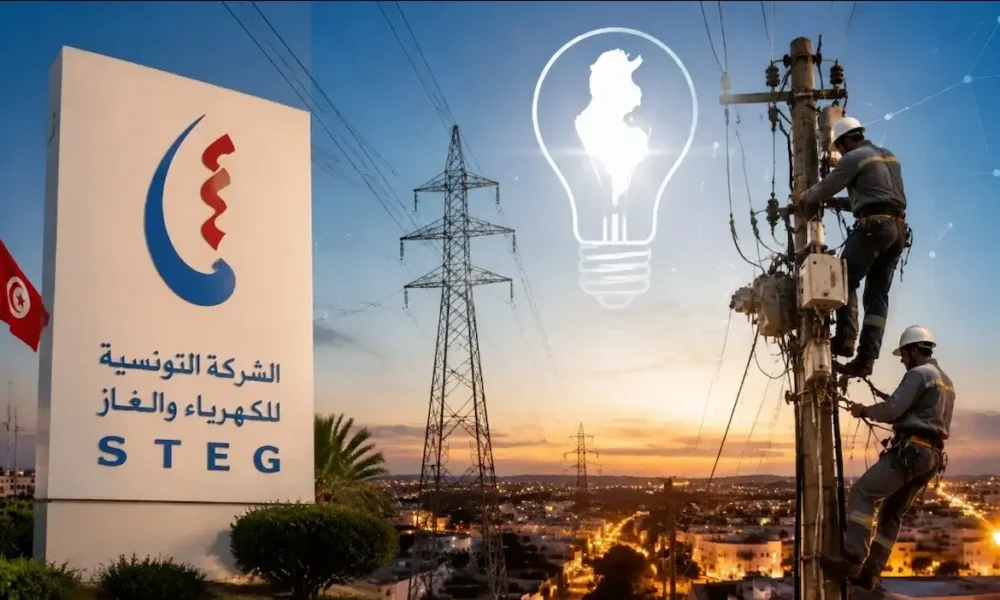
Power outages affecting Tunisia, especially during periods of intense heat and record consumption, are no longer seen as mere seasonal incidents. They now raise deeper questions about the capacity of the national energy system to respond to the economic, social and demographic transformations of the country.
The Tunisian Electricity and Gas Company (STEG), long regarded as a symbol of the State’s success in delivering essential services, now faces major challenges related to production, networks, financing and the energy transition.
But to understand the current situation, one must look back at the history of this company, because STEG is not the story of a permanent failure. It is above all the story of a historic success in an initial phase, followed by difficulties adapting to a new energy reality.
From sector fragmentation to the creation of a national operator
Created on April 3, 1962, two years after Tunisia’s independence, STEG was born as part of a national project aimed at unifying a fragmented electric sector.
Before its creation, electricity was managed by seven private companies, each controlling a part of the territory according to a colonial-era organization. Electric coverage was then concentrated in certain urban and economic areas, while many rural regions remained largely without access to electricity.
At the time of STEG’s creation, the country’s electrification rate did not exceed 21 %. In rural areas, it was below 6 %, leaving a large portion of the population dependent on traditional means of lighting such as kerosene lamps or artisanal devices.
The successful bet of national electrification
The mission entrusted to STEG was substantial: to build a national electricity infrastructure and connect Tunisia’s northern and southern regions, despite limited financial means and an infrastructure that was almost non-existent.
Over the decades, the company has managed to transform the Tunisian energy landscape profoundly.
The electrification rate today has surpassed 99 %, allowing virtually all Tunisians to have access to electricity.
The company also grew from around 183 employees at its inception to an enterprise employing thousands of staff and serving more than 4.5 million customers.
Historically, the balance is thus clear: STEG has successfully accomplished its founding mission, that of generalizing access to electricity and linking the country to a national grid.
When success becomes a new challenge
However, the success of this initial mission has given rise to new challenges.
The network designed and developed over decades must now respond to a society that is entirely different: urban growth, changing consumption patterns, a growing number of electrical devices and a continual rise in demand.
The current issue therefore concerns not only electricity production, but also the capacity of infrastructures to transport and distribute this energy reliably.
An extended network but insufficiently modernized
For several decades, STEG’s priority has been the expansion of the network to connect more regions and ensure access to electricity.
But this expansion has not always been accompanied by a corresponding pace of modernization, particularly in terms of:
- renewal of equipment;
- maintenance of infrastructure;
- improvement of transmission and distribution networks;
- integration of new management technologies.
Today, even with increased production, some infrastructures can reach their limits during periods of high demand, especially in summer.
Air conditioning has changed consumption habits
Over the past twenty years, the way Tunisians consume electricity has evolved profoundly.
The gradual widespread adoption of air conditioners in homes, businesses and administrations has disrupted the consumption curve, particularly during heatwaves.
During summer peaks, hundreds of thousands of devices operate simultaneously, putting substantial pressure on the electricity grid.
This shift had not been anticipated in the initial design of much of the infrastructure.
A strong dependence on natural gas
STEG also faces a structural challenge related to Tunisia’s energy model.
A large portion of electricity production still relies on natural gas, while Tunisia faces increasing pressure on its energy resources and rising costs related to imports.
Rising international energy prices directly affect production costs.
Moreover, electricity tariffs are regulated by the state, placing STEG in a position where its real costs do not align with the revenues generated from electricity sales.
This situation limits its ability to invest at the pace needed to modernize the sector.
The energy transition, an unavoidable challenge
Globally, electric systems are evolving toward new models based on renewable energy, grid digitization and smarter management of consumption.
Tunisia has significant potential, particularly in the solar energy domain, but still needs to accelerate its adaptation to this new reality.
The energy transition is not only about producing electricity from renewable sources. It also requires grids capable of integrating decentralized and variable production.
Governance and management challenges
Like several public companies, STEG has not been spared from governance difficulties, management efficiency issues and delays in certain reforms.
In a company of this size and strategic importance, management problems can have a direct impact on investment and innovation capacity.
Has STEG failed?
The answer depends on the criterion chosen.
If STEG is assessed on its historic mission, the results show a major success: transforming a country where electricity was a limited service into a country where the electrification rate exceeds 99 %.
But if one analyzes its current capacity to meet new challenges — surging demand, aging infrastructure, the energy transition and financial constraints — the difficulties are real and require deep reforms.
In the end, STEG’s history can be summed up as follows: a company that succeeded in electrifying Tunisia, but now must succeed in transforming itself to build the energy model of the future.
The real challenge today is no longer merely to produce more electricity, but to build an energy system that is more modern, more reliable and more sustainable, capable of supporting the country’s future needs.