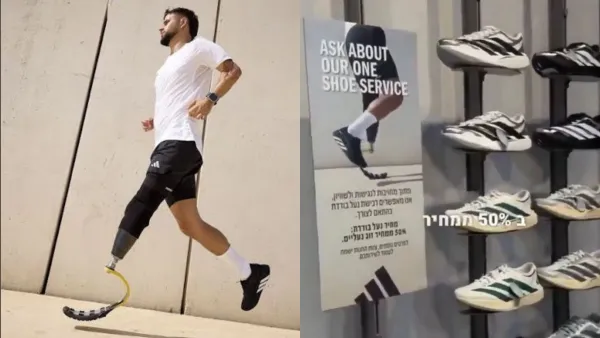
The pressure produced a first concrete response. Adidas apologized on Monday, September 7, 2026 after the international wave of boycott calls sparked by an Israeli campaign featuring Shalev Biton, a former Israeli army soldier who had his leg amputated. The post at the origin of the controversy was also removed.
This development came less than twenty-four hours after the controversy took on an international dimension, with boycott calls amplified by Spanish actor Javier Bardem and several pro-Palestinian personalities and activists.
The Essentials
Adidas apologized: the German group acknowledged that the local campaign broadcast in Israel had sparked strong reactions and offered apologies to those affected.
The advertisement was removed: the post featuring the former Israeli soldier Shalev Biton was removed following the boycott calls.
The service itself continues: Adidas does not question its “Single Shoe Service,” intended for amputees or people with a limb difference.
The controversy mainly concerned the choice of face: critics accused Adidas of featuring a former Israeli soldier in a campaign about amputation while Gaza has thousands of amputees since 2023.
No measurable commercial impact yet: the boycott calls prompted a concrete response from the brand, but no public data yet show a decline in sales.
Adidas acknowledges “strong reactions”
In a statement transmitted from its global headquarters, the German equipment maker acknowledges that the image chosen by its local team in Israel provoked a strong reaction.
Adidas states that its intention was not to offend and offers apologies “to anyone affected.” The brand adds that it takes the reactions sparked by the campaign seriously and intends to continue ensuring that its actions reflect its inclusion values.
The wording is telling: Adidas does not challenge the principle of its service for amputees, but acknowledges that the choice of an image in its Israeli variant caused trouble.
The brand also stresses the local nature of the advertising, speaking of an “initiative by the local team,” not a global campaign centered on the former soldier Shalev Biton.
The removed advertisement
Another important development: the Adidas Israel account post featuring Shalev Biton has been removed, according to several media outlets following the matter.
However, one should not go further than what is established: this is the removal of the advertisement that sparked the controversy. Adidas did not announce abandoning its “Single Shoe” program, nor indicated having removed the entire campaign dedicated to disabled people in Israel.
The Israeli variant featured eleven athletes and public figures with disabilities, including Biton. The posters involved were used in Israel and were not part of the group’s global campaign.
What Adidas changed after the controversy
1. Public apologies: Adidas acknowledged that the local campaign had provoked strong reactions and stated that its intention was not to offend.
2. Removal of the contested content: the post featuring Shalev Biton was deleted.
3. Distance from the local campaign: the group emphasized that the image came from its local team in Israel and did not constitute a global campaign centered on the former soldier.
4. No abandonment of the program: the “Single Shoe Service” remains maintained as an international accessibility device for amputees.
The first visible consequence of the boycott
For the boycott supporters, the apologies and the removal of the post already constitute a result.
The movement does not yet have data showing a decline in Adidas’ sales. It is thus too early to measure a commercial impact. But the mobilization succeeded in getting a response from the brand’s global headquarters within a few days and the removal of the contested content.
This is precisely one of the aims of consumer boycotts: create a reputational risk large enough to push a company to reverse a decision, even before a possible sales impact can be measured.
In Adidas’ case, the speed of the reaction is notable. The controversy developed over the weekend of September 5-6; by Monday, September 7, the brand had already published its apologies.
Why the campaign triggered such a reaction
The debate did not primarily focus on the “Single Shoe Service.”
This device allows amputees or people with a lower limb difference to buy one shoe for about 50% of the price of a pair, instead of having to buy two shoes.
The breaking point was the choice of Shalev Biton to promote the service in Israel.
A former member of the Nahal Brigade of the Israeli army, Biton lost his left leg after being severely injured on the May 12, 2021, when an anti-tank missile fired from Gaza struck the military vehicle he was in near the border.
Contrary to some posts that went viral, he was not amputated during the war that began in October 2023.
This factual clarification, however, was not enough to extinguish the controversy.
What is established, what is not yet
Established: Shalev Biton is a former Israeli soldier who was amputated after being wounded in 2021.
Established: Adidas used him in a local campaign in Israel dedicated to its service for amputees.
Established: international calls for boycott followed, then Adidas issued apologies and removed the contested post.
False or misleading: the “Single Shoe Service” was not created specifically for Israeli soldiers and Biton did not lose his leg during the current war in Gaza.
Not yet demonstrated: no public data yet allow attributing a decline in Adidas’ sales or revenue to this boycott campaign.
Gaza at the heart of the criticism
The boycott supporters reproach Adidas mainly for having chosen a former Israeli military member to embody a campaign about amputation while Gaza suffers a major crisis linked to devastating injuries.
The World Health Organization estimates more than 5,000 traumatic limb amputations in Gaza since October 2023. This figure has been widely echoed in boycott calls and in reactions from pro-Palestinian activists.
Images of Biton running with his prosthetic were thus circulated on social media alongside photographs of Palestinian children with amputations.
For activists, the issue was not to deny the disability of the former Israeli soldier or his right to benefit from Adidas’ service. It focused on the symbolic choice made by a global multinational in the context of the war in Gaza.
Adidas responds on accessibility, but not entirely on the face choice
In its response, Adidas recalls that its “Single Shoe” service is an international program aimed at improving the accessibility of athletic footwear.
The brand notes that the service continues to expand in Europe, Asia and the Middle East, notably in the United Arab Emirates, Palestine, Lebanon, Saudi Arabia, Kuwait, Qatar and Egypt.
This argument addresses a false claim circulating on social media, according to which Adidas would have created the program specifically for Israeli soldiers.
That is not the case.
But it addresses less directly the main objection raised by activists: why choose precisely a former Israeli soldier to promote in Israel a service linked to amputation in the current context?
The apologies implicitly acknowledge the sensitivity of this choice without announcing a break with the service itself.
A precedent that returns in the debate: Bella Hadid
Critics of Adidas also recall a precedent from 2024.
The brand had then pulled advertising images featuring the American-Palestinian model Bella Hadid for the rerelease of its SL72 shoe after protests related to the Munich 1972 Olympics. Adidas later apologized to Bella Hadid as well as to the other participants in the campaign.
For supporters of the current boycott, the comparison fuels the accusation of double standards: Adidas had quickly changed a campaign after criticisms from Israel, then initially kept a controversial advertisement in the Gaza context.
The apologies and removal on September 7 are now seen as a response to this pressure, even if they do not end the debate.
A symbolic victory, not yet a commercial victory
At this stage, three facts can be established.
The boycott call has internationalized. Adidas apologized. The contested post was removed.
However, no public data yet shows that the movement has caused a significant drop in Adidas’ sales or revenue.
This distinction is important.
To speak today of an “sales collapse” would be unfounded. But to consider that the boycott had no effect would be equally incorrect: the brand publicly changed its stance in a few days and removed the content at the center of the controversy.
The next steps will depend on the militants’ reaction. Will Adidas’ apologies be enough to slow the movement, or will boycott calls continue on the grounds that the brand did not explicitly condemn the initial choice of its Israeli team?
For Adidas, the case has, in any case, become a textbook example of reputational risk: a local campaign broadcast on a single market was enough, in a few days, to trigger a global controversy and force the German headquarters to intervene.