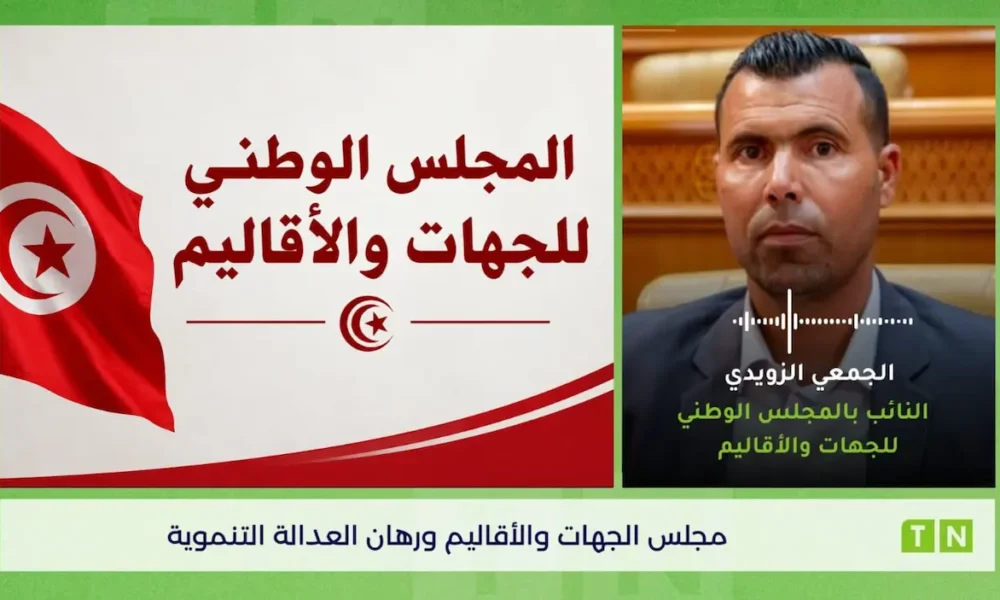
The concrete effects of the territorial division into districts are expected to begin to appear in 2028, with the implementation of projects listed in the 2026-2030 development plan. This is what Jomâa Zouidi, a member of the Bureau of the National Council for Regions and Districts responsible for information and communication, said in an exclusive interview with Tunisia Digital.
Projects from the Local and Regional Levels
According to Jomâa Zouidi, the first effect of the territorial division manifests in the nature of projects integrated into the development plan. It includes local projects concerning the imadas, regional projects for the governorates, and projects covering an entire district.
These proposals, he explained, originate from the elected local, regional and district bodies. They were then forwarded to the Ministry of Economy and Planning, before the plan was presented to the National Council for Regions and Districts.
The deputy indicated that the impossibility of modifying the plan or adding articles had raised concerns within the Council about its approval. However, a thorough review would have shown, according to him, that the majority of the selected projects originated from the proposals made at these different levels.
Expected results in 2028, with programming already underway
Jomâa Zouidi linked the expected on-the-ground results to a more equitable distribution of development across the local, regional, district, and national levels. He placed the appearance of concrete achievements related to this dynamic at the beginning of 2028.
He also specified that some projects had already been programmed in the 2026 budget and that their initial effects were beginning to be perceptible. Others must be included in the 2027 budget, in accordance with the five-year programming of the 2026-2030 Development Plan.
The 2028 deadline mentioned by the deputy thus concerns the anticipated outcomes of territorial division, while the programming and execution of certain projects are already underway, according to his statements.
The ministries implement, the assemblies control
Regarding responsibility for execution, Jomâa Zouidi stressed that it falls to the executive branch, through the various ministries.
The National Council for Regions and Districts and the Assembly of the People’s Representatives oversee, according to him, the implementation of the projects. Other elected bodies and civil society can also monitor their progress, each from their position.
Territorial Equity as a Goal
The deputy estimated that the plan aims for a fairer distribution of development among the different parts of the country. This orientation includes, notably, greater attention to territories less attractive to investment, without concentrating projects in areas that already attract investors, nor making population size the sole criterion of distribution.
According to him, the bottom-up approach, going from the base to the center, should translate citizens’ choices into concrete projects. He stated that the Council had not ruled out any project transmitted by the local councils, considering that they express the priorities of the inhabitants.
The announced objective is to make territorial equity and social justice tangible by bringing the five districts closer in terms of completed projects, then by strengthening equity among regions, governorates, delegations and social categories.
Jomâa Zouidi also criticized previous development models, arguing that they had not sufficiently taken into account the rights of poorer territories for several decades. The current model aims, according to him, to overcome these disparities.
A meeting on Thursday to prepare parliamentary work
Regarding the parliamentary session, Jomâa Zouidi announced that it would take place tomorrow, Thursday, October 1, 2026, with a meeting of the Bureau of the National Council for Regions and Districts.
This session will be devoted to defining the parliamentary work program for the forthcoming period, particularly the scheduling of plenary sessions.