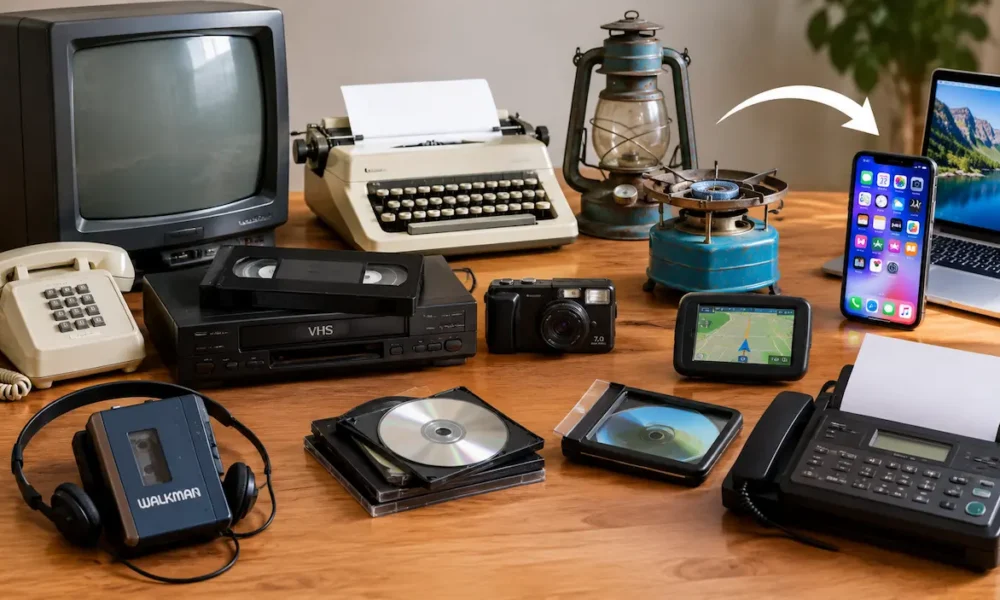
Technological progress does not stop at creating new devices: it also changes our habits and gradually relegates certain equipment that was once essential to the background. Objects that used to occupy a central place in homes and offices have today become rare, replaced by newer, more compact technologies, and often multifunctional.
The cathode-ray tube television
For decades, the cathode-ray tube television sat in living rooms. Bulky, heavy, and with a deep screen, it nevertheless constituted one of the main entertainment devices in households.
The arrival of LCD, LED, and then OLED screens gradually changed the game. Modern televisions are thinner, lighter, and offer better image quality. Cathode-ray tube models have thus almost disappeared from daily use.
The typewriter
Before the widespread adoption of computing, the typewriter was indispensable in offices, administrations, and many households.
The computer gradually replaced this device by allowing not only to type text but also to correct it, save it, format it, and print it. The typewriter persists today in particular uses, notably among some collectors or vintage enthusiasts.
The kerosene stove
The kerosene stove long formed part of the equipment used for cooking, notably in households lacking modern current appliances.
The spread of gas and electric stoves has significantly reduced its use. It remains present, however, in certain particular contexts.
The kerosene lamp
Before widespread electricity, the kerosene lamp constituted an essential source of illumination.
With the expansion of electrical networks, followed by the appearance of energy-saving bulbs and LEDs, its daily use gradually disappeared. It is now more closely associated with a bygone era, although it can still be used in particular situations.
The fax
Fax machines were for a long time an indispensable tool in businesses, administrations, and professional establishments. They allowed rapid transmission of documents over distances.
The rise of email, digital documents, and file-sharing platforms has greatly reduced its use. In some sectors, faxing still exists, but it occupies far less space than it did in the past.
The landline phone
For decades, the landline was the main means of communication in households.
The arrival of mobile phones, then smartphones, has profoundly changed habits. Calls, messages, videoconferencing, and Internet access are now all in one device, which has significantly reduced the use of the traditional landline.
The VHS recorder
The VHS VCR marked an entire generation. It allowed recording television programs and watching movies at home.
After the arrival of DVDs, then on-demand video services and streaming, VHS tapes and VCRs gradually left homes. They are today mostly sought after by collectors and retro technology enthusiasts.
The DVD player
The DVD player itself enjoyed a long period of success before being overtaken by new audiovisual consumption habits.
Streaming platforms and connected TVs now allow direct access to a vast catalog of films and series. The DVD player has thus lost much of its daily use.
The CD player
The CD player has also fallen victim to the dematerialization of music.
Digital files, smartphones, and streaming platforms have gradually replaced CDs as the main way to listen to music. The physical medium still retains users, notably among collectors and some music enthusiasts.
The Walkman and the Discman
The cassette Walkman and its successor, the Discman, revolutionized portable music listening.
They were later challenged by MP3 players and were largely supplanted by smartphones. Today, a single phone can store or stream music and connect to wireless headphones.
The compact digital camera
Small digital cameras enjoyed immense success before the smartphone photography boom.
Advancements in sensors and image processing software integrated into phones have reduced the need to carry a separate camera for everyday photos.
The family camcorder
There was a time when filming holidays, a birthday, or a ceremony required a camcorder.
Smartphones gradually assumed this role by offering the ability to film in high definition, store the videos, and share them immediately. The family camcorder thus lost much of its traditional function.
The standalone GPS
Dedicated GPS devices also faced strong competition from smartphones.
Navigation apps today let you access maps, calculate routes, and obtain traffic information from a single device. Standalone GPS units nevertheless continue to exist for certain specific uses.
Devices replaced by a single smartphone
One of the most significant changes lies in the concentration of several functions within one device.
A smartphone today can replace, in many situations, a compact camera, a GPS, a music player, a voice recorder, a calculator, a video camera, or an alarm clock.
These devices have not all disappeared entirely. Their common thread is that they have lost their once indispensable place in daily life, due to technology becoming more versatile and more accessible.