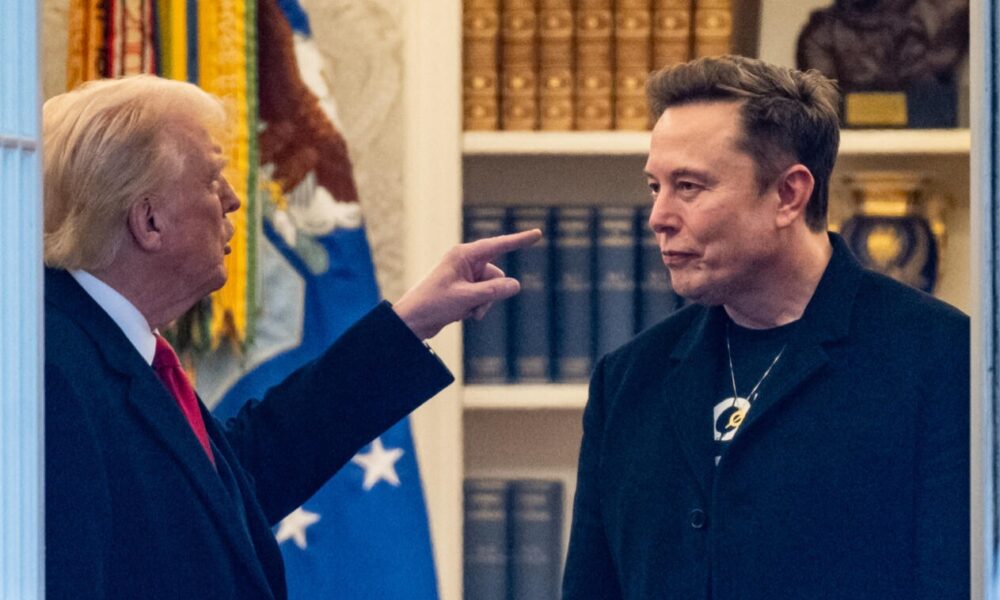
Faithful, as always, to his tradition of inventing nicknames or changing names, in his politics, his ideology and his business, the new modification of the American president concerns artificial intelligence.
In recent weeks, Trump has insisted on forcing the term “super intelligence” (SI) to be used instead of the label “artificial intelligence” (AI).
Recently, on his Truth Social network, he even crossed into verbal territory, insisting that he would treat as an “enemy” anyone who would not follow him in this path and without giving details about what this threat entails: “The White House regards as ENEMY anyone who uses the term ‘artificial intelligence’ instead of the newly well-accepted and more accurate term ‘super intelligence’.”
For reminder, Trump had already mentioned this name change on September 22 last year before the UN General Assembly, deeming it already that it “sounded much better”: “From now on, all United States documents, and I hope those of the world, will be amended to use the far more precise term of super intelligence rather than artificial intelligence.”
The State Department had ordered diplomats to use this term after that speech at the United Nations.
A decree imposes this term on government services
Donald Trump signed at the end of September a decree officially imposing this terminology on government services, ordering federal agencies to modify how they describe AI in their official communications.
This new rule, however, does not provide for any sanction for using this term, as detailed by Forbes.
This presidential decree published by the White House also notes that the country’s “extraordinary technologies” of tech giants “far exceed what had been envisaged when the term ‘artificial intelligence’ was first used.”
This decree states that current leading-edge AI models can do far more than imitate or automate “discrete aspects of human intelligence.” It specifies that the executive branch will no longer recognize “the use of the terms ‘artificial intelligence’ and ‘AI’ in any relevant context.”
Moreover, Trump’s decree orders the ministries and federal agencies to use the terms “super intelligence” and “SI” in their communications and official documents, even if regulations, contracts or previously published documents do not need to be modified.
A solution to the multiple concerns
Tuesday, during the launch in September 2026 of the new website america.gov – a digital platform powered by AI to serve as a single entry point to federal information and government services –, Donald Trump spoke about the presidential decree and offered an explanation for this name change: “We do not want to hear about artificial intelligence, because it is not artificial. It is very powerful… and it will be put to optimal use.”
Politically, the American president, a fervent advocate of this world-changing technology, seeks to give it a positive connotation. Americans’ concerns have been mounting for some time, against a backdrop of numerous local mobilizations against the construction of data centers.
The Trump administration, worried about China’s rapid rise in the sector, therefore hopes to exploit the economic opportunities offered by AI, while trying to counter these growing concerns about risks of cyberattacks, job losses and higher energy prices related to powering energy-hungry data centers.
The private sector is not affected!
If the decree officially imposes this terminology on government services, that obligation does not extend to the private sector, where some players are already complying. Donald Trump posted his message on Truth Social a few hours after AI industry leaders met him at the White House and signed a “morally binding” agreement, pledging to improve controls and internal audits. Major players like Meta or Nvidia have begun to adopt or integrate this terminology in their official communications. Elon Musk quickly supported this initiative by renaming his accounts and entities (such as SpaceXAI to SpaceXSI or TeslaAI to TeslaSI).
The semantic evolution sought by the Trump administration blurs a distinction: “superintelligence” generally refers to an AI whose intellectual capabilities would far exceed those of humans.
Yet Trump’s decree applies this label to technologies already encompassed by the federal legal definition of artificial intelligence.
However, this terminology grievance should not dispel the concerns, according to Virginie Mark Warner, Democratic senator and vice-chair of the Senate Intelligence Committee and a fervent advocate of AI security legislation, who explained: “Changing the name we give to artificial intelligence does not resolve in any way the real risks tied to the growing power of these systems.”