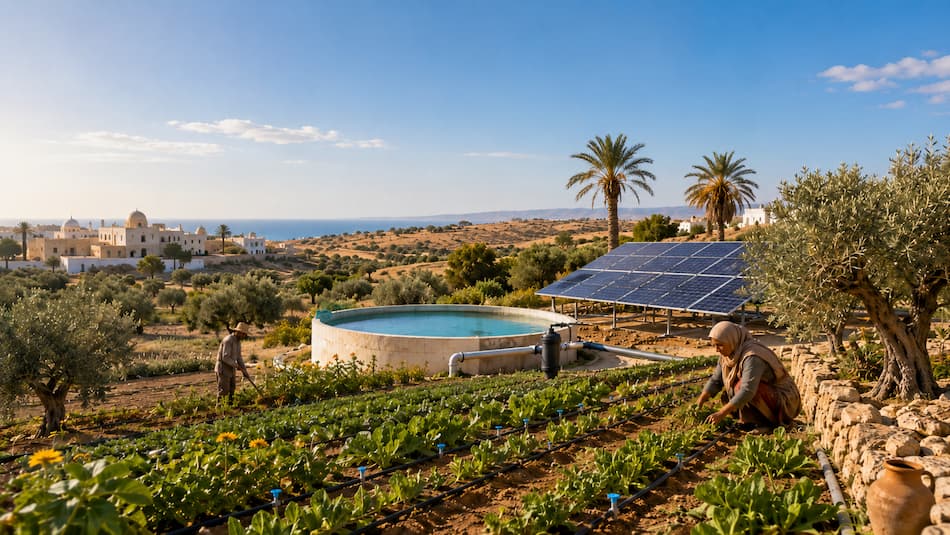
The figure has circulated for years, but it retains all its brutality: less than 400 cubic meters of freshwater per inhabitant per year, one of the lowest levels in the Mediterranean basin. As of October 10, 2025, the country’s dams were only 27.4% full, roughly 649 million cubic meters stored.
This water stress is only the visible part of a broader crisis affecting soils, air, sea, waste, and, increasingly, social peace. In several regions, residents are now openly demanding a right that the 2022 Constitution nonetheless recognizes for them: the right to live in a healthy and balanced environment.
This finding comes from a policy brief published by IACE in collaboration with ECOTOUS, titled “Tunisia in the Face of Environmental Sustainability: the Urgency to Act!” Its multidisciplinary analysis forms the basis for this article.
A country rich in brains, poor in results
Tunisia’s paradox lies in two rankings. According to the Global Sustainable Competitiveness Index 2024, the country ranks 114th out of 191, with 40.61 out of 100 points, i.e. the 6th place in Africa. But its intellectual capital, meanwhile, rises to 68th worldwide. Put differently, Tunisia has the skills, but not yet the capacity to turn them into coherent public policy.
The Environmental Performance Index 2024 confirms this in-between position: 91st worldwide, with 45.3 points. Jordan does better (74th), Algeria (114th) and Morocco (128th) fare worse. The gap with Estonia, at the top of the ranking, or with France, 12th, remains vast.
Gabès, the symbol of a deferred bill
Nowhere is the cost of inaction as visible as in Gabès. Since the 1970s, the Tunisian Chemical Group has been discharging into the sea about 2.8 million tonnes of phosphogypsum per year. The Posidonia oceanica meadows have almost disappeared, by about 90%, while residents report a rise in respiratory and cancer diseases. More than 100,000 people mobilized to demand the closure of production units, and the protest spread to Gafsa, Sfax, Kelibia, and Sayada.
The brief shows that this is not an isolated case. The country counts 756 identified sources of water pollution. Fine PM10 particles reach 70 to 80 micrograms per cubic meter on average annually in several cities, compared to 50 recommended by the WHO.
Of the 2.6 million tonnes of household waste generated each year, 30% is not collected and only 10% is recycled. Illegal dumps reached 157 sites in 2023, and more than 4 billion plastic bags are still used annually despite the partial ban of 2020.
The invisible network that has stalled