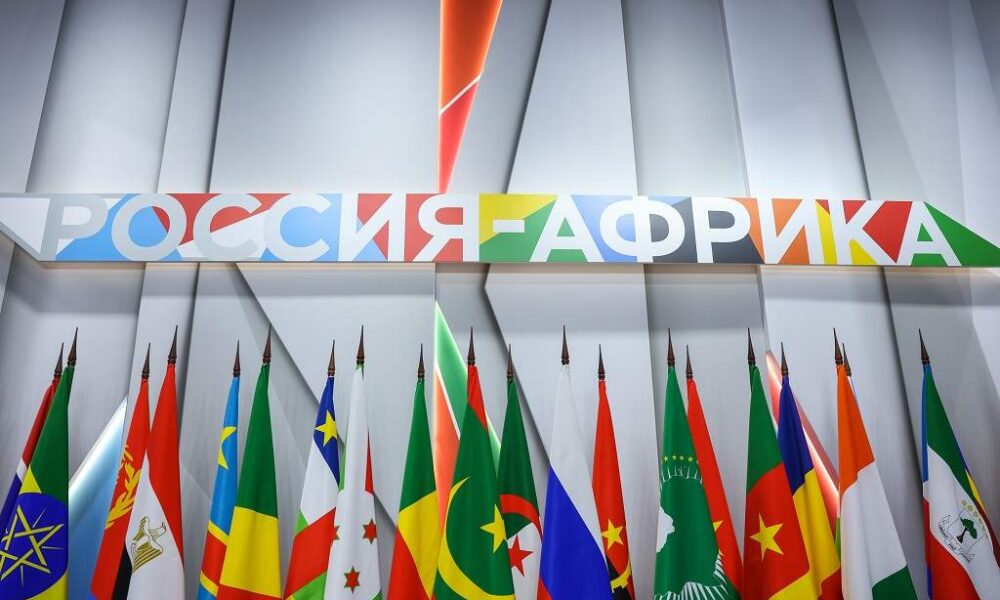
On the eve of the Russia–Africa Summit of October 28–29, 2026 in Moscow, Vladimir Putin promises new economic and military partnerships.
Yet Russia’s trade weight remains limited compared to the European Union, China and the United States.
Between promises of investments, media influence, military operations in the Sahel and recruitment of Africans to fight in Ukraine, the rapprochement with Moscow raises a question: what real benefits for African populations?
Africa, a secondary economic partner for Moscow?
According to information released by the Kremlin, 48 African delegations are expected in Moscow, including 22 led by heads of state. On the agenda: trade, energy, cereals, investments and military cooperation.
Since the invasion of Ukraine, Moscow has sought to develop its commercial and diplomatic relations with non-Western countries. But the figures show the gap between Russian ambitions and its actual economic weight.
Annual Merchandise Trade with Africa
| Partner | Annual Trade | Year |
| European Union | Nearly €355 billion | 2024 |
| China | $348 billion | 2025 |
| United States | $83.35 billion | 2025 |
| Russia | $27.7 billion | 2025 |
Sources: EU Council, Chinese customs, U.S. Census Bureau and Russian estimate. The year 2024 is retained for the EU, due to the lack of confirmation of a strictly comparable 2025 value. Different currencies and statistical methods: indicative comparison.
Based on these amounts, Russo-African trade represents about a third of the United States’ and less than one twelfth of China’s.
The difference also shows up in investments. According to UNCTAD, European investors hold the largest stock of foreign direct investment (FDI) in Africa, followed by the United States and China.
Foreign Direct Investments in Africa
European Union: more than €250 billion in FDI stock by end-2024, according to the EU Council.
United States: second largest investing bloc behind Europeans, according to UNCTAD.
China: about $42 billion in FDI stock, according to UNCTAD’s 2025 report.
Russia: a much more targeted economic footprint, mainly in energy, mining and certain industrial projects.
Sources: EU Council and UNCTAD. The amounts are FDI stocks, not annual flows. The US and Russian amounts are not displayed due to a lack of a sufficiently comparable consolidated series.
Russia remains particularly present in cereals, fertilizers, hydrocarbons, armaments, mining and civil nuclear. Its political and military influence in certain African countries thus far exceeds its commercial weight on the continent.
But an investment is not reduced to an announced amount. For African populations, the essential indicators remain completed projects, jobs created, tax revenues, transfer of skills and value added retained locally.
Were the promises of 2023 fulfilled?
At the St. Petersburg summit in July 2023, Vladimir Putin announced several initiatives aimed at strengthening Russo-African cooperation.
Some have been carried out. Russia says it completed in February 2024 the delivery of 200,000 tonnes of cereals donated to six African countries, including Mali, Burkina Faso and Somalia.
By contrast, the goal of bringing Russo-African trade to $40 billion, formulated in 2019, has not yet been achieved. Trade was estimated at $27.7 billion in 2025.
Moscow also highlights the cancellation of $23 billion in African debt. This amount concerns mainly old debts inherited from the Soviet era and does not correspond to new investments.
Industrial and energy projects exist, notably in Egyptian nuclear power. This is not enough to demonstrate a general transformation of the Russian economic presence on the continent.
The financing of African institutions also reveals differences between partners. According to the African Union’s official budget, international partners were to contribute up to $370.08 million in 2024, or about 61% of an overall budget of $605.76 million.
Russia stands out for its absence from the African Development Bank (AfDB) Group, whose non-African members include the United States, China and several European countries. This institution participates in financing development projects, infrastructures and economic programs on the continent.
This observation illustrates a difference in the modalities of cooperation: while several great powers participate in Africa’s multilateral financial mechanisms, Moscow mainly favors bilateral partnerships in the energy, trade and security domains. It does not, however, allow concluding an outright absence of Russian funding for African institutions.
The information battle: Is Africa really supporting Putin?
The rapprochement with Africa is accompanied by a communications strategy.
Moscow presents itself as a defender of African sovereignty in the face of former colonial powers. This discourse rests on real criticisms of Western policies, but it presents a contradiction: Russia publicly defends the sovereignty of African states while pursuing a war of invasion against Ukraine.
A June 2025 study by VIGINUM, the French service responsible for fighting foreign digital interference, documented the activities of the African Initiative network, linked to Russian influence operations in Africa.
But does this media strategy translate into popular support?
According to an Afrobarometer survey conducted in 2024-2025 across 38 African countries, 36% of respondents view Russian influence positively, versus 62% for China, 52% for the United States and 50% for the European Union.
Positive perception of the influence of powers in Africa
European Union — 50%
Source: Afrobarometer, 38 African countries, 2024-2025 surveys. Average proportions of respondents judging economic and political influence as positive.
Another finding: among people who have heard about the war in Ukraine, 72% wish their country to remain neutral.
National situations, however, remain highly contrasted: in Mali, 88% of respondents have a positive opinion of Russian influence.
These results contradict the idea of Africa being uniformly in favor of (or against) Moscow. They also show that diplomatic relations between governments do not necessarily reflect public opinion.
Wagner, Africa Corps and natural resources: the cost of security alliances
In Mali, Burkina Faso, Niger and the Central African Republic, cooperation with Moscow carries a significant military dimension.
After the disappearance of Yevgeny Prigozhin (former head of the Wagner mercenary group) in 2023, Russia reorganized part of Wagner’s activities around Africa Corps, linked to the Russian Ministry of Defense.
On October 22, 2026, Human Rights Watch accused Malian forces and their Russian allies of new abuses against civilians, including torture. The organization also documented a military strike that killed eight civilians in the Mopti region in September.
Investigations have also highlighted links between networks associated with Wagner and the exploitation of natural resources, notably in the Central African Republic and Sudan.
These activities raise a central question: do military partnerships really improve the security of populations, or do they also advance particular political and economic interests?
The comparison with multilateral mechanisms provides additional perspective. For the 2024-2025 period, United Nations peacekeeping operation funding obligations allocate about 26.9% of contributions to the United States, 18.7% to China and 2.3% to Russia. European states also contribute, individually, to this global budget.
These percentages correspond to funding obligations and not necessarily to amounts actually paid. They cover all United Nations peacekeeping operations, and not only those conducted in Africa.