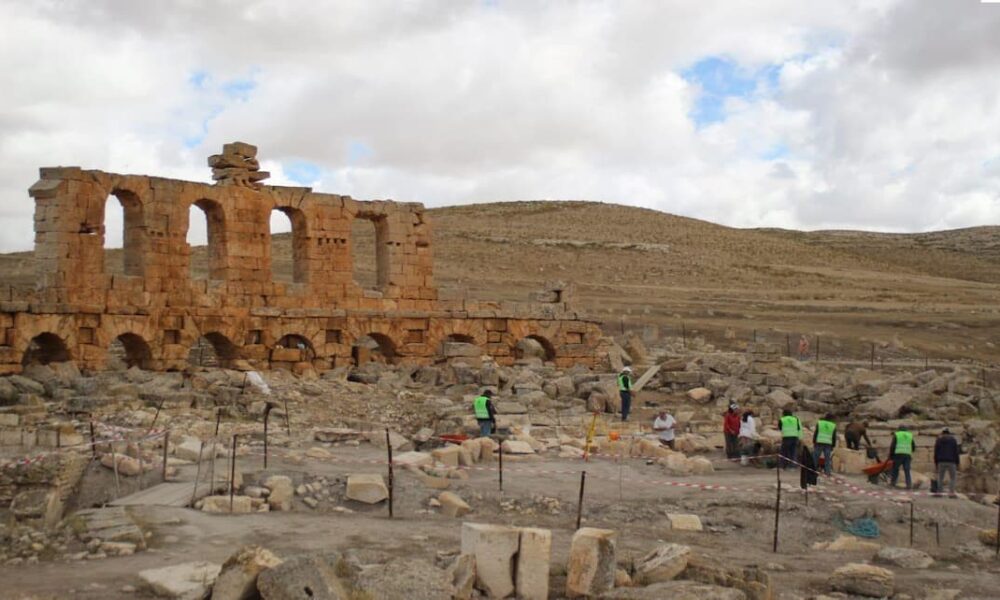
The National Heritage Institute (INP) announced the discovery of remains of dwellings dating to the Aghlabid and Fatimid periods inside the Roman theater of El-Mdaïna, at the ancient site of Althiburos, located in the Dahmani delegation, in the Kef governorate.
This discovery comes at the conclusion of an archaeological digging campaign conducted from October 11 to 22, 2026, as part of a scientific cooperation project between the National Heritage Institute and the University of Palermo, Italy, under the aegis of the Ministry of Cultural Affairs.
The Essentials
- Location : the Roman theater of El-Mdaïna, the ancient site of Althiburos, in Dahmani (Le Kef).
- Dates : excavation campaign from 11 to 22 October 2026.
- Major discovery : remains of dwellings dating to the Aghlabid and Fatimid periods.
- Other results : details on the seating, the stage, and the ornamental elements of the theater.
- Partnership : National Heritage Institute and the University of Palermo (Italy).
Dwellings from the Islamic era at the heart of the Roman theater
The archaeological work was carried out by a Tunisian-Italian scientific team bringing together researchers, heritage conservators, and archaeology students.
The objective of this mission was to better document the different phases of occupation of the site, notably during Late Antiquity and the Islamic era.
The excavations thus revealed remains of dwellings dating back to the Aghlabid and Fatimid periods, evidencing the reuse of the Roman theater space in the centuries following its construction.
New details on the theater’s architecture
In addition to discoveries related to the medieval occupation of the monument, the archaeologists gathered new information about its architectural organization.
The research notably clarified the arrangement of the seating and the placement of the stage, while revealing several ornamental elements.
Some of these elements were found in situ, that is, in their original location, while others had been reused in the walls and floors during later phases of occupation of the site.
An archaeological approach particularly rare in North Africa
According to information released by the National Heritage Institute, this operation stands out for its methodological approach, which is not limited to clearing the structures of the Roman theater.
It also aims to trace the monument’s evolution across the different historical periods, based on rigorous stratigraphic and chronological documentation.
The INP emphasizes the exceptional character of this approach in North Africa, where many Roman theaters have been excavated without their transformations and subsequent occupations ever being the subject of such in-depth studies.
The results of this campaign thus bring new elements to the understanding of Althiburos’ history and the evolution of its occupation from Antiquity to the Islamic era.