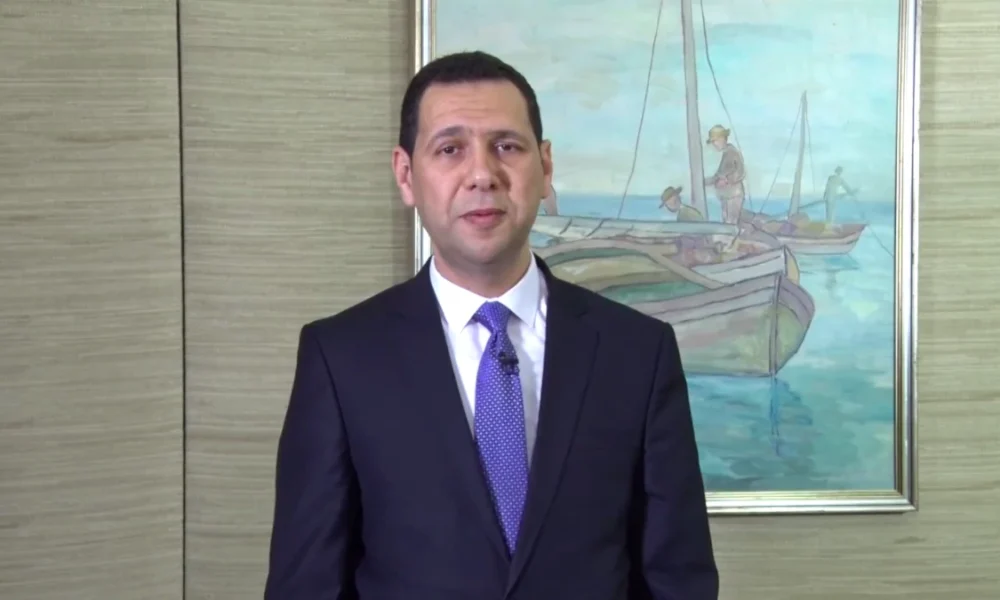
Nizar Chaddad a été nommé directeur général de la Société Monétique Tunisie (SMT), succédant à Bilel Darnaoui.
The former director-general of payments and financial inclusion at the Central Bank of Tunisia (BCT) announced his appointment on Sunday, November 1, 2026, on LinkedIn, after 27 years at the central bank.
This appointment comes in a context of growing digital payments in Tunisia, while cash withdrawals still account for the majority of card-based monetary transactions.
Key Highlights
Nomination : Nizar Chaddad takes the helm as Chief Executive Officer of Monétique Tunisie, succeeding Bilel Darnaoui.
Parcours : 27 years at the BCT, notably in payments and financial inclusion.
Priorities announced : innovation, interoperability, trust and security of digital payments.
A 27-year career at the Central Bank
Within the BCT, Nizar Chaddad led or contributed to projects dedicated to payment systems, financial innovation and financial inclusion. His career notably includes work related to payment infrastructures and to regulatory devices for innovation, including the regulatory “sandbox.” He also represented the central bank on several regional and international committees.
The new executive also cites Cambridge Judge Business School in his educational background. Before joining SMT, he regularly spoke about regulatory and technical developments in payments in Tunisia.
Tunisie Numérique had notably reported on his interventions on the TuniChèque platform, as well as his explanations on the development of mobile payments, which recorded five million operations in 2024.
The priorities announced by the new CEO
In his LinkedIn post, Nizar Chaddad states that he intends to work with SMT teams and all sector players to encourage innovation, strengthen interoperability, improve trust and the security of transactions, and accelerate the development of more inclusive digital payments.
The Tunisian Electronic Payment Company occupies a central place in the national ecosystem of electronic payments. Its role in interconnection and transaction processing concerns, in particular, banks, payment institutions, merchants and users of payment services.
Electronic payments: real progress, but still challenges
According to the 17th bulletin “Payments in Figures” of the BCT, Tunisia had 6.151 million bank cards and 45,600 electronic payment terminals (EPTs) at the end of June 2026. In the first half of 2026, online payments accounted for 10.3 million operations, for 771.4 million dinars, representing an increase of 28.1% in value compared with the same period in 2025.
In the same half-year, mobile payments totaled 5 million transactions, for 914.2 million dinars. But card payments still accounted for only 42% of electronic payments and 25% of the amounts, versus respectively 58% and 75% for withdrawals. These figures were detailed by Tunisie Numérique in August 2026.
The new SMT leadership will thus have to accompany a market in transition, marked by the growth of electronic transactions and the challenge of broader adoption among merchants and consumers.