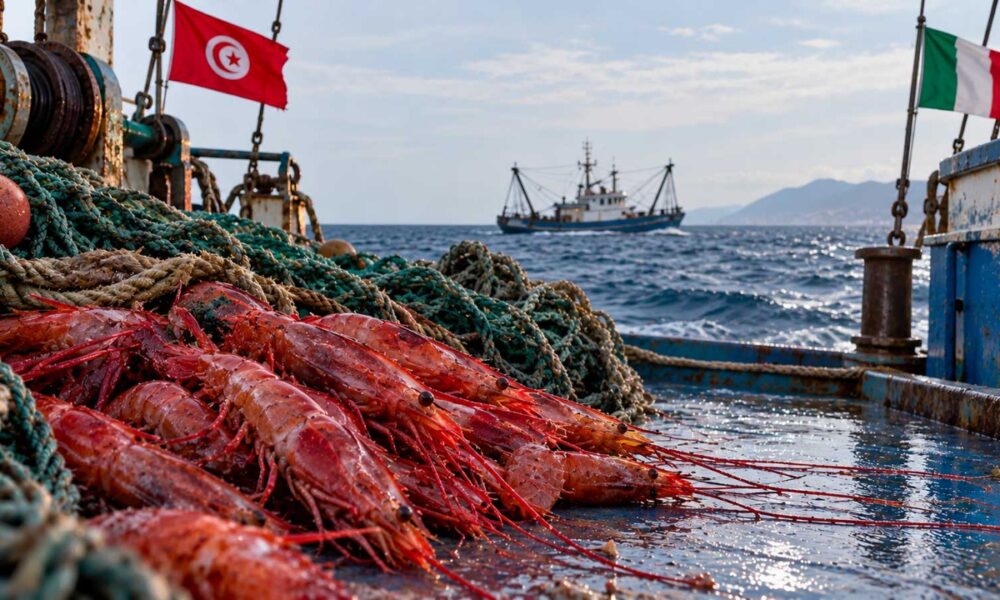
Tunisia has secured an agreement to increase its fishing quota for deep-water Mediterranean red shrimp, following negotiations held in Rome. The advance comes amid a dispute with Italy over the quantities certified for 2026. The new ceiling has not yet been publicly quantified, and the agreement does not automatically resolve questions of traceability and access to the European market.
The announcement was made on Friday, October 30, 2026 by the Tunisian Embassy in Rome, and subsequently relayed by TAP. The discussions took place on the margins of the 49th session of the General Fisheries Commission for the Mediterranean (GFCM), organized from October 26 to 30 at the FAO headquarters. Tunisian representatives conducted several technical and diplomatic exchanges with the European side.
What the Rome agreement allows us to affirm
An increase in the quota was announced for deep-water Mediterranean red shrimp.
The amount of the new ceiling has not been disclosed in the October 30 announcement.
The exact implementation period and execution terms are not detailed enough to claim that the 2026 commercial difficulties have been resolved.
Why did Tunisia seek a revision?
Deep-sea red shrimp fishing, practiced notably in the Sicilian Channel, is subject to catch limits designed to protect stocks. For the giant red shrimp (Aristaeomorpha foliacea), the Tunisian quota applicable in 2026 had been set at 36 tonnes, according to information on the CGPM/48/2025/9 recommendation relayed by the Italian agency Agenzia Nova. This ceiling is distinct from the volumes of all fishing products exported by Tunisia.
Rome had reported an alleged overrun: according to Italy’s Ministry of Agriculture (MASAF), certificates of catch validated by Tunisian authorities and destined for the European market accounted for at least 50.96 tonnes. The quantities cited thus exceeded the 36-tonne limit by at least 14.96 tonnes, i.e., a minimum gap of about 41.6 % (TN calculation). These are the quantities listed on the certificates invoked by the Italian side, not an independent assessment of the actual volume fished.
In a June communication, Italian authorities had urged the professionals to consider suspending the relevant supplies for the remainder of 2026, flagging the risk of cargo rejection. An official dialogue had been opened to examine the accounting discrepancies. The quota announced in the new declaration cannot be numerically compared to that of 2026 as long as its scope, the species covered, and the effective date have not been published.
The quota file in four figures
| Indicator | Value |
| 2026 giant red shrimp quota | 36 tonnes |
| Certificates invoked by MASAF | At least 50.96 tonnes |
| Alleged gap (TN calculation) | At least 14.96 tonnes |
| New quota announced in Rome | Volume not specified |
Sources: announcement relayed by TAP; MASAF cited by Agenzia Nova. The first three figures relate specifically to the 2026 dispute.
An economic issue that extends beyond the red shrimp
The Italian market plays a major role in Tunisian fisheries product sales. According to data from the National Observatory of Agriculture (ONAGRI) cited by Agenzia Nova, 34 % of Tunisia’s exports of fishery products were destined for Italy during the period considered, ahead of Spain (12 %), Libya (11 %), then Algeria and Malta (9 % each). These shares concern the entire fisheries sector, not exclusively the red shrimp.
During the first seven months of 2026, Tunisian exports of fishery products reached 18,400 tonnes and generated 422.3 million dinars. Revenues were down 4.8 % year on year, while the average export price stood around 23 dinars per kilogram, down 4.6 %. The sector maintained a trade surplus of 92.6 million dinars, with a coverage rate of 125 %, according to the same data.
These figures should not be interpreted as the revenue from red shrimp: they include several species and fishery products. They nevertheless indicate the importance of smooth access to the European market for Tunisian operators.
The figures of Tunisian fish exports, January–July 2026
18,400 tonnes exported, across all categories of fishery products.
422.3 million dinars in revenue.
-4.8 % in revenue compared with the first seven months of 2025.
34 % of sector exports directed to Italy, according to the statistics cited by Agenzia Nova.
The quotas issue does not settle sanitary controls
A second appointment is announced: a European mission is expected in Tunisia on November 16, 2026 to examine, in particular, the sanitary and veterinary conditions of the sector. Inspection operations and infrastructure improvements have been reported at the ports of Sousse and Hergla, concerning hygiene, the cold chain, equipment, and marketing conditions.
It is important to distinguish these two procedures. Quotas fall under stock management and catch traceability, while sanitary controls concern the compliance of installations and products. An increase in fishing opportunities does not automatically authorize marketing of lots that do not meet other European requirements.
The upcoming decisions will be decisive
The GFCM, the FAO regional body, completed its Rome session on October 30. The publication of the new numeric limits, the targeted species, the implementation calendar, and the control modalities will allow assessing the real scope of the agreement announced by Tunisia.
For the Tunisian sector, the stakes are twofold: to have fishing opportunities appropriate within a sustainable management framework and to secure export outlets, without leaving any uncertainty about certificates and controls.