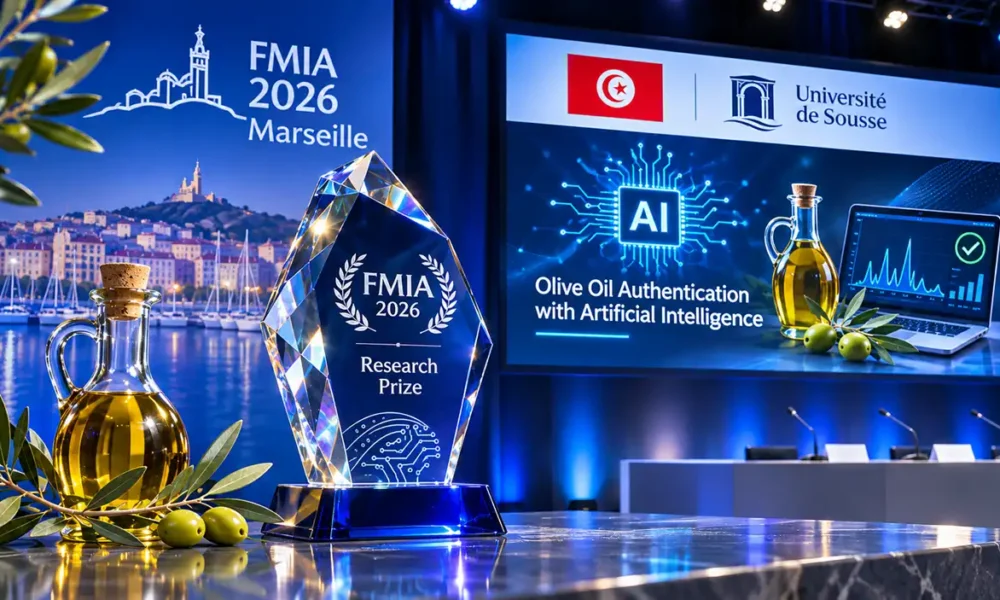
A Tunisian team won the Economic Innovation Prize at the Mediterranean Forum on Artificial Intelligence, held on November 5, 2026 in Marseille.
The project led by researcher Farah Jemili of the University of Sousse harnesses AI to address two challenges in the olive oil sector: the authentication of olive oil and the forecasting of harvest yields.
The prize figures. 83 projects were contenders at the outset; six were selected to present their work before the jury, according to the Tunisian embassy in France. The “Economic Innovation” prize was announced as endowed with 5 000 euros in ANIMA’s call for proposals.
An award presented in Marseille on November 5
The prize was awarded as part of the third edition of the Mediterranean Forum on Artificial Intelligence (FMIA). In a message published after the event, the Tunisian Embassy in France congratulated Professor Farah Jemili and her team for the project titled “AI for Olive Oil Authentication and Olive Harvest Yield Prediction.”
The research competition, supported by the forum organizers, distinguished two categories: social innovation and economic innovation. Each was endowed with 5 000 euros according to the call for proposals published by ANIMA Investment Network in August 2026. This amount corresponds to the prize’s announced endowment, without detailing the modalities of its disbursement.
Why olive oil authenticity is an economic issue
Authentication aims to establish that a product matches the announced characteristics and to identify potential anomalies consistent with fraudulent practices. For a sector that sells its production on national and international markets, trust in the origin and quality of the products is a matter of reputation and commercial value.
The Tunisian project is presented as mobilizing resource-efficient AI techniques and agricultural and climatic data to help verify the authenticity and quality of olive oil, detect fraud, and anticipate olive oil production.
These objectives should not be confused with a certification already available on the market. The consulted communications do not specify either the measurement protocol, the data used at each step, or the detection rate achieved on independent samples.
Forecasting harvests: a second possible application
The other aspect concerns the prediction of olive yields. By combining agronomic and climatic data, a forecasting solution could help operators anticipate the available volumes and better prepare harvesting, crushing and milling, storage capacities, and marketing.
The quality of such a forecast depends notably on the data used, their geographic coverage, and their updating. The project is awarded for its proposal and its research; no forecast precision figure or realized economic gain is established in the public information consulted.
This is a collaboration involving the University of Sousse, notably the Higher Institute of Computer Science and Techniques of Communication in Hammam Sousse, and the Olive Institute affiliated with the University of Sfax. Among the people named are Wajdi Korba, Salma Mezni, Mouna Ayachi Mezni and Imen El Khatib, around the project lead Farah Jemili.
This composition illustrates the multidisciplinary dimension of the subject: the effectiveness of an AI tool for agriculture requires bringing together computer science expertise, knowledge of crops, and scientific validation methods.
A possible bridge between research and industry
The recognition obtained in Marseille could foster new exchanges between laboratories, sector companies, and innovation players. However, it does not allow concluding that a commercial product is already deployed or that contracts have been signed: the information available concerns a rewarded research project.
The next step, to assess its industrial potential, would be to document tests on representative samples, the reproducibility of results, the cost of analyses, and the conditions of use with producers, mills or exporters. These elements will allow measuring the transition from scientific distinction to an economic application.
Among the 83 applications, the six finalists presented their work before a multidisciplinary jury. The prize awarded to the Tunisian researcher highlights the skills developed within the country’s universities and their potential application to a strategic sector of the Tunisian economy.