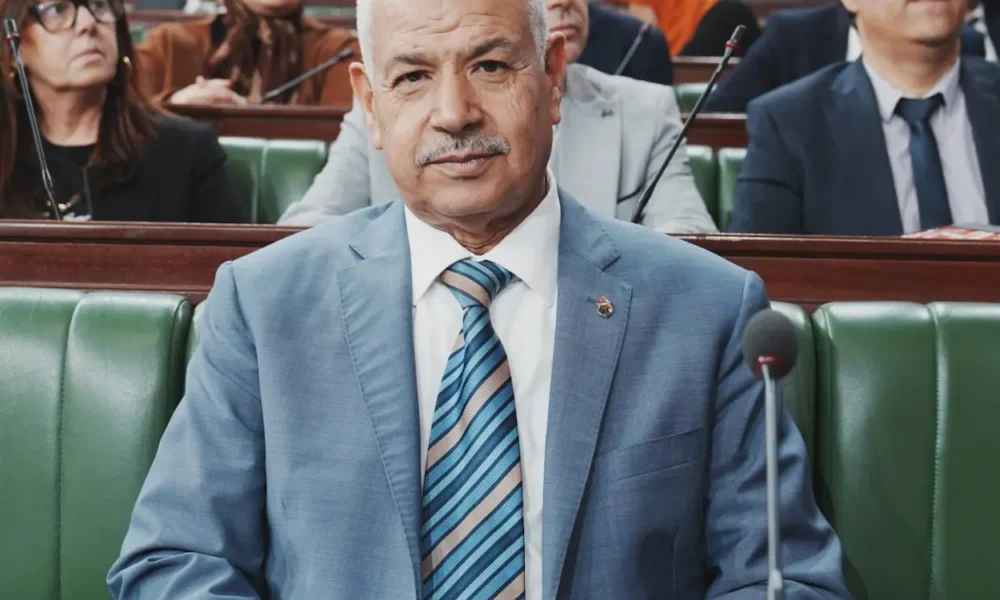
The Minister of Trade and Export Development, Samir Abid, stated that storage does not necessarily equate to hoarding, noting that it is no longer acceptable to systematically equate these two practices. He reminded that storage constitutes a fully-fledged economic activity, linked to the nature of several commercial and industrial activities, as well as to the peculiarities of distribution and export circuits.
Speaking during the joint plenary session of the People’s Representatives Assembly (ARP) and the National Council of Regions and Districts, dedicated to examining the budget of the Ministry of Trade and Export Development within the framework of the 2027 Finance Bill, held Friday evening, Samir Abid explained that declaring storage operations to the regional directorates of commerce would clarify the legal status of the operators concerned and protect them against potential prosecutions merely for holding stocks.
In this context, the minister stressed the need to distinguish storage, as a legal commercial or industrial activity, from hoarding, which consists of removing products from circulation on the market or using stocks to exert influence on supply and prices. He emphasized that simply holding stocks by economic operators does not, in itself, constitute evidence of speculative or monopolistic practices.
The minister also indicated that his department had carried out field visits to several warehouses, notably in the Mahdia Governorate and in the south of the country, in order to monitor storage operations, to learn about the nature of the stored products, and to examine the activities related to them.
He added that all products likely to be stored are subject to these operations, including olive oil, which is the subject of storage activities throughout the year, given the particularities of its marketing and export. He particularly recalled that this Tunisian product is destined for several foreign markets, especially the United States, Canada and certain Asian countries.