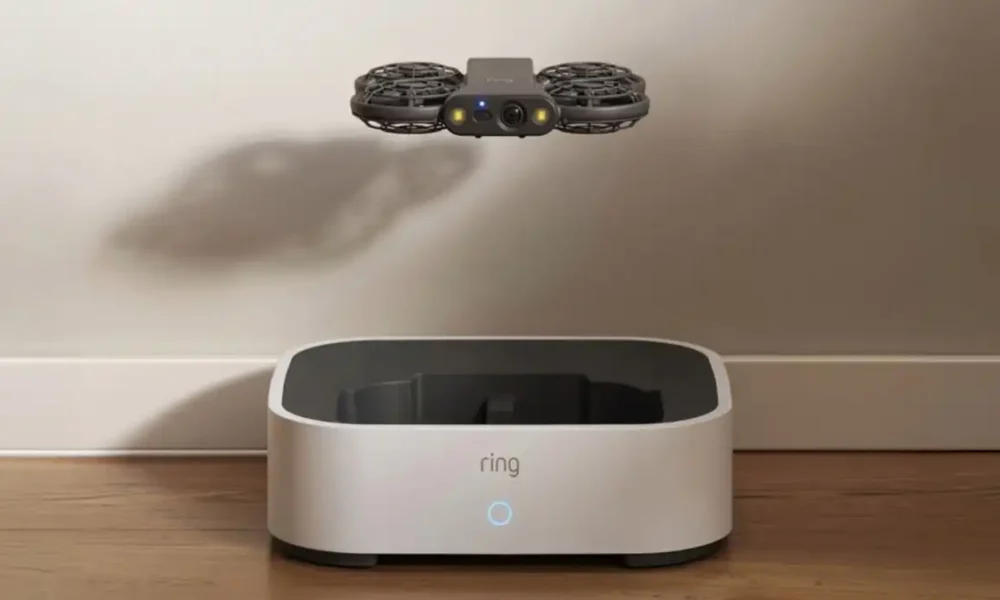
A camera placed in a corner can only film what lies in front of it. Amazon wants to change this logic: its new security drone takes off from its base, traverses the rooms and checks what is happening inside the house.
Presented on November 10, 2026, the device raises as many questions about privacy as about security.
The Essentials
- Announced price: $249.99 (about 750 TND) for the Ring Drone Cam, aimed at the American market.
- Expected date: deliveries begin on January 27, 2027, subject among other things to pending American regulatory approval.
- Technical sheet: 2K video (1920 × 1920 pixels), weight 165 grams, and up to eight minutes of flight per charge.
- Other novelty: Ring Rover Cam, a wheeled robot for businesses priced at $999.99, with US deliveries announced for December 16, 2026.
Imagine an alarm going off while you’re at the office. Instead of displaying only the video from the camera mounted near the door, your phone can receive images from a small device that moves through the living space. That is the promise of the Ring Drone Cam, unveiled by Ring, Amazon’s company focused on connected security.
The announcement comes with the creation of Ring Robotics, a new line of autonomous devices. It also includes a wheel-based robot designed to patrol shops, offices and warehouses. Neither device is announced for sale in Tunisia.
How does this flying camera move around the house?
During installation, the user lets the drone survey their home to create a map of the rooms. They then choose passage points: entry, window, corridor, or door to the outside. The device can follow a recorded route, be sent to a zone on demand, or depart to verify an event signaled by another Ring device.
The system, named AI Pilot, combines onboard sensors, computer vision and processing to identify obstacles and adjust the trajectory. It is not a device meant to fly freely over a garden: its use is limited to indoors and, in its initial configuration, to a single floor. Crossing multiple levels is announced as a future possibility, not a launch-day feature.
Its camera delivers images of 1920 × 1920 pixels, presented as 2K video, with a field of view of 148 degrees in each direction. Two LED lights let it film in dimly lit rooms. The device has no microphone or speaker: it cannot listen to a conversation or allow talking to an intruder.
Eight minutes in the air, then back to base
The technical sheet lists a weight of 165 grams, battery included, for a device measuring about 17.2 × 13.7 × 3.3 cm. Its maximum endurance is eight minutes of flight, achieved in controlled testing conditions. Real duration will depend on the environment, maneuvers and battery wear.
This figure puts the promise into perspective: the drone is not a waking, flying guardian. It is better suited for occasional checks than for continuous surveillance. Once the mission is complete, it returns to its docking station to recharge.
The device operates with a 2.4 or 5 GHz Wi-Fi connection, the Ring app, and a power outlet for the base. A downstream connection of at least 5 Mbit/s is recommended by the manufacturer for operation, while higher throughput may be required to preserve 2K quality. Scheduled patrols and some recording features require a compatible Ring subscription, the cost of which is added to the device price.
A camera in every room: and privacy?
The central debate is not only technical. A fixed camera generally requires choosing which areas are surveilled. A mobile camera can, it seems, enter several rooms in sequence. Are guests, family members, or employees present in the premises aware that they could be filmed? Who has access to the footage? How long is it stored?
Ring asserts that the drone’s camera is turned off when it rests on its base and that recording only starts during flight. The blades produce an audible noise and a light indicates operation. The company also announces encryption technology called Throw Away the Key, aimed at strengthening video privacy.
These protections are
For businesses, a robot at $999.99
The second device, Ring Rover Cam, does not fly: it moves on wheels within professional premises. Priced at $999.99, it can map and patrol interior spaces up to 5,000 square feet, or about 465 m², on a single level.
It carries a camera capable of filming up to 4K, an adjustable shot mast, a 360-degree sweep, a speaker, a microphone, a siren and a light signal. It can launch a planned patrol, head toward a designated area or verify an alert. While moving, it records video; even at its base, certain detection events can trigger a capture. It is not, however, a 24/7 video recording device.
This robot weighs around 9.35 kg, does not take stairs, and also requires a Wi-Fi network. Its American launch is slated for December 16, 2026. For a business, its value will depend notably on the layout of the premises and the real cost of the subscription.
Why Amazon revisits a six-year-old idea
The idea of a flying Ring camera is not entirely new. Amazon unveiled a first concept named Always Home Cam in 2020. It never reached broad consumer availability. The version announced this week rests on new components, more advanced navigation and deeper integration with the Ring ecosystem.
One concrete hurdle remains: the Ring Drone Cam spec notes that it is still awaiting the authorization required from the U.S. telecommunications authority, the FCC. The January 2027 date is therefore an announced deadline, not a guarantee of immediate sale.
A technology that raises questions well beyond the United States
For Tunisian consumers, these products are not yet associated with a local price, a delivery date, or an announced after-sales service. It would be misleading to automatically convert their American prices into dinar prices.
The broader issue is that domestic video surveillance is entering a phase where devices are no longer stationary. They can decide to move, analyze a situation, and send images without a person physically operating the camera. The question is no longer merely where to install a lens, but how far to let an autonomous device look inside your home.