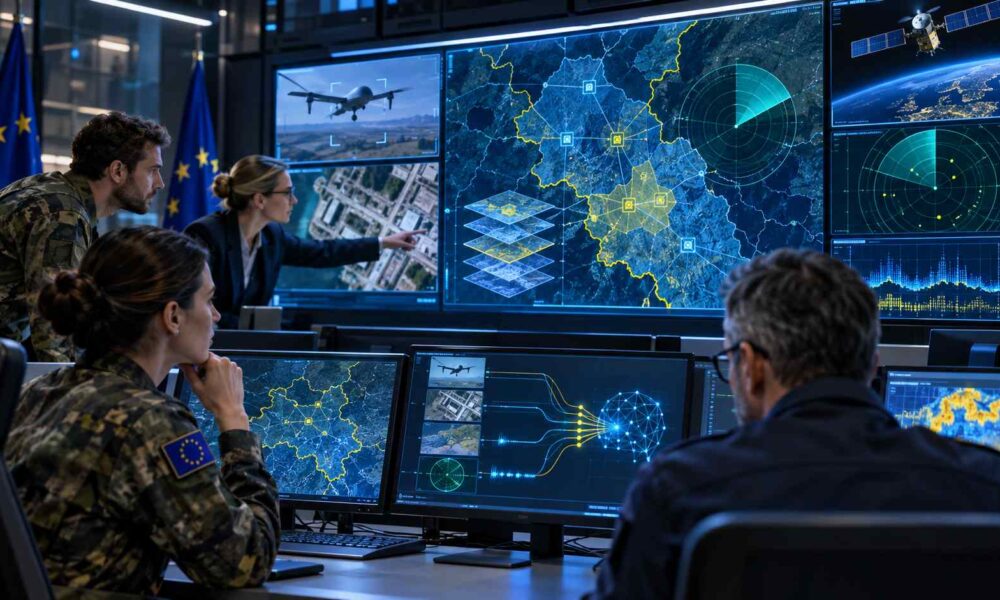
Clarity: An Artificial Intelligence for Analyzing the Battlefield
Modern armies have access to enormous amounts of information: satellite images, drone videos, radar data, communications, and field reports.
The problem is no longer merely collecting these data, but analyzing them quickly to identify threats and enable commanders to make decisions.
This is precisely the function announced for Clarity.
According to Helsing’s official press release, the platform relies on hundreds of specialized artificial intelligence agents capable of processing different sources in parallel and cross-checking their results.
The software can thus identify positions and military equipment, gather the available information on a potential target, and prepare the elements necessary for an operational decision.
Helsing claims that some analyses can be performed in a few seconds, whereas today they require numerous human interventions. This claimed performance has not yet been validated by independent comparative tests.
Humans Retain the Decision to Strike
The platform is not limited to intelligence analysis. It can also prepare the information necessary for the use of an armed system.
However, Helsing insists on maintaining human control.
According to the company, every proposed target must be reviewed by an operator, who checks the available information and personally authorizes its transmission to an armed system.
The software must also cross-check multiple independent sources before recommending a target. Decisions are logged to enable traceability.
These are the security mechanisms advertised by the manufacturer. Their effectiveness in operational conditions remains to be evaluated.
AI-assisted targeting systems indeed raise important questions about misidentification, data quality, and the actual time available to verify an automated recommendation.
Why Europe Wants to Compete with Palantir
The market for military data analytics software is currently dominated by several American groups, including Palantir Technologies.
Its Maven Smart System enables the exploitation of large amounts of military information to facilitate target identification and operational planning.
The platform is used by the American forces and certain NATO structures.
But dependence on foreign technologies raises concerns in several European capitals, especially when software handles classified military information.
According to Reuters, transatlantic tensions and questions about the long-term reliability of relations with Washington have strengthened calls for European technological autonomy.
Helsing highlights three characteristics: software developed in Europe, European AI models, and operation on infrastructures owned by the military customers.
The stated objective is to allow the armed forces to retain control of their data and their operations.
Germany Prepares Its Own Military Intelligence System
Germany constitutes one of the first potential markets for this type of technology.
According to Süddeutsche Zeitung, the Bundeswehr is currently examining around thirty solutions offered by European companies, including Helsing, to develop a national AI-based military analysis capability.
The army plans to have a prototype by mid-2027, before a possible deployment in 2028.
The daily also reports the reservations voiced by German military officials regarding foreign companies’ access to sensitive operational data.
Clarity thus enters a market where needs are identified, but contracts remain to be won.
Helsing has not specified whether its new platform is already used by an army, nor issued a timetable for commercial deployment.
The War in Ukraine Accelerates the Development of Military AI
Russia’s invasion of Ukraine has significantly accelerated the use of drones, sensors, and analytical software on the battlefield.
Ukrainian forces have notably developed DELTA, a system designed to centralize and share operational information.
Kyiv also uses Palantir technologies for intelligence analysis and the planning of certain operations.
Meanwhile, Helsing already supplies military equipment to Ukraine, notably drones. The company thus benefits from experience tied to operational needs observed during the conflict.
According to the Ukrainian Ministry of Defense, its Avengers Labs platform holds more than five million annotated battlefield images, a resource for training AI models.
Access to real military data becomes an industrial challenge, but also a sovereignty issue: states must decide which companies can exploit them and under what conditions.
An Industrial Battle for European Digital Sovereignty
The unveiling of Clarity comes in a context of rising European defense spending.
Governments are seeking to strengthen their capabilities in drones, autonomous systems, cybersecurity, and intelligence processing.
For Helsing, the ambition is to offer a European solution capable of operating with the equipment and software already used by the armies, without imposing a single supplier for all of their systems.
The company says it complies with relevant NATO standards and favors a modular architecture enabling the integration of hardware from different manufacturers.
These characteristics will, however, need to be confirmed in military evaluation and procurement processes.
With Clarity, Helsing directly enters competition with Palantir in a strategic market: software capable of turning battlefield data into information usable for military decision-making.
The November 11 presentation marks a new milestone in Europe’s ambition to master its defense technologies. The real test will now be Helsing’s ability to convince the armed forces, demonstrate the platform’s reliability, and secure operational deployments.