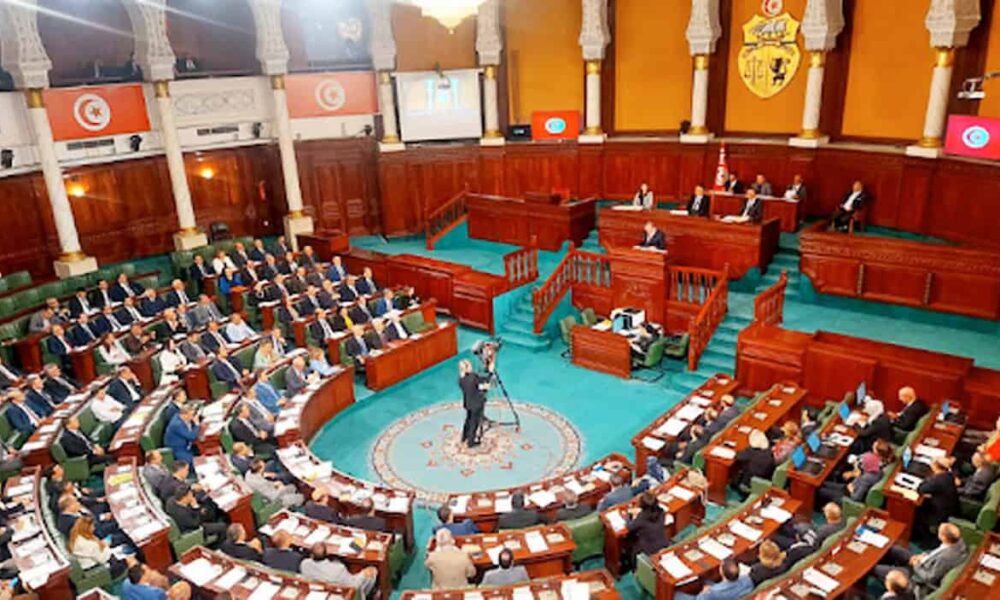
Members of the Assembly of the People’s Representatives approved the referral of the bill concerning the regulation of exchange offenses (No. 2025/058) to the commission responsible for its examination, namely the Finance Commission, by a majority of 54 deputies, with two abstentions and three votes against.
This decision came at the end of the plenary session held this Tuesday, April 14, following an official request submitted by the text’s initiator, namely the Independent National Bloc, due to what it described as a “large number of amendments proposed to the project text and the need for a thorough examination and a comparison with the initial version before submitting it again for a vote.”
For his part, the president of the Finance and Budget Committee in the Assembly of the People’s Representatives, Maher Ktari, expressed his astonishment at what he considered “a change of position by certain deputies, even though the proposal had enjoyed broad support in the morning, before opinions subsequently shifted toward postponing its examination.”
The bill No. 2025/058 constitutes a dual‑purpose mechanism, combining an exceptional and conjunctural measure to settle past exchange offenses, as well as a permanent provision enabling resident individuals to open accounts in foreign currencies or convertible dinars.
According to the final report of the Finance and Budget Committee, this proposal targets exclusively resident individuals, excluding legal entities, notably companies, due to the complexities related to tax control. It also covers several offenses, including the failure to declare assets held abroad, the non-repatriation in Tunisia of revenues in foreign currencies, and the possession of currencies on national territory outside the legal frameworks. Conversely, the text provides an explicit exclusion of amounts related to terrorist crimes and money laundering.
According to its initiators, the proposal aims to achieve several economic objectives, primarily the integration of the parallel economy through the reduction of currency circulation outside official channels, the strengthening of the country’s foreign currency reserves, and the establishment of a reconciliatory relationship between the State and the violators, based on voluntary regularization in exchange for legal exemptions. The project also intends to stimulate investment by allowing beneficiaries to inject the regularized funds into the national economy.
The proposal sets several conditions to benefit from the settlement, including the filing of a sworn declaration with an accredited intermediary, indicating the value of the assets and their legal origin, the repatriation of funds to Tunisia and their deposit into dedicated accounts, as well as the payment of a settlement contribution to the State, exempting beneficiaries from prosecutions as well as from criminal and financial penalties. A maximum period of one year from the publication of the law has been set for completing these formalities.
The text also grants several advantages, including the possibility of opening accounts in foreign currencies or in convertible dinars, and freely using the deposited funds to invest or cover expenses in Tunisia as well as abroad. The Finance Commission moreover introduced an amendment authorizing transfers abroad without prior authorization, up to 50% of the total amount of transfers. In return, these operations remain subject to the control of the Tunisian Financial Analysis Commission to verify the legality of the funds’ origin.
During the discussion of the project in July 2025, representatives of the Ministry of Finance had expressed technical reservations, notably regarding the possibility of opening currency accounts for residents. They had warned against potential repercussions on the stability of the national currency and called for prudence in adopting this measure.