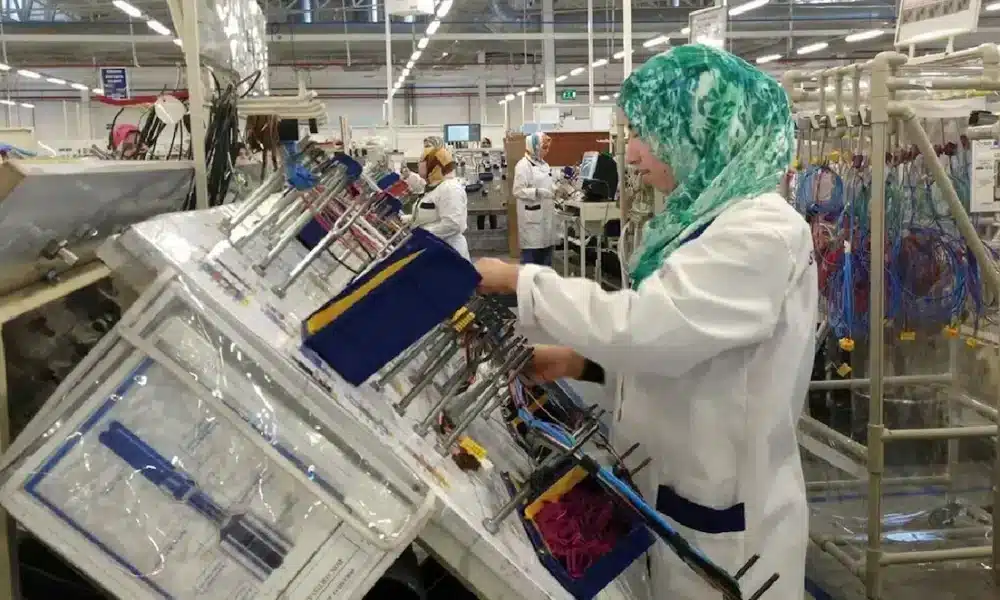
Tunisia reinforces the promotion of its automotive industry to Spanish investors. The specialized magazine AutoRevista dedicated, in its November 2026 issue, a special dossier to the evolution of the Tunisian automotive sector, highlighting its industrial capacities, technological potential, and the prospects for cooperation between the companies of the two countries.
This initiative, conducted jointly by the Foreign Investment Promotion Agency (FIPA Tunisia) and the Tunisian Association of Automotive Components Manufacturers, aims to better promote the strengths of the Tunisian sector to Spanish industrialists and economic decision-makers.
A Tunisian automotive industry of more than 300 companies
In its Tunisia-focused dossier, AutoRevista highlights the development of the national industrial ecosystem linked to automobiles and component manufacturing.
According to the data presented by the Spanish magazine, this sector today counts more than 300 active companies and employs over 130,000 people.
The annual value of exports is estimated at around €3.4 billion, illustrating the importance of this industry in Tunisia’s trade.
These figures, for which the reference year is not specified in the provided information, underscore the production and export capacities of the sector.
The publication of this dossier comes in parallel with the organization of the “Leader of the Year 2026” awards, an event bringing together several major players in the Spanish automotive industry.
The goal is to increase Tunisia’s visibility among companies likely to develop industrial activities or partnerships with Tunisian operators.
Engineering, software and embedded systems: the new strengths of the sector
Beyond traditional activities of automotive component manufacturing, the dossier highlights the growth of high value-added professions in the Tunisian industry.
Among the highlighted areas are engineering, software development, embedded systems, as well as research and development.
This evolution represents a key axis for cooperation prospects with Spanish manufacturers, particularly in activities requiring specialized technical and technological skills.
The magazine also notes the availability of qualified human resources in Tunisia, with 10,000 to 15,000 graduates trained each year in engineering and information and communication technologies.
These skills are presented as a factor likely to facilitate the establishment of industrial projects integrating more design and technological development activities.
Tunisia showcased for its scientific and technical graduates
The AutoRevista dossier pays particular attention to the qualifications of Tunisian graduates.
It indicates that Tunisia held, in 2026, the world’s top position for the proportion of graduates in the sciences and engineering fields, with a rate of 37.93% of all higher education graduates.
This figure is attributed by the publication to the World Intellectual Property Organization (WIPO).
This percentage represents a share of higher education graduates and not the proportion of scientists or engineers in the active population.
The dossier presents this indicator as an asset for the development of industrial activities requiring specialized technical skills.
Energy transition: Tunisian companies facing environmental requirements
The Spanish magazine also focuses on the efforts undertaken by Tunisian industrial companies to adapt to new environmental requirements, particularly those of European markets.
Among the initiatives mentioned is the development of self-generation of electricity from photovoltaic solar energy.
These steps are part of efforts to reduce the carbon footprint of industrial activities and to improve their energy performance.
The dossier also mentions the ELMED project, dedicated to the electrical interconnection between Tunisia and Italy.
This infrastructure is presented in the broader context of the energy transition and the strengthening of electrical exchanges between the two shores of the Mediterranean.
For automotive component manufacturers, adapting to environmental requirements represents a major challenge in their relations with international builders and equipment suppliers.
Relying on geographical proximity and Tunisian skills
The dossier includes several interventions by institutional officials and representatives of the Tunisian automotive sector.
The Director General of the Foreign Investment Promotion Agency, Jalel Tebib, notably highlighted the geographical proximity between Tunisia and Europe, as well as the Tunisian competencies in engineering professions.
He also stressed the importance of the competitiveness pact and the public-private partnership to support the development of the automotive sector.
According to him, these factors are levers to attract complementary technological projects and strengthen industrial integration between Tunisia and its European partners.
Towards industrial partnerships based on co-development
Meanwhile, Meriem Almi, president of the Tunisian Association of Automotive Components Manufacturers, emphasized the reliability of Tunisian suppliers and the evolution of their industrial skills.
She notably mentioned strengthening the operational capacities of companies as well as efforts in decarbonization.
These developments could, in her view, promote the shift from traditional subcontracting relationships to partnerships based more on the co-development of products and industrial solutions.
This orientation reflects the sector players’ aim to develop collaborations integrating design, innovation and engineering activities.
Moving beyond traditional subcontracting
The president of the Tunisian-Spanish Chamber of Commerce and Industry and honorary president of the Tunisian Association of Automotive Component Manufacturers, Nebhane Bouchaâla, also advocated for an evolution of industrial relations between the two countries.
He called for moving beyond traditional subcontracting models to favor integrated industrial alliances.
These partnerships should, in his view, be based on innovation, complementary skills, and the ability of companies to respond quickly to market evolutions.
This approach aims to foster deeper cooperation between Tunisian and Spanish companies, beyond mere production operations.
Madrid: transforming economic contacts into investment projects
The director of FIPA’s Madrid office, Zied Lahbib, specified that the publication of this dossier is part of a communication initiative aimed at Spanish industrialists and professional organizations.
This action is carried out in collaboration with the Tunisian embassy in Spain.
The objective is to strengthen exchanges with Spanish economic operators and to promote the realization of identified opportunities into durable partnership and investment projects.
The dossier published by AutoRevista thus constitutes a promotional operation for the Tunisian automotive industry to a specialized audience.
It places particular emphasis on cooperation prospects in high value-added activities, notably engineering, software, embedded systems, and technologies related to digital and energy transitions.
The challenge for Tunisian actors now is to turn this international visibility into concrete industrial collaborations with Spanish companies.

Adel Khelifi