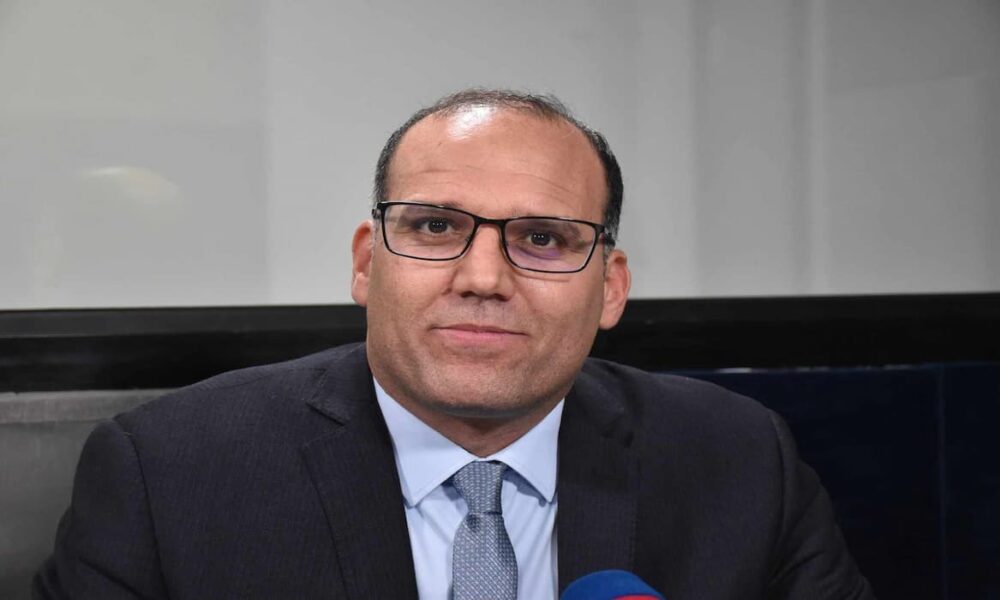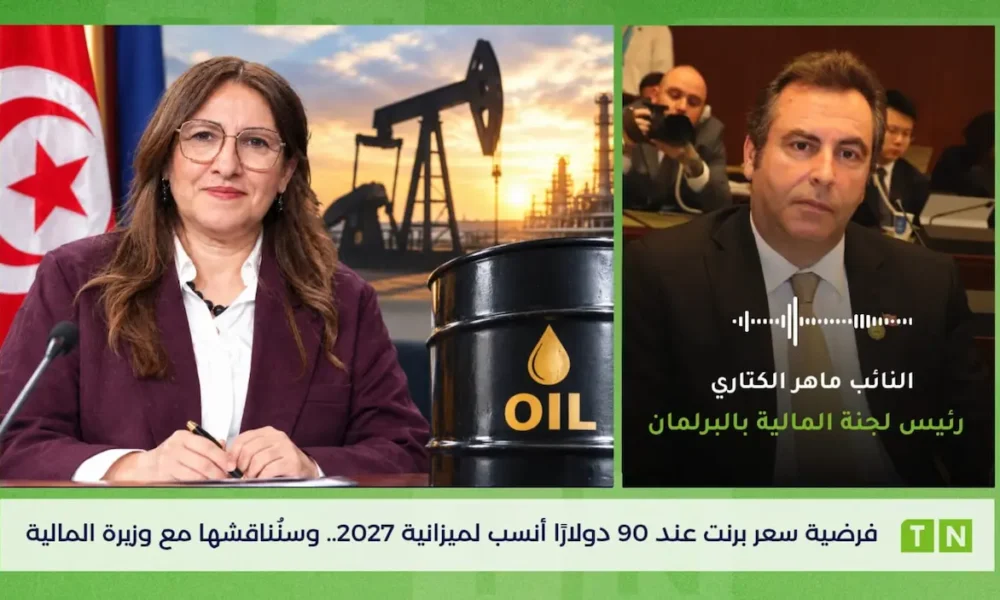
The president of the Finance and Budget Committee of the People’s Assembly, Maher Ketari, believes that a Brent crude oil price assumption averaging $90 per barrel would have been more suitable for drafting the State budget for 2027. He told Tunisie Numérique that this estimate will be discussed with the Minister of Finance, to whom the committee will also request the data used to establish the ministry’s assumptions.
A Brent price assumption of $90 to be discussed with the minister
The report on the assumptions and directions of the 2027 budget sets the average Brent price between $75 and $80 per barrel. Maher Ketari believes that the ongoing tensions in the Middle East and in other regions, as well as global instability, justify retaining a higher assumption, at $90.
While recognizing that it is impossible to predict oil prices with certainty, the committee chair believes that a $90 estimate would provide a more comfortable margin if the price were to fall to $70. He, however, described this assumption as particularly difficult to establish.
The committee intends to address this issue with the Minister of Finance and ask her on what data the ministry based its forecasts.
Requests for clarifications on the execution of the 2026 budget
The Finance and Budget Committee met on Wednesday, October 7, 2026 to examine the main orientations of the state budget project for 2027 as well as the execution of the 2026 budget up to the end of June.
According to Maher Ketari, the deputies considered that the report on budget execution was too general to allow a precise assessment. Several lawmakers requested details on the facilities granted by the Central Bank of Tunisia to the Treasury, amounting to 11 billion dinars, as well as on the use of these funds and the criteria used to establish expenditure priorities.
Other deputies called for precise data on the guarantees provided by the state to the borrowings of public enterprises and on their effects on public finances.
Maher Ketari also spoke about the impact of rising petroleum prices on the budget. He welcomed the decision not to raise gasoline prices, saying it helped preserve purchasing power. He nonetheless asked how the increase in expenditures allocated to energy support had been financed: through new resources, the deferral of certain projects, or the non-payment of some debts?
A meeting with the minister before October 15
The chair of the commission noted that a letter had been sent to the Minister of Finance the previous week and that he would follow up to invite her to a meeting the following week, before the submission of the 2027 Finance Bill. According to Maher Ketari, the Constitution sets October 15 as the deadline for submitting the bill to the Assembly of the People’s Representatives.
He specified that this meeting would not be a session of questioning, but a working meeting aimed at examining achievements, their modalities, and the reasons for the levels of execution recorded. He specifically cited investments, the execution rate of which reportedly had not exceeded 10%, according to his statements.
No new tax pressure and a tight grip on spending
Regarding the main orientations of the 2027 budget, Maher Ketari indicated that the commission had requested that no additional tax burden be imposed on individuals or businesses. According to him, this orientation is included in the document dedicated to the budget’s broad outlines and was also confirmed by the President of the Republic.
The commission also urged for better governance of public spending and for no increase in ministerial budgets compared with those of 2026. These stood at around 63.575 billion dinars, he specified, noting that the State must control its spending while calling citizens to sobriety.
Tunisia’s industry and the 2026-2030 development plan
Maher Ketari cited among the positives of the budget orientations the willingness to invest in Tunisia’s industry. He argued that support for the national industry was linked to the economy’s ability to generate growth.
He also emphasized the need to align the 2027 budget orientations with the 2026-2030 development plan, which aims for 4% growth while preserving the social role of the State.
The exchange and investment codes
The chair of the commission regards the exchange code and the investment code as two essential texts for the national economy. According to his estimate, the exchange code could contribute to increasing the growth rate by one point, provided it is accompanied by an effective investment framework.
He urged the adoption of these two texts within the framework of the 2027 Finance Law, as well as an amnesty law concerning exchange offenses and customs offenses. Maher Ketari mentioned estimates from experts, the Customs Service, and the Ministry of Finance indicating that this measure could bring the Treasury close to one billion euros by September 2027, or about 3.45 billion dinars, according to his statements.
He also called for greater openness to the Mediterranean basin and Sub-Saharan Africa, arguing that this would require revising the exchange code and adopting a new investment code.
The commission, he added, does not want to pass the exchange code without having the Central Bank’s opinion, in order to favor applicable texts.
A working method for MPs’ proposals
Regarding additional articles that MPs might propose in the 2027 Finance Bill, Maher Ketari stated that an agreement had been reached with the presidents of the parliamentary blocs. Each bloc should submit 4 to 5 proposals, which will then be grouped and examined by the Finance Committee before being transmitted to the plenary session.
According to Maher Ketari, the objective is not to accumulate articles, but to prioritize their effectiveness and feasibility, in order to preserve the credibility of Parliament and the State and to prevent provisions included in the finance law from not being implemented.