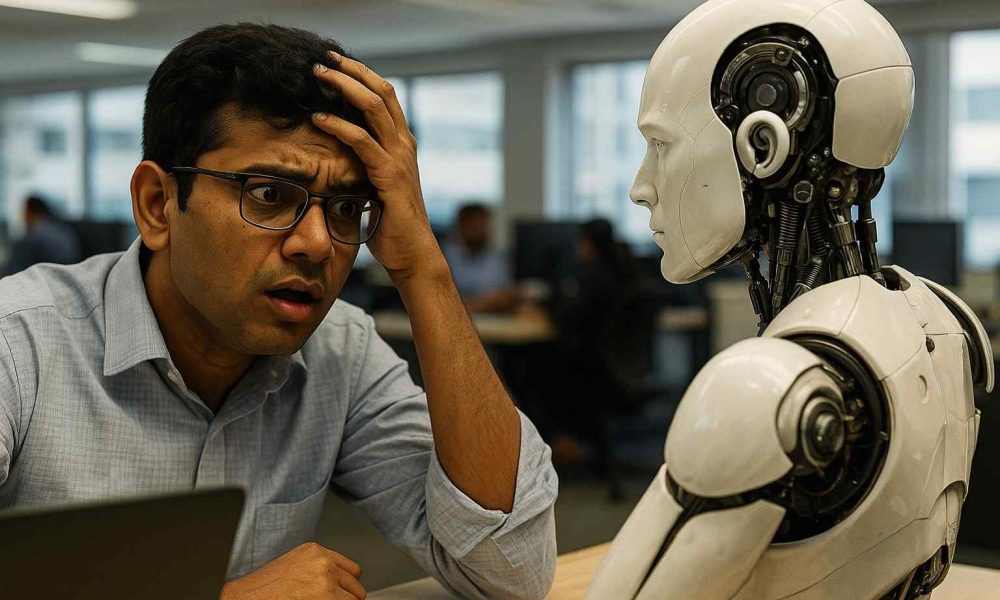
It’s a discreet court decision, issued in Hangzhou, but it touches on one of the major concerns of the moment: what happens to an employee when the company believes that an artificial intelligence can do their job?
In China, a court has just provided a first answer. A company cannot dismiss an employee solely on the grounds that their position could be replaced by AI.
The decision, published on April 28, 2026, does not curb technological innovation. It recalls a limit: digital transformation does not allow bypassing labor law.
An individual case that became a symbol, a 40% pay cut
The case concerns a 35-year-old employee, identified by the name Zhou. He worked in the quality control of an artificial intelligence model.
His company offered him a demotion, with a salary drop from 25,000 yuan to 15,000 yuan per month (from €3,200 ≈ 10,800 Tunisian dinars to €1,900 ≈ 6,500 Tunisian dinars, a decrease of €1,300 ≈ 4,300 Tunisian dinars per month), i.e. -40%, arguing that AI could now carry out part of his tasks.
Zhou refused. He is dismissed. The justice system rules: illegal dismissal, with compensation of about 260,000 yuan (€33,000 ≈ 112,000 Tunisian dinars).
The message is simple: a company can automate, but it cannot use AI as a shortcut to sideline an employee without a legal framework.
Innovation yes, circumvention no
The court does not challenge the use of artificial intelligence. It does not protect jobs at any price. But it recalls a fundamental rule: technological progress does not absolve the company of its social obligations.
This case comes during a sensitive period for China. In 2026, the country must integrate about 12.7 million new graduates into the job market, while aiming for 12 million urban jobs.
In this context, AI is not only an economic opportunity. It becomes a political and social issue.
A signal for all countries
The Chinese case goes far beyond its borders. Global investment in AI surged by 127.5% in 2025, signaling a massive acceleration. Everywhere, the same question arises: what becomes of the employee when the machine becomes more efficient?
For Tunisia, this decision deserves attention. AI can modernize companies, reduce certain costs, and improve services. But if it becomes merely a tool for wage compression or rapid job cuts, it can also generate social tensions.
In Hangzhou, the court did not halt innovation. It set a limit.
Behind the 260,000 yuan granted to an employee lies a broader idea: AI can replace tasks, but it cannot replace rights.