Access to climate finance is a major challenge for Tunisia, which is facing climate transformations affecting its water resources, its agriculture and its territories. A climate challenge that is also a development challenge. In the face of this situation, Tunisia has chosen to act.
With its NDC 3.0, Tunisia has set a clear ambition: to mitigate the effects of climate change, to adapt to them and to strengthen its resilience.
However, this ambition comes at a cost: nearly $55 billion in investments will be required between 2026 and 2035. To respond to these needs, a shift in approach is required: moving from isolated projects to coherent, structuring and bankable portfolios. The available instruments are diverse: subsidies, concessional loans, guarantees and blended financing.
But no actor can act alone. Governments, businesses, banks and partners must move forward together around a single portfolio of projects. This mobilization also involves diplomacy, which should valorize national priorities and bring international resources closer to Tunisian projects.
The objective is to transform ambition into projects, projects into investments and investments into concrete impacts.
A National Workshop on Access to Climate Financing
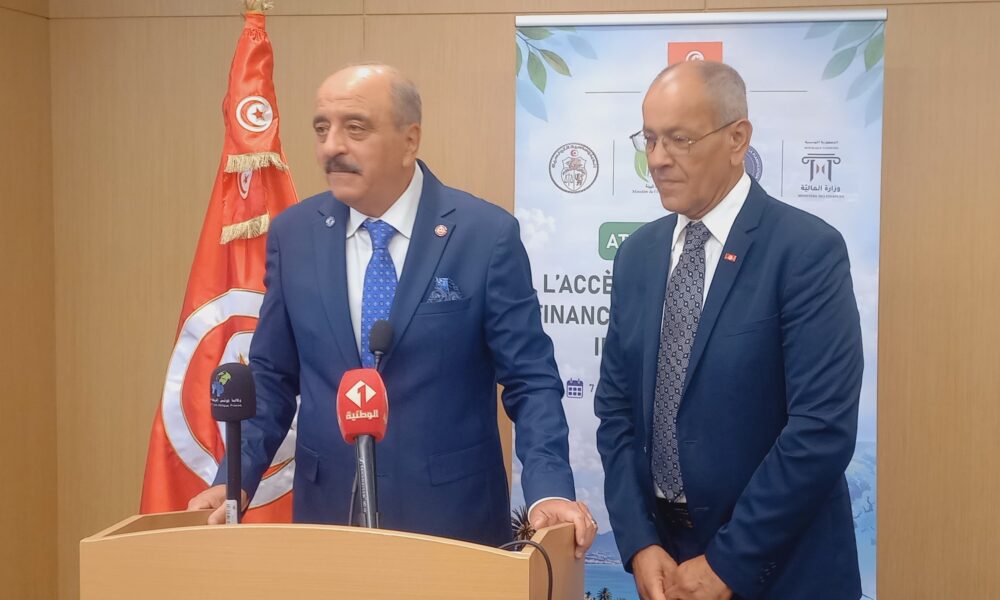
Within this framework, the Ministry of Foreign Affairs, Migration and Tunisians Abroad organized today, in collaboration with the Ministry of Finance, the Ministry of Economy and Planning, and the United Nations Development Programme (UNDP), a national workshop on Tunisia’s access to climate financing.
The mobilization of the funds necessary for adaptation and the climate transition is more of a priority than ever. It is no longer just about knowing which financing exists; it is about determining how Tunisia can access it, better preparing its projects and strengthening its ability to attract international resources.
The workshop organized today aims to share experiences, identify obstacles and outline concrete and operational avenues to improve Tunisia’s access to these financings.
Mohamed Ali Nafti: « Current mobilization remains below our potential »
« The ambition we nurture cannot be measured other than by investments and financing that match the needs,” said Mohamed Ali Nafti, Minister of Foreign Affairs, Migration and Tunisians Abroad, at the opening of the workshop.
And he added: « Tunisia has significant potential. It can mobilize more resources offered by multilateral and bilateral mechanisms. It can also better leverage the growing diversity of available instruments. Yet we must recognize that current mobilization remains below our potential and the needs tied to our climate ambitions. »
The minister stressed the need to better exploit concessional loans, guarantees, blended financing as well as other innovative instruments.
« We must also further explore debt-for-investment mechanisms in favor of climate and development. They can constitute an innovative instrument to create budget space and direct resources toward priority projects », he added.
Mohamed Ali Nafti stated that it is no longer simply about seeking funding for a single project, but about constructing bankable projects capable of attracting and combining multiple financing sources.
Habib Abid calls to accelerate procedures
Habib Abid, Minister of the Environment, indicated on this occasion that this workshop constitutes an opportunity to strengthen national commitment to adaptation and resilience in the face of climate challenges, through mobilizing the necessary financing.
Referring to the projects, experiences and efforts undertaken by Tunisia in the environmental domain, the minister specified that the role of his department is notably to mobilize funds in order to implement the various projects related to climate resilience.
Habib Abid also called for reflection on ways to reduce the delays between the presentation of a project and its validation, as well as the support to be provided to young Tunisians in the various bidding processes in this field.
« We must also consider the carbon authority, how to establish it and determine eligible projects », declared the Minister of the Environment at the opening of the workshop.
In a press statement, Habib Abid indicated that since 2025 the Ministry of the Environment had begun, in partnership with the Ministry of Foreign Affairs, steps to mobilize the necessary financing for various environmental projects, notably in the areas of coastal protection and photovoltaic energy.