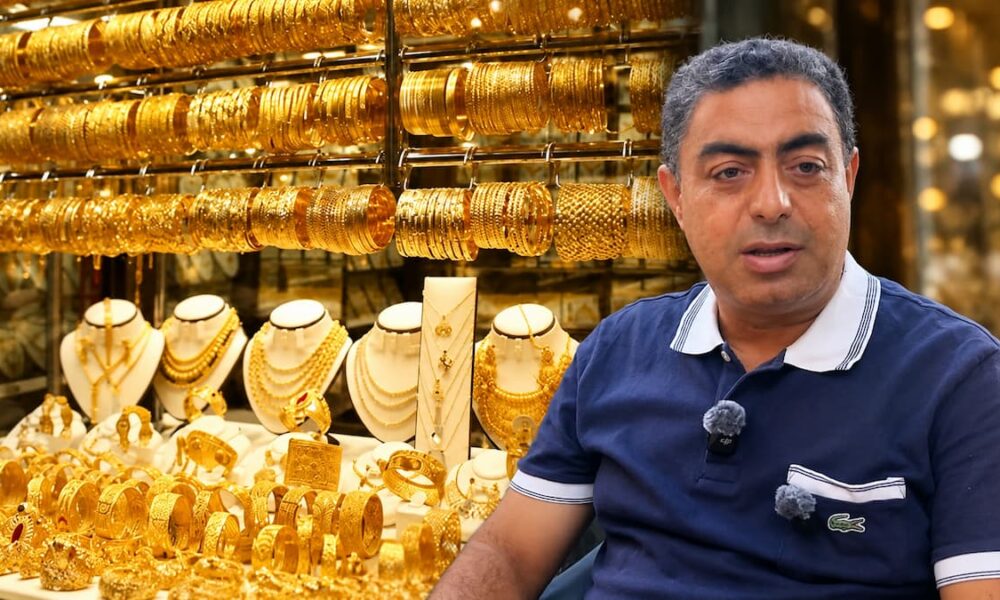
Gold prices continue to fluctuate on international and local markets. In Sfax, the price of a new 18-carat gram of gold is currently trading between 390 and 400 dinars, according to Wajih El Mesfar, treasurer of the Regional Chamber of Goldsmith Artisans of Sfax. Facing market uncertainties and difficulties faced by professionals, he calls for a revision of the legislation governing the sector.
The Essentials
18-carat new gold:between 390 and 400 DT per gram on the local market.
-
- 18-carat gold destined for melting: between 285 and 290 dinars per gram.
-
- 9-carat new gold :between 220 and 250 dinars per gram.
-
- Puncturing :call for reopening the Sfax office, currently closed according to the professional representative.
-
- Legislation :
Gold prices: between international fluctuations and tensions on the local market
Wajih El Mesfar indicated that gold prices are experiencing a period of instability, despite a notable decline observed midweek. According to him, uncertainties tied to the international conjuncture complicate forecasts of price evolution over the coming weeks.
On the international market, the price of an ounce of gold was around 4,040 dollars, according to the figures he provided. He spoke of a phase of stability compared with the previous week, followed by a renewed upward trend.
He also estimated the price of a gram of 24-carat gold on the international market at about 387 dinars, after conversion to the national currency.
How much does a gram of gold cost in Tunisia?
On the local market, prices vary according to the fineness of the gold and the nature of the product, new or destined for melting. The amounts communicated by Wajih El Mesfar show significant differences between categories.
| Type of gold | Price per gram |
|---|---|
| 18-carat new gold | 390 to 400 DT |
| 18-carat gold destined for melting | 285 to 290 DT |
| 9-carat new gold | 220 to 250 DT |
| 9-carat gold destined for melting | 110 to 120 DT |
Regarding silver, the professional representative reported a stable price of 6 dinars per gram. He nonetheless emphasized that labor costs remain a key factor in determining the final price of jewelry. The price of an item can thus vary depending on the manufacturing work and the product’s characteristics.
The olive harvest, a traditional engine of jewelry making in Sfax
The treasurer of the Regional Chamber of Jewelry Artisans also returned to the historical link between the olive harvest season and the activity of the jewelry sector in Sfax.
According to his explanations, this time of year traditionally marked the start of the jewelry manufacturing season, particularly for 9-carat gold pieces.
The olive campaign thus helped energize commercial exchanges and support the activity of jewelry artisans.
Wajih El Mesfar expressed hope to see these commercial practices revived, which in the past brought extra momentum to the local market during the olive harvest season.
The Sfax stamping office still closed
Among the difficulties faced by professionals, Wajih El Mesfar notably mentioned the closure of the Sfax precious metals stamping office.
He called for its reopening to enable artisans to stamp their gold jewelry and to facilitate the conduct of their activity.
The professional representative also addressed the issue of laser stamping, a technology whose adoption had already been requested by artisans.
However, he explained that this method raised some concerns related to counterfeiting risks.
In this context, he defended maintaining manual stamping, deeming that this technique helps preserve the characteristics sought in the marking of jewelry. He nevertheless acknowledged that the different stamping processes can be exposed to attempts at counterfeiting.
A revision of the 2005 legislation demanded by artisans
Regulatory-wise, Wajih El Mesfar estimated that the Tunisian system governing the gold sector is among the best in the world, noting that some neighboring countries have similar provisions.
He did, however, insist on the need to modernize the legal and regulatory framework to grant professionals more flexibility.
According to him, the 2005 legislation governing the sector presents several implementation difficulties, notably due to provisions he regards as restrictive for artisans. He recalled that an alternative legislative text had been developed in 2018, after professionals were invited to present their proposals.
| File | Position expressed by Wajih El Mesfar |
|---|---|
| Sfax stamping office | Call for reopening to facilitate artisans’ activity |
| Laser stamping | Consideration of counterfeiting risks associated with this technique |
| Manual stamping | Maintaining this method to preserve marking characteristics |
| 2005 legislation | Revision of provisions deemed burdensome for professionals |
| Proposal developed in 2018 | Reminder of an alternative text prepared by artisans |
Wajih El Mesfar thus renewed his call for a revision of the 2005 legislation, aiming to simplify procedures, ease artisans’ work, and improve the conditions for practicing jewelry professions in Tunisia.
This request comes in a context, according to the professional representative, marked by fluctuations in gold prices and a slowdown in production activity on the local market.