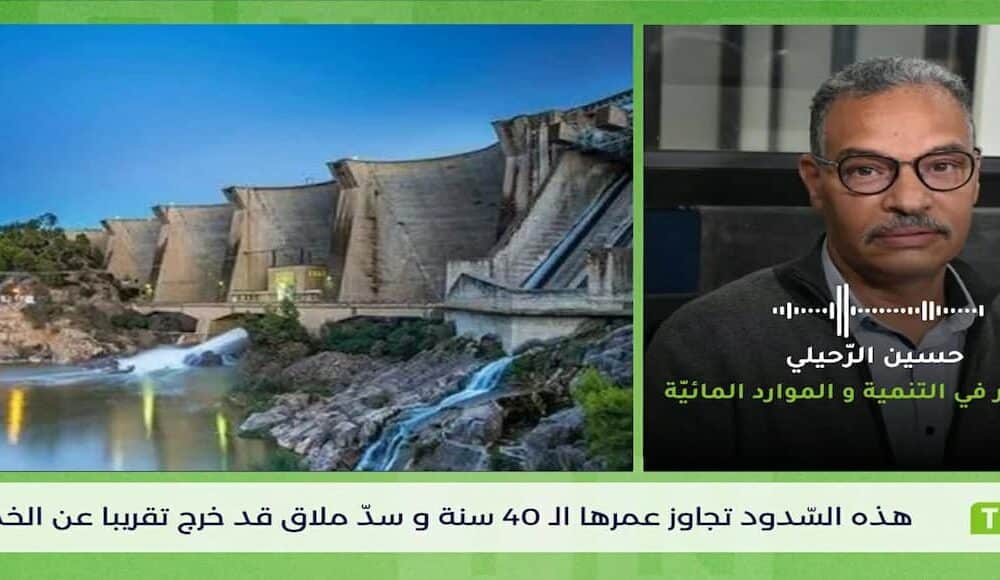
The development and water resources expert, Houcine Rhili, returned this Wednesday, June 24, 2026, in a statement to Tunisie Numérique, regarding the technical incident that recently occurred at Mellègue Dam, which caused the release of large quantities of water.
A failure at the control valve
Houcine Rhili explained that the incident was due to a loss of control of a valve during its opening. This operation was intended to supply the irrigated areas with 100 thousand cubic meters of water, intended for the irrigation of seasonal crops.
According to him, this technical failure led to the discharge of more than 20 million cubic meters of water stored in the dam. He noted, however, that this quantity was not wasted, as it flowed toward the Mellègue River, then toward the Medjerda River, before finally stabilizing at the Sidi Salem dam.
Periodic maintenance of the dams in question
The expert estimated that this incident raises today the question of the maintenance and periodic servicing of Tunisian dams, especially those that are aging.
He recalled that Mellègue Dam has reached the age of 72 years and that it is, in his view, almost out of service, particularly given the quantities of water available for several years. Houcine Rhili added that the operation of the upper Mellègue Dam should begin, according to the Ministry of Agriculture’s schedule, between September and December 2026.
For him, this situation also raises questions about Tunisian dams whose theoretical lifespan is approaching its end.
Dams built in the 1970s and 1980s
Houcine Rhili indicated that several dams were built in the 1970s and 1980s, and that some have now surpassed 40 or 50 years of existence.
He stressed that these works still exist technically, but the main problem lies in the absence of periodic maintenance and in the accumulation of sediment. According to him, this shows that, when these dams were built, attention to the catchments, reforestation, and protection of hydraulic structures was not sufficiently paid.
These factors contribute, according to him, to reducing the lifespan of the dams and to increasing the volume of sediment accumulated.
A rehabilitation program deemed necessary
The water resources expert called for the establishment of a periodic maintenance program and regular technical tests. He recommended opening the valves at least two to three times a year in order to verify their operation and avoid this type of incident.
He clarified that, by chance, the amount of water present in Mellègue Dam at the time of the breakdown was small and did not exceed 30 million cubic meters.
Houcine Rhili also urged technical administrations to take responsibility for regular maintenance of the dams, including during drought years. He estimated that these periods can represent an opportunity to carry out tests, undertake maintenance work, and carry out the necessary repairs.
He added that today there are other types of valves, less prone to failures and easier to control, which would allow envisaging a rehabilitation program for Tunisian dams by relying on modern techniques.
Several structures affected by aging
Houcine Rhili named several dams built in the 1970s, notably the Sidi Saad, El Haouareb, Béni Metir, Kasseb, and Siliana dams. According to him, these structures are aging and require serious periodic maintenance programs and sediment management.
He stressed that dams must be considered as an integrated system, consisting of catchments, wadis, and retention zones. An effective intervention must therefore concern the entire chain, and not only the dam itself.
A significant loss of storage capacity
The expert recalled that Mellègue Dam, aged more than 72 years, is among the oldest dams in Tunisia. He estimated that after 50 years, it becomes necessary to seriously consider thorough maintenance or replacement of existing dams.
He finally warned that some dams, once they exceed 30 years of operation, can lose up to about 50% of their storage capacity due to the rising level of sediment, the ineffectiveness of catchments, and the absence of serious reforestation programs.