The repercussions of the war in Iran and the disruptions to navigation near the Strait of Hormuz are pushing Kazakhstan to accelerate its plans to expand its trans-Asian rail network.
Aim: to capitalize on the gradual shift of part of trade between China and Europe toward land transport, deemed more stable than maritime routes exposed to geopolitical tensions.
Land Transport Becomes More Attractive
The CEO of the Kazakh national railway company, Kazakhstan Temir Zholy, Talgat Aldybergenov, told Bloomberg that tensions in the Middle East are pushing an increasing number of Chinese companies to favor land corridors.
According to him, Chinese customers are seeking greater reliability and better predictability of delivery times, in a context of rising risks on the maritime routes linked to the Gulf.
The Middle Corridor at the Heart of the Strategy
This trend strengthens the importance of the “Middle Corridor,” also called the Trans-Caspian Route. This axis connects China to Europe via Kazakhstan, Azerbaijan, Georgia and Turkey, bypassing Russia and Iran.
Since the start of the war in Ukraine in 2022, this corridor has gained importance, with several European and Asian companies seeking to avoid routes that pass through Russian territory.
Thus Kazakhstan aims to become a major logistics hub in Eurasia by modernizing its railway and port infrastructures.
10 Billion Dollars in Investments by 2030
Kazakhstan Temir Zholy plans to invest about $10 billion by 2030 in railways, ports and logistics services. Nearly half of this amount has already been spent.
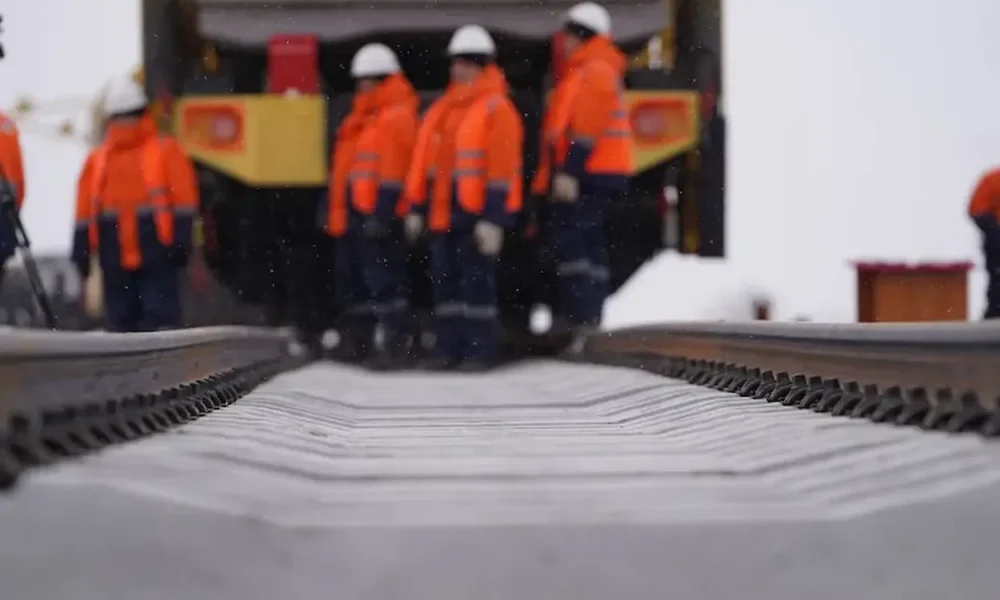
This year, the company is building around 900 kilometers of new rail lines, including the Ayagoz-Bakhty line, about 272 kilometers long, up to the Chinese border.
This project is set to become the third rail passage between Kazakhstan and China, after Dostyk and Khorgos.
The new infrastructures are expected to raise the railway transport capacity between the two countries to nearly 100 million tonnes by 2030, compared with about 55 million tonnes currently.
The Caspian Sea Bottleneck
The Caspian Sea remains one of the main weak points of the Middle Corridor because of the lack of ships able to transport containers and goods between Central Asian ports and Azerbaijan.
To address this, Kazakhstan Temir Zholy plans to invest over $100 million in purchasing six new ships. Four will be built by the Chinese group Jiangsu Hantong, while two more will be built at a shipyard in Baku, Azerbaijan.
These ships will be used to transport goods from Kazakhstan’s ports of Aktau and Kuryk to Baku, before their onward journey to Europe by land and sea.
A Strengthened Logistics Presence in China and Europe
In recent years, Kazakhstan has expanded its logistics footprint in China and Europe. In 2020, the national company acquired a logistics platform at the Chinese port of Xi’an, a key hub for container trains connecting China to Europe via Kazakhstan.
It is also in talks to acquire container terminals in Romania, Hungary, and Germany.
Another joint project is being studied in Chengdu, in China’s Sichuan Province, to link Chinese logistics investments to an agricultural container hub in Kokshetau, Kazakhstan, to support exports to China.
Growing Support from International Institutions
Kazakhstan’s railway projects linked to the Middle Corridor are receiving growing support from international financial institutions.
The World Bank announced, last February, its support for the Kazakhstan rail connectivity development project, aimed at improving network efficiency and strengthening the financial viability of the national company.
The Asian Infrastructure Investment Bank is also participating in financing the project, which envisions building new lines to reduce transport times and relieve congestion on existing routes.