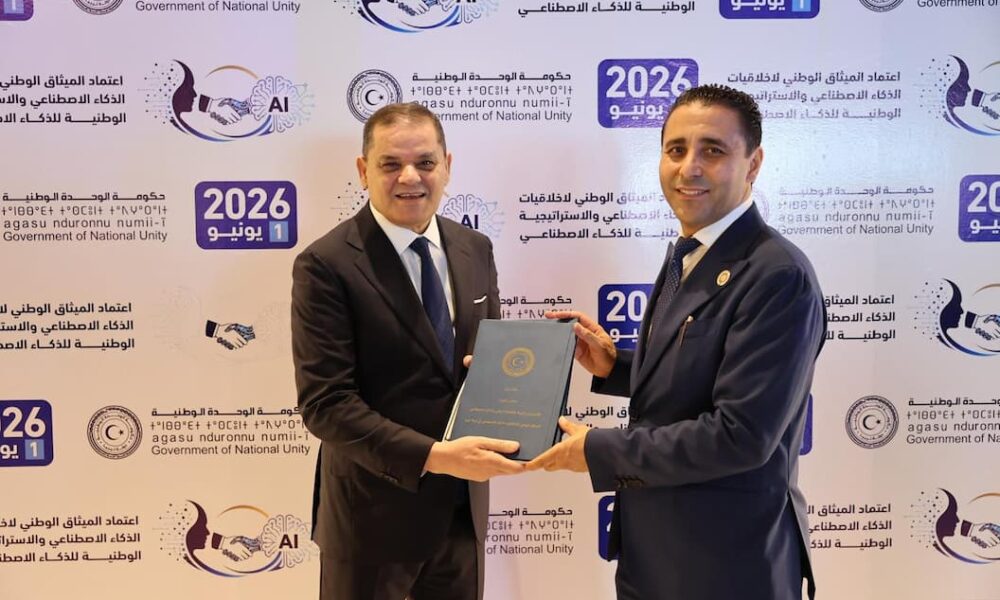
The Libyan Prime Minister, Abdelhamid Dbeibah, on Monday adopted the National Charter of AI Ethics and launched the National AI Strategy 2026-2030.
The Libyan Charter of AI Ethics provides for the anchoring of the principles of justice, transparency, and accountability, while guaranteeing the rights of individuals, their digital freedoms, as well as the protection of national security and the digital sovereignty of the State.
The document also asserts the centrality of the human being in the technological process, considering that artificial intelligence systems are tools to assist human decision-making, and not substitutes for it, notably in sensitive sectors such as health, justice and security. This charter constitutes a national reference for the public, private, and academic sectors, with the aim of strengthening society’s trust and consolidating the principles of good governance.
The Libyan strategy for artificial intelligence aims to establish a global and balanced digital transformation, through the development of digital infrastructure, the strengthening of national competencies, as well as support for innovation and entrepreneurship. It should contribute to improving the quality of public services, strengthening national security, and promoting sustainable development, according to a defined timeline and progressive evaluation indicators enabling a gradual and organized implementation of digital transformation programs across the various vital sectors.
The strategy also sets several quantified objectives, including the use of AI solutions by 80% of public institutions, the activation of the national digital identity for 70% of the population, as well as the training and qualification of 10,000 agents in the field of advanced technologies. It also plans to support the creation of 100 start-ups specializing in artificial intelligence, to automate 50% of administrative transactions, and to convert 70% of paper archives into modern digital systems.