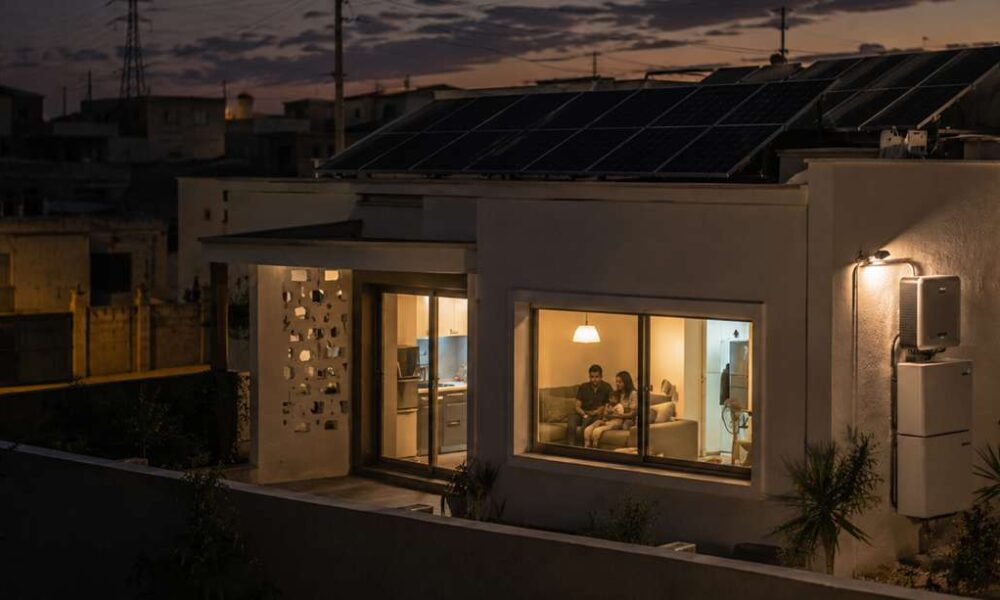
The calendar has rarely been so eloquent. As Tunisia has been experiencing rotating power outages since July 7, the Tunisian Electricity and Gas Company (STEG) published on July 21, 2026 a new 143-page technical standard that explicitly opens the way for integrating storage batteries into photovoltaic installations connected to the low-voltage grid — subject to the dossier’s approval and compliance with the technical requirements it defines.
Until now, the technical framework for STEG-connected residential solar installations did not explicitly provide for the use of a battery enabling certain circuits to stay energized during an outage. The standard changes this by setting out, for the first time in this document, the optional incorporation of energy storage systems by battery — designated by the acronym BESS — with the stated aim of improving efficiency and solar self-consumption.
The Essentials in Two Minutes
What changes: solar production storage is now regulated, which makes it possible to use it at night or during a grid outage.
What this could enable: with a compatible inverter and isolation device, the installation can operate in island mode during a outage and supply either the entire dwelling or a dedicated emergency circuit. The real potential depends on the architecture validated by STEG.
This is not automatic: the connection remains subject to STEG’s prior approval based on a technical dossier, and the installation power cannot exceed the power subscribed by the customer.
Two families of batteries are admitted: lithium-ion and sealed lead-acid, with mandatory conformity certificates.
Why a Solar Installation Stops When the Power Is Cut
The absence of storage in the classic layout was not arbitrary. A grid-connected photovoltaic installation must necessarily disconnect when power disappears: this is the anti-islanding protection, which prevents a panel from continuing to inject current into a line presumed de-energized, where an operator may intervene. The reference standard maintains this requirement and imposes compliance with the corresponding test methods.
Grid Safety First
Allowing storage implies precisely framing how the installation switches to autonomous mode without ever refeeding the public grid. This is the purpose of the new text, which defines the minimum design, construction, and maintenance requirements.
The context of the moment is obviously not neutral. While demand approached 5,000 megawatts, STEG shows a developable capacity of 4,630 MW, in a context where the actual availability of production means remains decisive. Yet residential storage offers a double interest for the operator: it helps households withstand outages, but it also shifts part of their consumption away from peak hours — precisely those that, in a heatwave, stress the network.
The Four Ways to Use a Battery
This is the heart of the system, and the point the reference document details the most. A single installation can operate in four modes, with transitions between them occurring automatically, without user intervention.
- During the day: solar energy first powers the home; any surplus charges the batteries, and the eventual excess can be injected into the grid.
- At night: the energy stored during the day covers nighttime consumption, maximizing self-consumption.
- In backup mode: during a grid outage, the system can power all loads or only those connected to a dedicated outlet — the reference conditions this behavior consistently on the type of inverter installed.
- In charger mode: the grid itself recharges the batteries, which serve as a backup reserve, on the principle of an inverter but on the scale of the dwelling.
A Battery Does Not Guarantee Electricity During the Outage by Itself
The most important caveat before purchase
Adding batteries to a conventional solar installation does not automatically guarantee powering a home during a blackout.
Autonomous operation requires a hybrid inverter or a device compatible with backup mode, a physical separation system from the public grid, a properly designed switching system, and, most often, a panel grouping priority circuits.
These priority circuits make all the difference in practical use. A modest sizing is enough to run lighting, the refrigerator, fans, the internet box, and phone recharges for several hours — more than enough to endure a planned outage, which STEG says should not exceed one hour under normal conditions.
Running the air conditioning is a whole other matter: it consumes several times more, and the battery capacity, hence the budget, increases accordingly. This is exactly the trap recently highlighted by a hotel owner regarding generators, often unable to cover air conditioning.
What Capacity to Plan For?
The standard provides accessible sizing benchmarks, even for non-specialists.
The calculation starts from daily consumption and the role assigned to the battery: self-consumption, outage backup, or bill optimization. It then takes into account the depth of discharge — the portion of the battery that is actually usable — estimated at 85-90% for lithium-ion versus 60-80% for lead-acid, as well as losses: around 95% efficiency for a lithium battery, 85% for lead, and about 90% for the battery inverter. A safety factor of 5 to 10% is recommended.
A Benchmark, Not a Requirement
For a grid-connected residential installation, the document locates the typically sought autonomy between 10 and 24 hours, rarely beyond. This is a sizing methodological benchmark, not a minimum autonomy required for every home.
Lithium or Lead: The Standard Does Not Decide
Both families are allowed, and the technology choice must be justified in the technical dossier. The standard thus describes the two families:
| Technology | Strengths | Limits noted by the standard |
|---|---|---|
| Lithium-ion | High energy density, fast response time, good longevity and high efficiency. | High cost, strong temperature sensitivity, significant fire risk and recycling methods still not widely deployed at industrial scale. |
| Sealed Lead-Acid | Robustness, controlled cost, mature commercial deployment and recyclability well established. | Low energy density, heavy weight, shorter lifespan with noticeable degradation over time, and slower charging due to overheating risk. |
Source: STEG technical reference for grid-connected photovoltaic installations at low voltage.
In a country where temperatures reached 49 °C this summer, this issue of thermal sensitivity is far from theoretical.
Safety: Ventilation, Thermal Management and Compliance Dossier
The standard requires conformity certificates to the applicable norms — notably IEC 61427, IEC 62619 and IEC 62620 — as well as a CE certificate.
On the installation side, it requires that areas containing batteries be well ventilated, or even air-conditioned, to maintain a stable temperature and avoid overheating, with temperature sensors integrated into the battery management system that can trigger cooling or an alarm.
Stricter requirements apply to the room housing the converter, which must be dry, ventilated and secure, with forced ventilation or air conditioning maintaining the temperature between 15 and 30 °C.
Framed installation conditions
Among the documents required for acceptance is a description of the fire protection and air conditioning measures adopted.
Beyond 100 kWh of capacity, factory pre-functional tests are required.
Nothing Is Automatic: The Procedure
Low-voltage grid connection is possible only after STEG’s approval based on a technical dossier. The power of the plant cannot exceed the power subscribed by the customer.
Beyond 20 kVA, STEG conducts a connection study that may require a reduction in the installation’s power or a reinforcement of the grid, at the producer’s expense.
Thus, going through a qualified installer is mandatory.
What Remains to Be Clarified: surplus, tariff and price
The standard discusses the technical possibility of injecting surplus into the grid. It is not sufficient on its own to determine the metering method, the purchase tariff, contractual terms, or the treatment of electricity previously drawn from the grid and then returned from the battery. Before incorporating a resale revenue into a profitability calculation, it is essential to have the applicable commercial framework confirmed.
What to Ask Before Signing
- the photovoltaic power in kWc ;
- the usable battery capacity in kWh ;
- the available output power during a blackout ;
- the exact list of supported circuits ;
- the protections, the inverter and the included backup panel ;
- the warranties, maintenance and STEG acceptance conditions.
Finally, cost remains the central obstacle. According to early estimates gathered from professionals, a complete photovoltaic installation incorporating a battery would amount to several tens of thousands of dinars.
Those amounts only make sense when expressed against a solar power in kilowatts-peak, a storage capacity in kilowatt-hours, and a precise list of equipment: battery, inverter, protections, backup panel and installation. A 5 kWh battery intended for a refrigerator and lighting is not comparable to a system capable of powering an air conditioner.
It is from this equation that the real scope of the decision will depend: a simple regulatory adjustment, or the beginning of an energy transition.