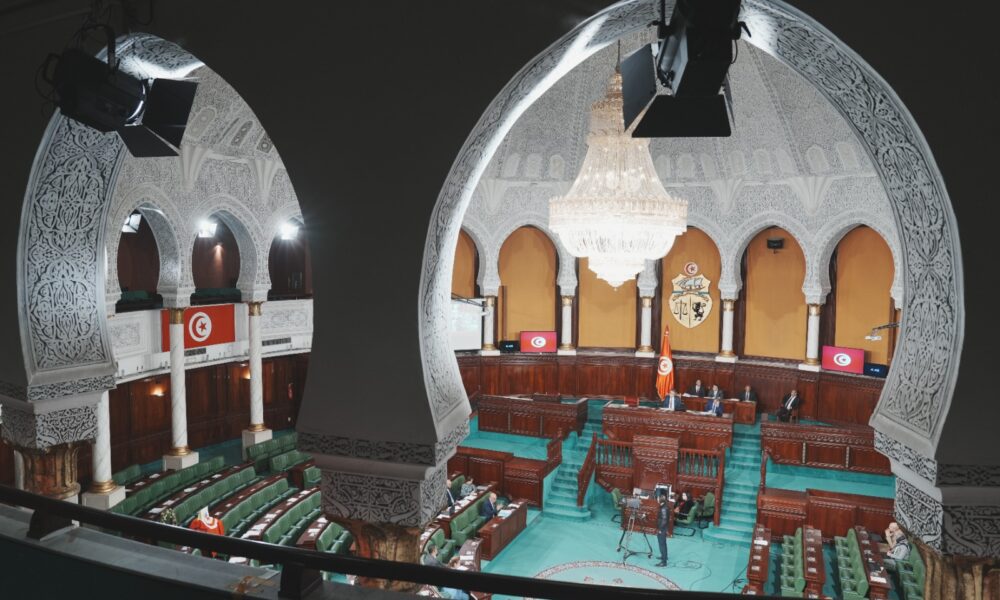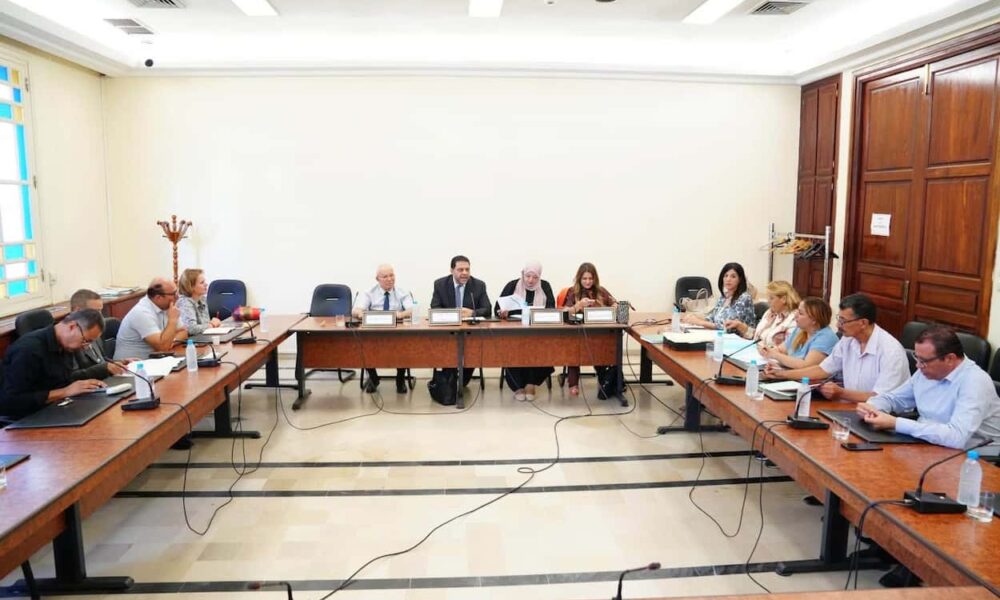
The Commission for External Relations, International Cooperation, Tunisians Abroad and Migration held, this Monday, a joint session with the Investment and International Cooperation Commission of the National Council of Regions and Districts. This meeting was devoted to hearing representatives of the Presidency regarding the mission of the presidency within the framework of the State budget project for the year 2027.
At the opening of the session, the chair of the Commission for External Relations, Riadh Jaidane, stressed the particular importance of the Presidency’s mission, given the nature of its constitutional and sovereign prerogatives, as well as the human, financial and logistical resources necessary to carry them out.
He specified that the budget examination is not limited to comparing figures or monitoring the evolution of allocated credits, but essentially aims to understand the modalities of using public funds and to assess their alignment with the programs, objectives and expected results. He also indicated that this meeting provides an opportunity to establish a constructive and transparent dialogue, allowing deputies to become aware of the presidency’s priorities, achievements and challenges.
For its part, the representative of the Presidency of the Republic presented the 2027 budget project, reviewing the three programs comprising this mission: the National Security and External Relations Program, the Presidential Security and Protection of Official Personalities Program, and the Direction and Support Program.
He also outlined the distribution of budgetary credits by program and presented a comparison between the presidency’s budget proposals for 2026 and 2027, notably concerning remuneration, operating, intervention and investment expenditures.
During the exchanges, deputies raised several questions and made various observations. They notably insisted on the need to establish direct communication channels between the representatives of the two parliamentary chambers and the Presidency. In this framework, they proposed the creation of a position of head of relations with the two chambers within the Presidency, while calling for more constructive interaction of the executive power’s representatives with the parliamentarians.
The discussions also addressed the issue of stalled projects and the lack of responsiveness of certain representatives of the executive power to deputies’ solicitations, whereas a more sustained dialogue could contribute to finding concrete solutions.
The parliamentarians also stressed the urgency of filling vacant posts at several diplomatic representations, to enable them to fully carry out their missions, both economically, through attracting investments, and socially, in supporting Tunisians living abroad.
On the budget front, the deputies requested clarification regarding the evolution of remuneration expenditures, particularly with regard to staffing, recruitment, promotions and the allocation of human resources among the different programs.
They also noted the rise in investment and intervention expenditures, asking for details on the projects involved, their completion deadlines, their progress rate and the concrete results expected. Operating expenses were also discussed, with questions about measures taken to rationalize spending and improve management.
The parliamentarians subsequently turned to the activities of the Tunisian Institute of Strategic Studies, questioning the studies carried out in recent years, their use in the formulation of public policies and the institute’s work program for the coming years.
They also pointed to the slowness in publishing regulatory texts, calling for accelerating their adoption to enable the effective application of laws, the realization of their provisions on the ground and to meet citizens’ expectations.
Regarding the matter of Tunisians living abroad, the deputies asked for clarifications on the national strategy aimed at making this community a genuine development partner, notably through knowledge and technology transfer as well as contributions to Tunisia’s international prominence.
They also questioned the added value that could be brought by creating a National Council of Tunisians Abroad, as a mechanism to organize relations between the different components of the State and the Tunisian community settled abroad.
In this context, several deputies proposed attaching the National Council of Tunisians Living Abroad to the Presidency, believing that such attachment could allow it to play a greater role in strengthening ties with diaspora members and improving communication with them.