At first glance, China would appear to be one of the big losers in a crisis in the Strait of Hormuz. The reasoning seems logical: Beijing is the world’s leading oil importer, Asia depends heavily on Gulf hydrocarbons, and any disruption of this passage immediately pushes energy prices higher.
The reality is more complex. China is heavily exposed to Hormuz, but not defenseless. It has built up colossal stocks, diversified part of its supplies and strengthened its positions in technologies capable of reducing the world’s dependence on oil. It is this paradox that makes Beijing a vulnerable actor to the shock, but able to reap a strategic advantage. Since the fragile ceasefire and the gradual reopening of the strait, China has already begun to redirect its purchases toward more stable Gulf suppliers — the United Arab Emirates, Saudi Arabia, Oman.
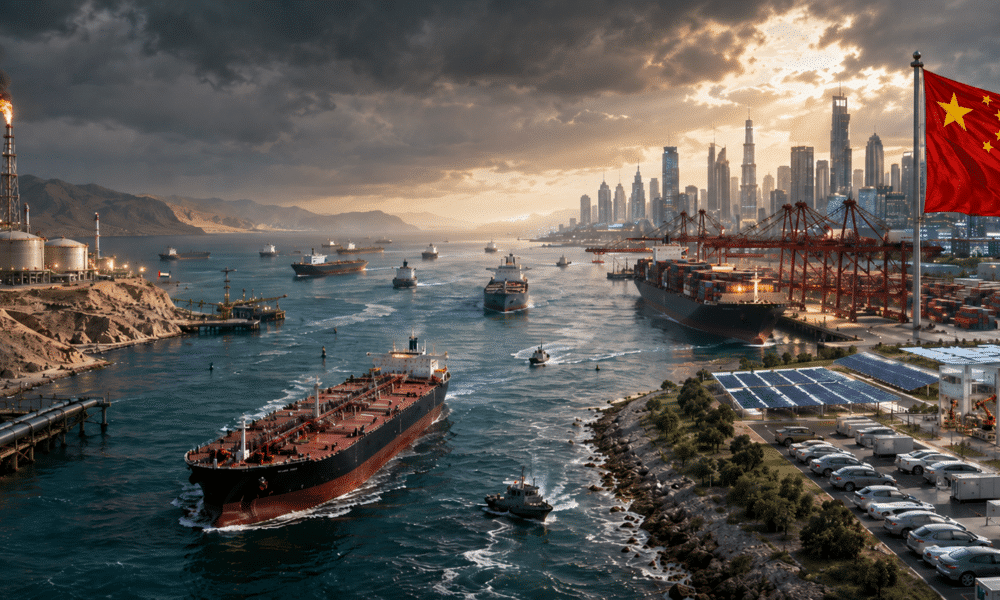
The Strait of Hormuz remains one of the planet’s major energy chokepoints. About 20 million barrels per day of oil and petroleum products passed through it in 2024, representing nearly 20% of global consumption of oil liquids.
In 2025, nearly 80% of this oil was destined for Asia, and a substantial share of the world’s LNG also traversed this corridor.
China is thus directly concerned: between 45% and 50% of its crude imports transit via Hormuz, and a durable interruption would be a serious shock to its economy. But Beijing has amortizers that few countries possess.
Hormuz weakens China in immediate energy terms, while strengthening several of its power levers.
Beijing has prepared for the shock better than its Asian neighbors
The Hormuz crisis hits Asia first. Japan, South Korea, India, China, Taiwan, and Southeast Asia rely heavily on flows from the Gulf. The difference is that Beijing has built much thicker safety cushions.
First, stocks. As the world’s top importer with a record 11.6 million barrels per day in 2025, China has massively built reserves: about 430,000 barrels per day set aside last year, accounting for most of the rise in its imports. As a result, its strategic reserve stood at around 1.2 billion barrels by early 2026, the equivalent of nearly 109 days of coverage of its maritime imports — a cushion, in an ironic twist of history, built up at low prices on the very barrels that Western sanctions sought to block.
Next, discounted crude. China would have imported at least 2.6 million barrels per day of sanctioned oil in 2025, more than 22% of its purchases: about 1.38 million from Iran, 389,000 from Venezuela and at least 800,000 from Russia in the context of only sanctions-barrels — Russia remaining, by the way, its top supplier overall, with nearly 2 million barrels per day. These flows pass through a “ghost fleet” and vessel-to-vessel transfers: Iranian and Venezuelan barrels are renamed upon arrival. The absurd proof? China imports more “Malaysian” crude (1.3 million barrels per day in 2025) than Malaysia itself produces (535,000 barrels per day).
This strategy does not eliminate the risk, but it reduces Beijing’s vulnerability — and makes it profitable. As the market tightens, the discount widens: at the height of 2025, China saved up to $28.8 million per day on its sanctioned imports, Iranian crude trading at as much as $8 to $10 below Brent by year-end.
In a global energy crisis, Beijing is not just buying oil: it is buying time, discounts, and influence.
A crisis that accelerates the move away from oil
The second reason why China can come out ahead lies in the energy transition. Every oil crisis reminds consuming countries that excessive dependence on imported hydrocarbons is a strategic weakness. This was the case in 1973; it remains the case with Hormuz.
When oil becomes more expensive, riskier, and more uncertain, governments accelerate alternatives: electric vehicles, batteries, solar, storage, energy efficiency. And in these sectors, China holds a considerable lead.
Sales of electric cars in China jumped by nearly 40% in 2024. The country accounted for half of global sales in 2021; that share rose to nearly two-thirds in 2024. Better: since July 2024, monthly sales of electric cars there have surpassed those of combustion models, bringing their share close to 50% for the year.
In other words, every oil crisis strengthens the strategic value of the technologies that China already produces at scale.
Batteries, solar, electric vehicles: China’s real advantage
China does not win simply because it buys its oil differently. It wins mainly because it sells the tools of the post-oil world. When oil markets are unsettled, its electric vehicles, its batteries, its solar panels, and its grid technologies become more attractive. For importing countries, the question is no longer just ecological; it becomes security: how to reduce exposure to chokepoints, to regional wars, to sanctions and to price spikes?
In batteries, the lead is crushing. LFP batteries, driven by Chinese industry, accounted for more than 55% of electric vehicle batteries deployed worldwide in 2025, versus nearly 50% in 2024 — and their production of cathode materials remains almost entirely concentrated in China. The country also accounts for nearly 75% of global electric vehicle manufacturing.
The Hormuz crisis thus accelerates a trend favorable to Beijing: global demand shifts from barrels to batteries, from refineries to electric-vehicle plants, from tankers to solar panels and smart grids.
China also benefits from the diplomatic narrative
The Hormuz crisis is not only energetic: it is also diplomatic. Beijing can use it to bolster its message to the Global South: the oil order dominated by the United States and its allies would be unstable, militarized, and dangerous; China, by contrast, presents itself as a commercial, infrastructural, and diplomatic partner, able to speak to Iran as well as to the Gulf monarchies.
This narrative does not erase China’s dependence on Hormuz — Beijing knows a durable closure would be dangerous for its economy. But China does not need to be spared to profit from the crisis. It suffices for it to appear less responsible for the disorder than Washington, less militarily involved, and more useful as a buyer, investor, and technology supplier.
It is an important narrative advantage: in a fragmented world, the one that seems to offer stability, financing, and opportunities gains influence without firing a shot.
A crisis that serves the new Silk Roads
Hormuz also pushes Gulf countries to invest in alternative routes: pipelines, ports outside the Strait, land corridors, the Red Sea, and Central Asia. This trend aligns with China’s interests, which for years has financed ports, railways, and energy infrastructures across its Belt and Road Initiative.
The more countries seek to reduce their dependence on maritime chokepoints, the more they require financing, engineering, and large-scale projects — precisely what Beijing knows how to supply with its state-owned enterprises, its banks, and its industrial expertise.
Again, Hormuz does not create the Chinese advantage: it accelerates it.
A real advantage, without being a cost-free victory
Saying that China comes out ahead from Hormuz does not mean it leaves unscathed. A durable surge in prices would weigh on its industry, transport, and consumers, and dependence on imported oil remains massive. The crisis showed this clearly: when non-Iranian Gulf deliveries dried up, Beijing had to ban its fuel exports and raise pump prices to cushion the domestic shock.
More subtly, a portion of China’s “gain” actually rebounds against Beijing. The crisis validates the argument Moscow has been hammering for years: the shipping routes to China can be cut at any moment by the United States, and only the overland Russian pipelines would be reliable. As a result, the Power of Siberia 2 gas pipeline project, politically approved in September 2025, could be accelerated — strengthening Russia’s dependence on, and thus its leverage over, China.
Beijing wants influence, contracts, ports and energy; it wants far less the role of Gulf gendarme, which Washington could persuade it to shoulder if the strait became durably unstable.
The Chinese paradox
China does not come out ahead of Hormuz because it would be insulated. It comes out ahead because it is better prepared than others to absorb the shock, better placed to buy hydrocarbons at discounted prices, better positioned in post-oil exit technologies, and more adept at turning the crisis into a diplomatic argument.
Hormuz remains a vulnerability for China: it reveals Beijing’s dependence on Gulf oil and reminds that its economy has not left the age of hydrocarbons. But this same crisis reinforces the world that China is already shaping: electric vehicles, batteries, solar, logistics corridors, alternative energy deals, and influence in the Global South.
The paradox sits there: the Hormuz Strait exposes China, while accelerating global demand for the industrial solutions it already dominates. In this crisis, Beijing can lose a few barrels — and gain much more: markets, influence, and strategic time.