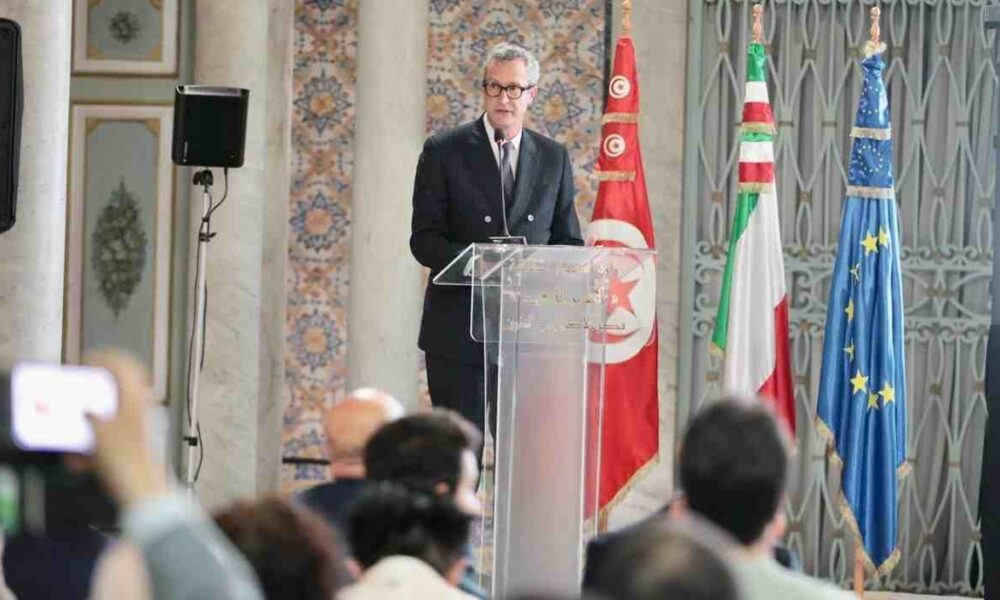
The Tunisian-Italian Days dedicated to the conservation and valorization of archaeological heritage concluded today, marking an important step in strengthening cooperation between Tunisia and Italy in this strategic field.
Organized in collaboration with several institutions, including the National Heritage Institute, the Italian Trade Agency, the Italian Institute of Culture in Tunis, the Italian Agency for Development Cooperation (AICS), Assorestauro, OICE and Conect, this event brought together public, academic and economic actors around a common objective: better preserve and valorize Tunisian heritage.
A strengthened historic cooperation
The days were inaugurated by the Director General of the National Heritage Institute, Tarek Baccouche, and the Italian ambassador in Tunisia, Alessandro Prunas. They were closed by Alfonsina Russo, head of the Department for the Valorization of Cultural Heritage at the Italian Ministry of Culture.
At the heart of the exchanges: the numerous joint projects and missions that make Italy the leading archaeological partner of Tunisia. This long-standing cooperation covers both research, restoration and the valorization of historic sites.
Culture and economy now linked
For the first time, these meetings have gone beyond the academic and cultural framework to include an affirmed economic dimension.
Alongside scientific presentations, an entrepreneurial forum and B2B meetings were organized between Tunisian and Italian companies specializing in the restoration and valorization of heritage.
This approach marks an evolution: heritage is no longer seen solely as a legacy to preserve, but also as an economic lever, capable of generating activity, investments and employment.
Heritage to be valorized internationally
This initiative is part of a broader vision carried by the Mattei Plan, which aims to strengthen partnerships between Italy and African countries, including Tunisia.
The objective is clear: to give Tunisian heritage greater international visibility, recognized for its richness and diversity, while developing structuring projects combining culture, research and economy.
In a context where cultural tourism and creative industries are gaining increasing importance, this integrated approach could help reposition Tunisia as a major destination on the international stage.