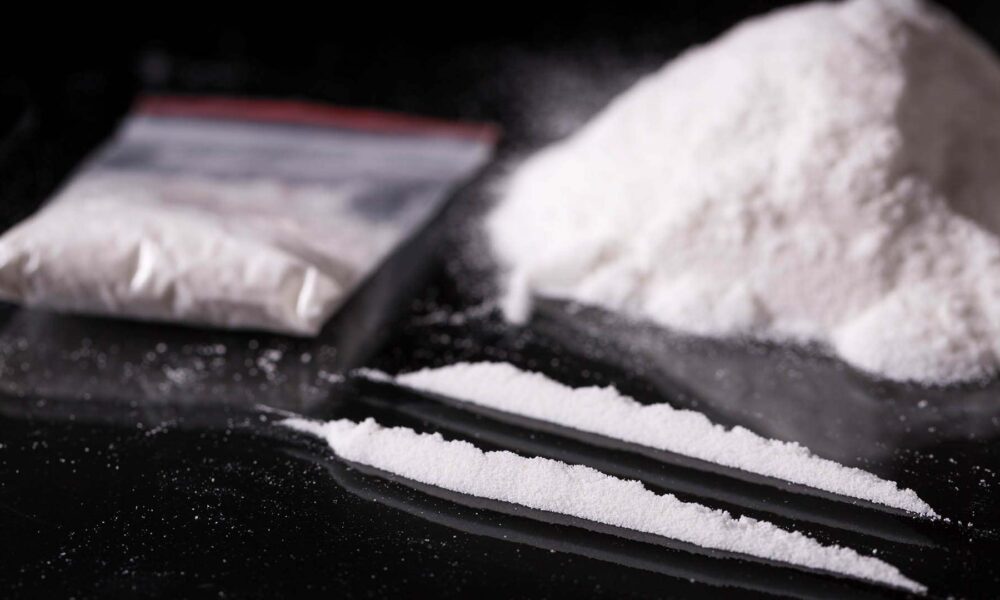
For several years, Tunisia has been experiencing a steady rise in the quantities of cocaine seized during operations conducted by security services and customs as part of the fight against drug trafficking.
At the same time, several international reports indicate an increasing use of North Africa as a transit corridor for drugs destined for Europe, which constitutes the world’s second-largest cocaine market after North America.
Official seizure statistics as well as statements by customs officials and the Ministry of the Interior confirm this upward trend.
In October alone, the Tunisian Customs announced that it had seized more than 101 kilograms of cocaine during the first nine months of 2026, compared with 94 kilograms for all of 2025 and 33 kilograms in 2024.
Similarly, Mohamed Ali Chaïbi, head of the anti-drug service at the El Gorjani Judicial Police Directorate, indicated that the quantities of cocaine seized had multiplied by nearly “a thousand” over a ten-year period, rising from about 150 grams in 2013 to more than 140 kilograms in 2023.
The official attributed this increase in particular to cross-border trafficking from Libya, with whom Tunisia shares a border of about 460 kilometers. “Large quantities” of narcotics, including cocaine, would transit through this border, according to statements he had previously given to National Television.
However, Libya is not the only route for cocaine to Tunisia. A United Nations report also highlighted the existence of an “inverse flow” from European ports, notably Marseille and Genoa, toward Tunisian ports such as La Goulette and Radès.
The shipments would be concealed inside passenger vehicles or commercial trucks carried aboard ships providing the maritime links for passengers and vehicles.
The report attributes this phenomenon to “gaps in border-control arrangements” at European ports, especially for shipments destined for the southern Mediterranean. This situation would also be explained by the persistent perception by European authorities of North Africa as a “transit zone and an export platform for cocaine and other drugs, rather than a final destination”.
Part of this cocaine transported by reverse flows would be destined for the Tunisian domestic market, while another portion would be redistributed to neighboring countries.
Moreover, several sources estimate that the relatively high prices of cocaine in Tunisia, compared with the European market characterized by an “abundance of supply”, constitute an attractor for criminal networks.
According to Mohamed Ali Chaïbi, the price per kilogram of cocaine in Tunisia would reach 300,000 dinars. In Europe, it would range between 25,000 euros (about 84,000 dinars) and 43,000 euros (nearly 144,000 dinars), according to the 2026 European Drugs Report published by the European Union Drugs Agency (EUDA).
Legislatively, Mohamed Ali Chaïbi had also indicated, during a previous intervention, that the Ministry of the Interior was working on revising Law No. 52 of May 18, 1992, relating to narcotics. He had notably argued in favor of adopting new mechanisms enabling the dismantling of trafficking networks.
In the same vein, Yasser Gourari, rapporteur of the General Legislation Commission at the Assembly of the People’s Representatives (ARP), had said on National Radio that the commission was moving toward revising Law No. 52 of May 18, 1992 relating to narcotics.
For his part, Oussama Nourredine El Basti, professor of private law and criminal sciences and member of the national bureau of the Tunisian Organization of Education and Family, called for replacing the current legislative framework with a new law founded on a proactive, preventive, and therapeutic approach, rather than on a purely repressive logic.