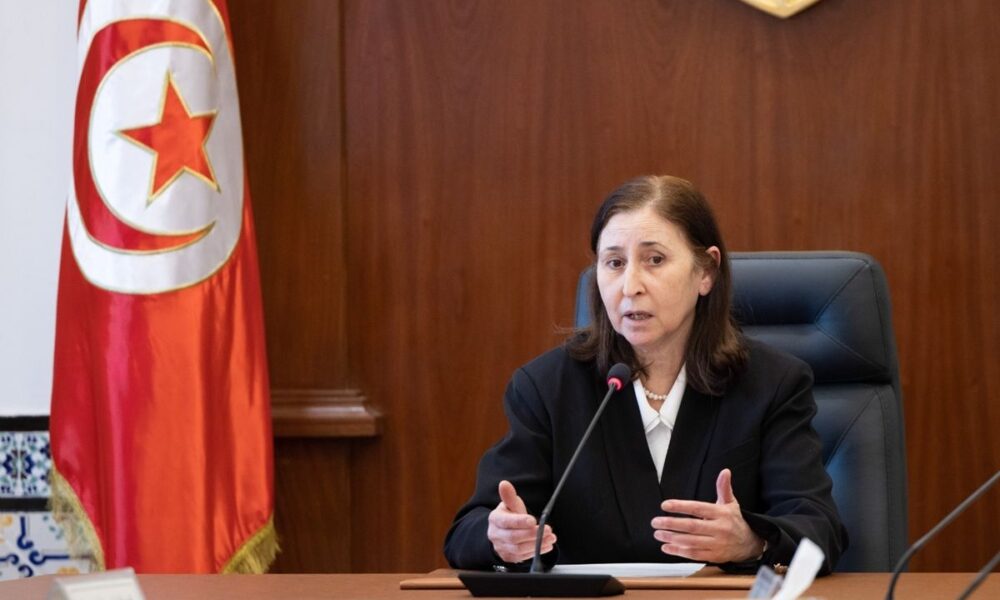
The Head of Government, Sarra Zaafrani Zenzri, on Tuesday delivered, at the Kenyatta International Conference Centre in Nairobi, the Tunisian address during the plenary session devoted to peace and security, on the occasion of the opening of the Africa-France summit “Africa Forward.”
At the outset of her remarks, the Head of Government conveyed the greetings of the Tunisian President, Kaïs Saïed, to the President of the Republic of Kenya, William Ruto, as well as to the President of the French Republic, Emmanuel Macron, and her heartfelt wishes for success for this summit, according to a communiqué from the Presidency of the Government.
She affirmed that this summit is taking place in a global context of great precision and complexity, marked by the interweaving of crises, an unprecedented escalation of armed conflicts, the worsening of humanitarian crises and the rise of instability and uncertainty, against a backdrop of rapid and unprecedented geopolitical upheavals, profound transformations in international power relations, and the emergence of protectionist trends that threaten the foundations of international cooperation.
She added that the gravest element of this context lies in the erosion of trust in the international order, due to increasing selectivity and double standards in the application of international law, as well as the silence of the international community in the face of flagrant violations of this law. “While the suffering of peoples worsens because of grave violations of international humanitarian law, the international community remains unable to take firm positions to end these tragedies, which threatens the foundations of international legitimacy and undermines its credibility,” she stated.
The Head of Government emphasized that Tunisia remains committed to respecting international law and believes that peace cannot be built on imbalanced power relations, nor on selective application of international law provisions, but on the principles of justice and equity, the respect for state sovereignty and the independence of their decisions, as well as the guarantee of the rights of peoples, with the right to self-determination at the forefront.
In this perspective, she reaffirmed Tunisia’s attachment to the central role of the United Nations, to the principles and foundations on which it was created, and to the principles of the UN Charter; this organization remains the refuge of international legitimacy and of peaceful coexistence among peoples. She also underscored that reform of the multilateral system has become an urgent necessity, driven by the scale of the profound changes the world is undergoing.
The Head of Government also reiterated Tunisia’s call to accelerate reform of the United Nations Security Council, so that it reflects the current changes in the international order, as well as to restructure the global financial system to make it more just, more equitable and more inclusive, in order to meet the needs of developing countries and to close the development financing gap. She insisted, in this regard, on respecting international commitments, notably those from the Fourth United Nations Conference on Financing for Development held in Seville in July 2025, as well as the Tripartite Conference of Parties held in Belem in November 2025. She also called for strengthening mechanisms of international collective action to face emerging crises, as well as debt relief, cancellation or rescheduling for poor countries, given the excessive rise in debt service, as the President of the Republic Kaïs Saïed had urged during his participation in the Summit on Financing Africa’s Economies, held in Paris in May 2021.
The Head of Government stated that it is not possible to discuss development financing without addressing the restitution of looted assets, which constitutes a sovereign right of peoples to which there can be no renunciation. She called for the establishment of an effective and binding international framework to accelerate the recovery of these funds, considering that they are not merely numbers on bank accounts, but a guarantee for the future of generations and for their national resources. She stressed that all these interdependent questions cannot be separated from the achievement of peace, security and stability.
She reaffirmed Tunisia’s commitment to the principle of “African solutions to African challenges,” provided that this is accompanied by real and lasting international support, notably for peace-support operations led by the African Union, to ensure their effectiveness and continuity. In this context, she added that the challenges Africa faces cannot be reduced to their military or security dimension alone, nor treated independently of their root causes, linked to marginalization, poverty and fragility, which generate economic and social crises as well as phenomena of violence, extremism, terrorism and human trafficking.
She stressed that, in this regard, the achievement of international peace and security is closely linked to adopting a new global, integrated and multidimensional approach, founded on the development of innovative solutions that go beyond traditional methods and address the causes of these difficult and abnormal situations experienced by African countries, despite their significant wealth and natural resources. These solutions must reinforce the foundations of stability and place investment in the human being at the heart of development and security processes.
The Head of Government considered that the challenges the world faces today transcend national borders by their nature, which makes international partnerships a strategic necessity rather than a tactical choice. She insisted that these partnerships must rest on new foundations capable of responding to ongoing changes and to the aspirations of Africa’s peoples for growth accompanied by an improvement in living standards.
She called for moving from traditional models of cooperation to genuine balanced partnerships, based on equality, mutual respect, trust, accountability and shared interests, in line with global transformations. She added that it is no longer acceptable for Africa to remain today merely a space of interventions or a battlefield of rivalries; it must be a full partner in defining mutual interests and in decision-making, through the enhancement of its own capacities and the respect for the independence of its development choices. These are the principles Tunisia articulated at the European summit held in Luanda on 24 and 25 November 2025.
The Head of Government stated that Tunisia, proud of its African, Arab and Mediterranean belonging, believes in its active role to ensure a bridge between African countries, European countries and the rest of the world. She also stressed that national development remains linked to deeper international solidarity, meeting the demands of just and balanced progress.
In this framework, she emphasized that Tunisia continues to build long-term partnerships at the heart of the African continent, based on joint investment and the transfer of expertise in several sectors, notably construction and public works, as well as the export of high value-added services in health, education and information technologies. She noted that Tunisia possesses, in these areas, qualified competencies capable of competing on a global scale and creating added value, while having accumulated significant experience.
In this context, the Head of Government expressed Tunisia’s wish for dense and constructive participation in the Investment Forum in Tunisia, which will be held on 25 and 26 June 2026. She highlighted that Tunisia is a top investment destination at the African and international levels, offering an attractive climate for both local and foreign investors. Large projects in vital sectors will be presented, notably renewable energy, digital technologies, mechanical and electrical industries, as well as construction and public works. She expressed hope that fruitful partnerships would emerge on this occasion.
The Head of Government stated that the world today stands at a true crossroads: either it continues the logic of selectivity, hegemony and indifference to international law, which will inevitably lead to chaos and collapse, or it undertakes a serious reform process, leading to a new international order that is more just, more equitable and more balanced, in line with a new and innovative approach that respects the sovereignty of states, their choices and the will of their peoples.
She indicated that this is the choice that Tunisia defends, in line with the directions of the President of the Republic, Kaïs Saïed, and that she regards as a fundamental condition for guaranteeing international peace and security. The current international situation, she added, calls for changing the methodology of collective action, moving from mere announcements of recommendations to the implementation of decisions requiring deep and bold reforms of the partnership model between the Global South and North, as well as reforming development finance, in order to consolidate the bases of stability, peace and security in Africa and across the world. She recalled that security and development are two inseparable elements and that global stability cannot be achieved while there remains a mismatch in justice and equity, and while peoples are deprived of the most basic conditions of a dignified life.
In conclusion, the Head of Government expressed the hope that the proceedings of this summit will yield tangible results that meet the aspirations of the peoples of the African continent for progress, prosperity and the construction of a better future.