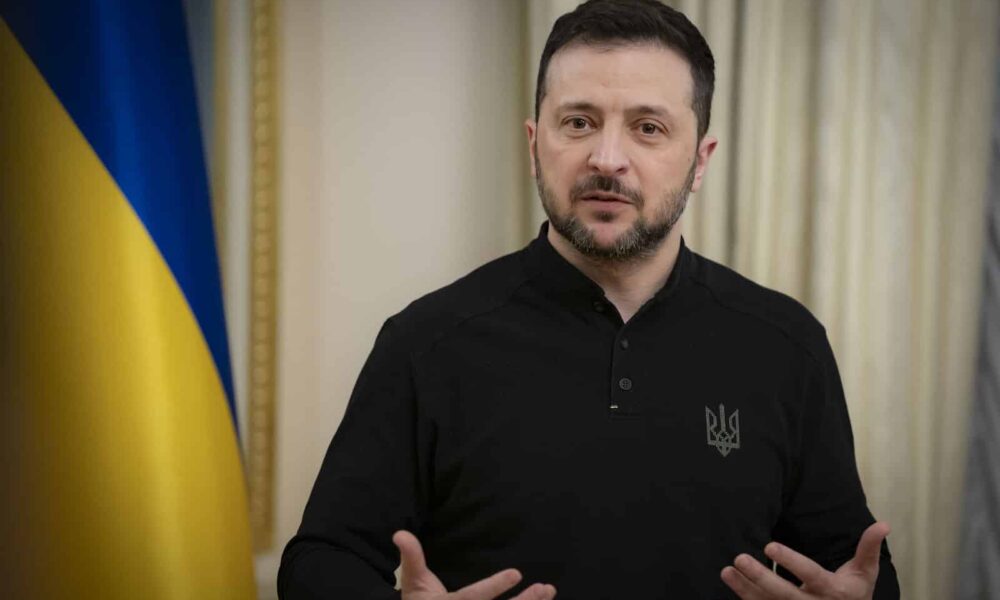
Volodymyr Zelensky asserts, on Sunday, October 18, 2026, that Russia conducted 76 attacks against Ukraine’s energy sector and its oil and gas sector within a single week. This tally rekindles the question of the scope of the ceasefire announced by Donald Trump.
Substations Hit in Four Regions
In his official release, the Ukrainian president cites nocturnal strikes against substations in the Vinnytsia, Zhytomyr, Khmelnytskyi and Odesa regions. He reports tens of thousands of households without electricity and ongoing repairs.
This tally comes from the Ukrainian presidency. The announced attacks should not be confused with a count of power plants destroyed or missiles fired. The statement does not provide a detailed inventory allowing separate verification of each incident.
Why a Substation Is Essential to the Grid
Produce, Transmit, Distribute: Three Distinct Stages
A power plant generates electricity. High-voltage lines carry it over long distances. Substations, also called electrical substations, connect different levels of the grid: their transformers raise or lower the voltage to enable this transport, and then feed neighborhoods and businesses.
The U.S. Energy Information Administration (EIA) explains that the continuity of power supply depends on the whole chain. A functioning generation facility alone is not enough if electricity cannot be routed to consumers.
Thus, the scale of a blackout depends on the equipment affected and the possibilities of rerouting electricity. The number of strikes does not, on its own, allow calculating the amount of power lost or the duration of outages. For residents, the decisive indicators are the actual restoration of service and its stability, beyond the count of sites repaired.
An Energy Ceasefire May Allow Other Battles to Continue
Neither Kyiv nor Moscow had confirmed the agreement announced by Donald Trump.
In principle, a ceasefire can be general or limited to a sector. The United Nations Department of Political and Peacebuilding Affairs distinguishes partial, local, or temporary arrangements. Its guide describes sectoral ceasefires protecting certain infrastructures, such as water or electricity, without necessarily stopping all military operations.
An operational framework requires defining prohibited acts, the installations involved, its duration and the verification modalities. Rules for reporting and reviewing incidents then allow distinguishing accusations from established violations. The precision of these commitments matters as much as the political announcement that accompanies them.
The existence of a declaration, its acceptance by the warring parties, and its implementation on the ground thus constitute three separate questions. A suspension limited to energy infrastructures would not, by itself, resolve the fate of occupied territories, security guarantees, or the other dimensions of a peace settlement.
In Poland, Precautions and Flights Suspended
Poland announced on Sunday preventive air operations to protect its airspace in response to Russian strikes on Ukraine. Its air navigation agency also signaled the suspension of flights to Lublin and Rzeszów, in order to enable action by military aviation.
These measures do not by themselves constitute the announcement of an attack on Poland or on these airports. A preventive suspension of flights should be distinguished from an airfield being damaged.
Sanctions: Exemptions, Without a General Rollback
The diplomatic context has also shifted with the American decree of October 16. Donald Trump grants exemptions to several sanctions, restrictions and duties provided for by the Graham Act, enacted on September 18. The text cites the United States’ national interest and indicates that the required certification has been transmitted to Congress.
Granting an exemption does not mean repealing the law. It waives the application of the provisions in question, within the framework set by the decision. The decree expressly preserves certain prior sanctions: it would therefore be inaccurate to speak of a disappearance of all American restrictions against Russia.
On October 17, Marco Rubio explained that the president would use up to 60 days to examine the economic consequences of the sanctions and tariffs. The Secretary of State also defended the separate agreement concerning Russian diesel.
This review period is not an expiration date written into the decree. Its Section 4 provides that the exemptions remain in force until a new decision by the competent authorities. An automatic restoration of sanctions at the end of these 60 days is therefore not announced by the text.
The Easing Will Be Measured by Commitments and Their Effects
The relaxation of trade restrictions and the halt of strikes are separate decisions. To assess de-escalation, one will need to monitor the commitments actually accepted, documented incidents, and the continuity of electricity supply. Establishing credible controls would allow confronting diplomatic announcements with observable facts.
For the economic aspect, read our dossier on Russian diesel and the American sanctions.