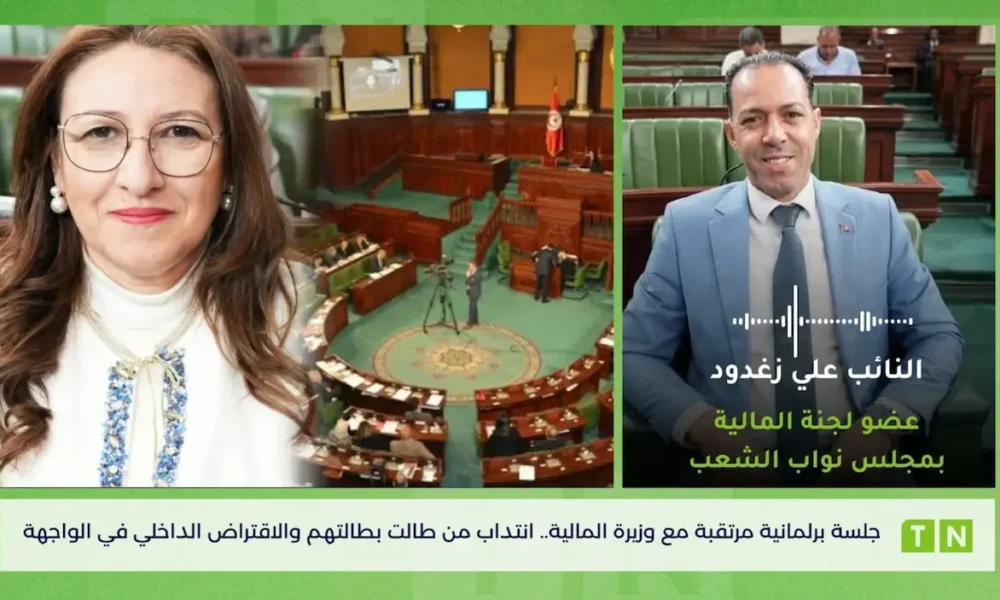
The Finance and Budget Commission of the Assembly of the Representatives of the People (ARP) will hear the Minister of Economy and Planning on Wednesday, October 28, 2026, regarding the economic budget. The Minister of Finance will be heard on Thursday, October 29 on the implementation of the 2026 Finance Law and the 2027 budget project, said Deputy Ali Zaghdoud to “Tunisia Digital.”
The member of the commission described the latter hearing as “heated.” The deputies are expected to question the minister, in particular about the provisions of the 2026 Finance Law that have not been implemented and about the consequences of resorting to domestic borrowing.
The price of oil and the assumptions of the 2026 budget
According to Ali Zaghdoud, the 2026 budget was drafted on the basis of an oil price of $63 per barrel, while it has reached $109 during the current period. The deputies will ask the minister for clarification on the execution of the budget in light of this gap and its effects on the state’s financial balances, before addressing the 2027 budget bill.
Unimplemented provisions and Chapter 57
The deputies should also seek explanations about the provisions of the 2026 Finance Law that have not yet been implemented and about the regulatory texts necessary for their application.
Chapter 57, concerning the recruitment of an initial tranche of unemployed people who have been out of work for a long time under Law No. 18 of 2025, will be particularly discussed. Ali Zaghdoud described this matter as one of the main social issues.
Discussions on the 2027 budget proposal
The ARP Finance and Budget Committee and the Finance and Budget Committee of the National Council of Regions and Districts held a joint session on Thursday, October 22 dedicated to the 2027 Finance Bill. A preparatory meeting of the parliamentary committee had taken place the day before, on Wednesday, to define the working method for the next steps.
The general discussion was opened to deputies from both legislative institutions. The discussions notably focused on the possibility of amending certain articles and adding new ones with an economic and social character.
The 70 articles of the draft to be clarified
In its first reading, Ali Zaghdoud noted that the 70 articles of the 2027 Finance Bill carried an economic and social orientation compared to the 2026 budget. The text specifically addresses the role of the State, social issues, energy, the shadow economy, and support for agriculture, notably through support for livestock.
The deputy nonetheless believes that these orientations remain general and require more precise details. The lawmakers intend to support the proposed provisions and present concrete measures in favor of investment, the economic climate, the social situation, and, in particular, employment.
The effects of resorting to domestic borrowing
Ali Zaghdoud believes that the State could continue, for the fourth consecutive year, to rely on domestic borrowing to finance the budget, notably with the Central Bank, and to borrow an amount higher than the previous year. He associates this approach with the difficulty of accessing external borrowing.
The deputy recalled having already warned against this strategy, which, in his view, could exacerbate inflationary pressures and weigh more on purchasing power.
The commission plans to question the Minister of Economy and Planning as well as the Minister of Finance on the effects of the increase in domestic borrowing on inflation, the purchasing power of Tunisians, and the country’s economic and financial situation.