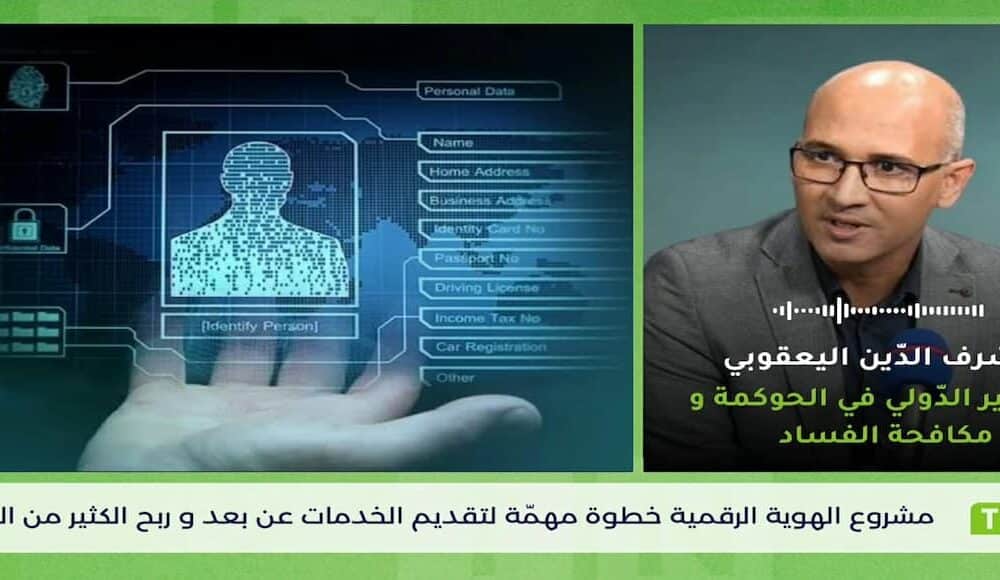
The international expert in governance and anti-corruption, Charfeddine Yaakoubi, stated, on Tuesday, June 23, 2026, in a statement to Tunisie Numérique, that digital identity constitutes the basis of any transition toward more efficient electronic services.
According to him, it is impossible to implement high-performing digital administrative services in the absence of a digital identity widely adopted by citizens, businesses and institutions.
He explained that digital identity enables access to several electronic services and simplifies administrative procedures. However, this dynamic requires effective participation in the digital identity project.
Limited uptake despite awareness campaigns
Charfeddine Yaakoubi recalled that a campaign had been organized two years ago, or even more, to raise citizens’ awareness of the importance of joining the digital identity.
However, the number of registrations was not significant, which, in his view, affected the nature and quality of the services offered.
The expert believes that before developing electronic services, one must first consider their content, usefulness, and their ability to encourage citizens and businesses to use the digital identity.
He also stressed the need to accompany users and explain to them the steps to follow to register for the project and access online administrative services.
Services still too limited
For Charfeddine Yaakoubi, if electronic services are established and made mandatory, this would naturally push citizens and businesses to adopt the digital identity.
But, up to now, the available services remain limited, which does not foster widespread adoption.
He estimated that the coexistence between electronic services and services provided directly at the counter weakens the use of digital means. According to him, when the same service is available both online and in person, a large portion of citizens will continue to prefer direct contact with the administration.
The National Register of Enterprises as an important step
The expert welcomed the decision related to the National Register of Enterprises, which requires companies to adopt the digital identity starting from July 2026.
This measure will make all transactions accessible online, thereby obliging companies, institutions, and, progressively, citizens to enroll in this digital logic.
For Charfeddine Yaakoubi, this step is important because it will help increase the number of enrollments in the digital identity, improve the quality of services, and encourage the use of remote administrative services.
Breaking with the preference for direct contact
The international expert in governance and anti-corruption also highlighted that the Tunisian mindset, as well as the traditional functioning of the administration, remains strongly attached to direct contact.
According to him, many people will continue to move toward the administrative counters for psychological reasons associated with trust in direct exchange.
He therefore believes that it is necessary to reduce, or even gradually close, this pathway of direct contact between the citizen and the administration in order to guarantee the success of the digital identity project.
Reducing corruption and administrative costs
Charfeddine Yaakoubi highlighted several benefits associated with the generalization of remote administrative services.
The first benefit concerns the reduction of the direct relationship between the administration and the citizen, which, in his view, is one of the causes of overruns, corruption, both active and passive, as well as the excessive use of discretionary power.
He also stressed that online services help reduce wasted time, limit travel, and lower the cost of obtaining administrative documents, for both individuals and the State.
According to him, the generalization of digital identity therefore represents a crucial step to modernize the administration, strengthen transparency, and improve the quality of public services in Tunisia.