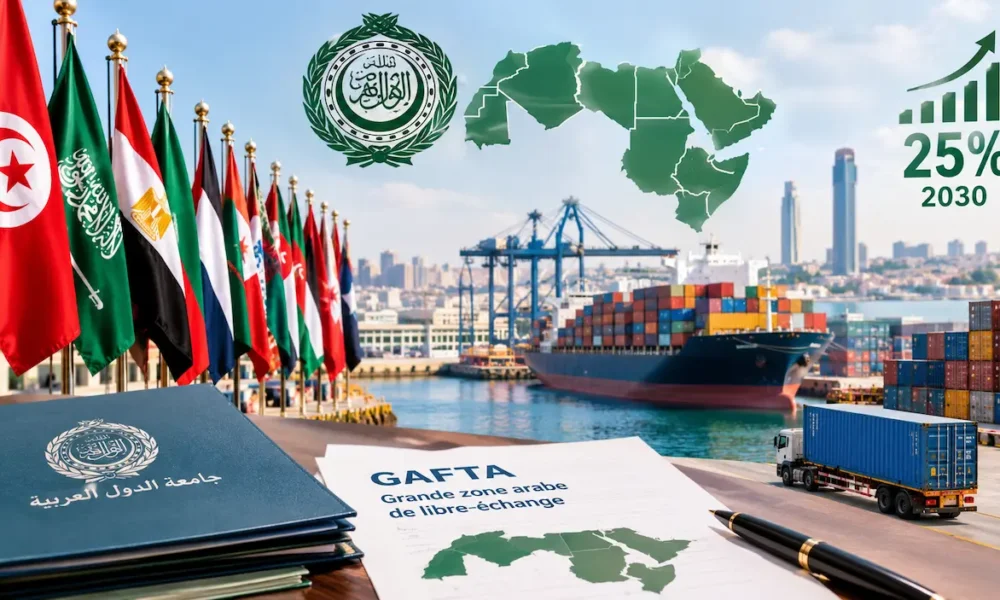
The Arab League aims to raise the share of intra-Arab trade to 25 % of the total external trade of Arab countries by 2030, compared with about 14 % in recent years, said on Tuesday in Tunis Ahmed Nizar Jamil, Director of the Arab Economic Integration Department at the League’s General Secretariat.
Strengthening private sector integration
Speaking at a national workshop devoted to the promotion of the advantages granted within the framework of the Greater Arab Free Trade Area (GAFTA), Ahmed Nizar Jamil stressed that the General Secretariat has, for several years, attached particular importance to the integration of the private sector into the area.
According to him, the private sector constitutes a key engine of the economy, of production, and of trade exchanges among Arab countries.
The main objective of the workshop held in Tunis is to bring together Tunisian private-sector representatives in order to present to them the anticipated benefits within the framework of the Greater Arab Free Trade Area and the mechanisms for taking advantage of them. This approach aims in particular to strengthen Tunisia’s trade with Arab markets and to improve the level of bilateral exchanges.
A specific framework for the private sector
Ahmed Nizar Jamil also indicated that the General Secretariat of the League of Arab States is currently working on a project to establish a specific framework for the integration of the private sector into the mechanisms governing the Greater Arab Free Trade Area.
The project has been submitted to member states so that they can formulate their observations and proposals.
Tariff advantages for Tunisian exporters
For his part, Jamal Al Ayla, Director General in charge of managing the Directorate General of Economic and Commercial Cooperation at the Ministry of Trade and Export Development, noted that the workshop activities would continue for two days with the participation of representatives from the public sector as well as chambers of commerce and industry.
The meeting is notably aimed at presenting the contents of the Arab Agreement establishing the Greater Arab Free Trade Area, its annexes, and the preferential advantages it offers.
It also provides a platform for direct dialogue with the private sector to identify difficulties and challenges hindering Tunisian exports from accessing Arab markets and to examine ways to overcome them.
Among the main advantages envisaged under the Greater Arab Free Trade Area is the full exemption from customs duties and taxes since January 2005, subject to compliance with the conditions required by each country, notably the applicable origin rules.
Rules of origin at the heart of the framework
Jamal Al Ayla added that the Ministry of Trade and Export Development, the Center for Export Promotion, and the chambers of commerce and industry are working to better disseminate these rules among economic operators.
This approach should enable the private sector to fully benefit from the advantages linked to origin rules within the framework of the integration of Arab production, notably through direct export operations.