The United States and Iran exchanged new strikes around the Strait of Hormuz, in one of the most significant escalations observed since the April ceasefire came into effect.
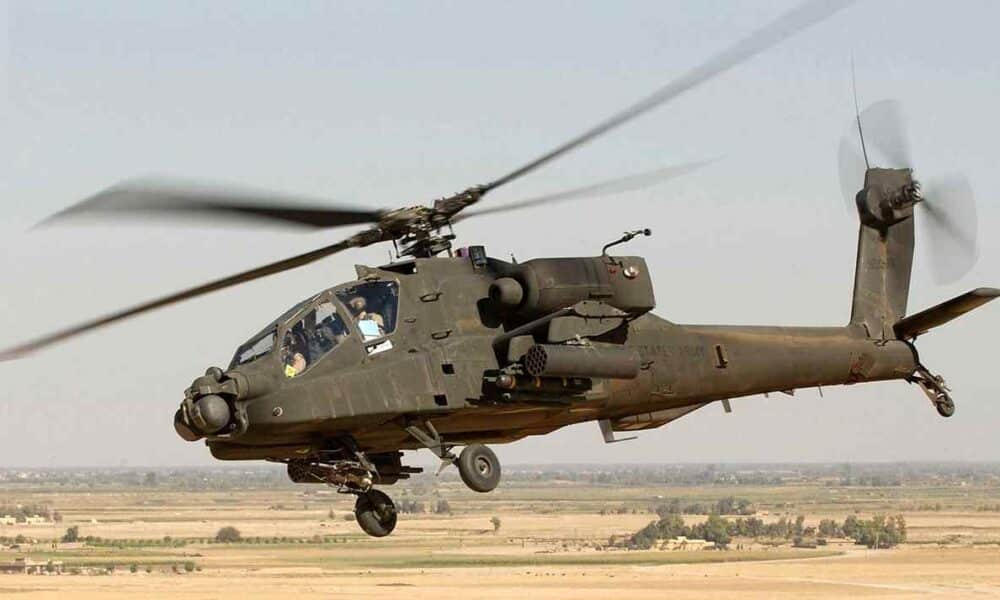
The American military announced that it had targeted air defense systems, ground-control stations, and Iranian radars, in response to what Washington now presents as Iran’s destruction of a U.S. Army Apache helicopter.
Tehran retaliated by launching missiles and drones against several American facilities in the region, notably in Jordan, Kuwait and Bahrain. No independent casualty toll was immediately available.
Washington invokes legitimate defense
The U.S. Central Command, Centcom, described the operation as a series of strikes carried out in “self-defense” and under direct instruction from President Donald Trump.
According to the American command, U.S. Air Force and U.S. Navy combat aircraft used precision munitions against air defenses, ground-control stations, and radar surveillance sites located near the Strait of Hormuz.
Centcom termed the operation a “proportionate response” to recent attacks against American forces and commercial ships moving through regional waters.
The strikes began on Tuesday at 5:00 p.m., Washington time, i.e. 10:00 p.m. Tunis time / 21:00 GMT. They ended about four hours later. An American official cited by Reuters said that nearly 20 Iranian targets had been hit.
Three waves of strikes against southern Iran
According to Axios, American forces conducted at least three waves of strikes during the same night.
Iranian media reported explosions on Qeshm Island as well as in the Sirik, Bandar Abbas and Jask regions, all located on or near Iran’s southern coast and the Strait of Hormuz.
Iranian television reported the activation of air defenses in several sectors. Military installations, radars, and coastal positions were said to have been targeted.
Iranian authorities also indicated that two water reservoirs had been damaged in the Sirik region, causing a disruption to drinking water supplies.
After several hours, official Iranian media announced a relative return to calm in the Qeshm, Jask and Sirik areas.
The Apache may have been hit by an Iranian drone
The American operation comes after the downing of an AH-64 Apache attack helicopter patrolling near the Strait of Hormuz.
The aircraft fell into waters off the Omani coast. Its two crew members were located and rescued by an American Navy unmanned surface vessel. They are in stable condition and were not reported to have suffered serious injuries.
Initial information did not indicate whether the helicopter had been shot down or was the victim of an accident. Donald Trump later stated that the U.S. military had concluded that Iran was responsible for its crash.
Subsequent reports indicated that the Apache had been struck by an Iranian drone. Tehran had previously denied responsibility for the incident, suggesting the possibility of an unintentional accident in a highly tense military environment.
Trump promised a “strong and firm” response
Asked by ABC News, Donald Trump said the United States was responding to Iran.
“They shot down a helicopter,” he said, noting that the American response should be “very strong” and “very firm.”
The American president nevertheless continued to advocate the possibility of a deal with Tehran. According to him, military operations and diplomatic negotiations can proceed in parallel.
A White House official cited by Politico also said that Donald Trump still believed a peace agreement with Iran remained within reach, despite the strikes.
Washington thus says it aims to send a military warning without officially closing the diplomatic path.
Iran strikes Jordan, Kuwait and Bahrain
Iran quickly announced retaliation against American forces in the region.
The Revolutionary Guards claimed to have launched missiles and drones against 21 American targets located in the Gulf and in Jordan.
Among the claimed targets is the Al-Azraq base in Jordan, where Iranian forces said they targeted hangars housing F-35 aircraft as well as a command and control center.
Tehran also claimed attacks on American installations in Kuwait and against the headquarters of the U.S. Fifth Fleet in Bahrain.
Most of the Iranian projectiles were reportedly intercepted. At the immediate moment, no fatalities or major damage affecting American forces had been officially reported.
Iranian claims about targets hit and damage inflicted could not all be independently verified.
A new escalation despite the truce
These exchanges constitute one of the most significant flare-ups of violence since the ceasefire agreed in April.
They come after a temporary resumption of strikes between Israel and Iran, followed by renewed commitments by both countries to observe the truce.
However, the Apache incident and the American response show the extreme fragility of this agreement. A single clash in the Strait of Hormuz could now trigger attacks against several regional countries hosting American forces.
The risk of an escalation remains heightened as the parties continue to formally negotiate while keeping their forces on alert.
Oil climbs back to around $92
Oil markets reacted immediately to this new escalation.
Brent rose to around $92 per barrel, as investors feared a worsening of disruptions in the Strait of Hormuz.
This passage remains crucial for global oil and gas exports. Any intensification of the clashes could slow navigation further, raise maritime insurance costs, and trigger another rise in energy prices.
The initial response remained relatively restrained, with markets appearing to bet on a short and targeted American operation. An extension of the reprisals would quickly alter this calculation.
Diplomacy and strikes now move in parallel
Washington says its response is over and that it does not aim to trigger a full-blown new war. Centcom, however, warned that American forces remained on alert and ready to respond to any new attack.
Iran, for its part, warned that harsher reprisals would follow if American strikes continued.
The contradiction is now at the heart of the crisis: both countries say they want to preserve the diplomatic track while directly exchanging missiles and drones.