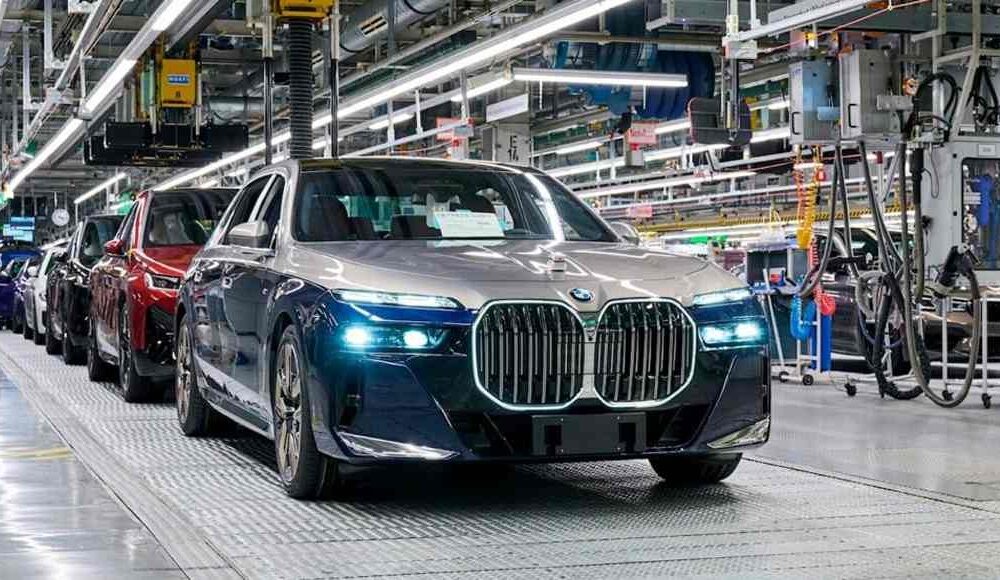
BMW, long regarded as one of Europe’s strongest manufacturers, is entering a phase of workforce reductions in turn. The German carmaker plans to cut about 8,000 jobs worldwide by the end of 2027, mainly through voluntary departures rather than outright layoffs.
The move is especially focused on Germany, where the group is preparing a severance program for several thousand employees. Production line workers would not be affected at this stage. The reductions would primarily target administrative functions, research, development, planning, corporate services and part of the management.
This decision confirms a broad trend: the German automotive industry, long dominant in the high end, is now being caught up by Chinese competition, the electric transition, slowing sales in China, high costs in Europe, and trade tensions with the United States.
A voluntary departure plan until the end of 2027
BMW aims to reduce its workforce without causing major social disruption. The group is thus expected to rely on voluntary departures, early retirements, severance payments, and the non-compensation of certain natural departures.
According to available information, the program is scheduled to begin in October 2026 and run until the end of 2027. In Germany, around 40,000 employees could receive a voluntary departure offer. This represents nearly half of the company’s permanent German workforce.
BMW employs about 150,000 to 154,000 people worldwide, including more than 80,000 in Germany. A reduction of 8,000 positions would thus represent about 5% of the global workforce.
The group had already indicated in its forecasts that a slight reduction in its workforce was possible. At BMW, a “slight” reduction can go up to 5% of the payroll.
Factories spared, offices affected
The key point is that production jobs would not be directly targeted by the program.
BMW is mainly looking to lighten its internal structures: administration, support functions, research and development, planning, engineering, management and central services. The Munich headquarters and the major innovation centers could therefore be particularly affected.
This choice is revealing.
The manufacturer does not want to abruptly weaken its industrial base as it prepares to launch new generations of electric vehicles and technological platforms. It wants to reduce fixed costs, simplify the hierarchy and accelerate decision-making.
In today’s automotive industry, the battle is no longer fought only in factories. It is also played out in development speed, software, batteries, embedded electronics, artificial intelligence, design costs and the ability to bring competitive models to market quickly.
China, the first shock for BMW
The main factor remains China.
For years, the Chinese market has been a gold mine for premium German brands. BMW, Mercedes, Audi and Porsche sold expensive, profitable models there, associated with a high social status.
But the market has changed.
In the second quarter of 2026, BMW’s deliveries in China fell by 30.2% year-on-year. At the same time, the group’s global deliveries declined by 4.9%, to 590,962 vehicles.
This decline is heavy, because China remains one of the most important markets for BMW. The problem is not only cyclical. It is structural.
Chinese manufacturers, led by BYD and other local brands, are advancing rapidly in electric vehicles, connected vehicles, embedded software, and aggressive pricing. They are no longer content with producing cheap models. They are now targeting the technological and premium segments, where German brands once dominated.
Chinese customers no longer view German brands in the same light
The challenge for BMW is also cultural.
The historical strength of German manufacturers rested on the internal combustion engine, build quality, brand prestige and performance image. But a new generation of Chinese buyers places more importance on screens, software, driver assistance, range, fast charging, price and the digital experience.
In this new environment, local manufacturers are moving faster.
BMW remains a powerful brand, but it can no longer rely solely on its image. In China, electric is become a technology product as much as an automobile. On this terrain, Chinese groups have gained the lead.
It is this loss of pace that pushes BMW to cut costs and reorganize its structures.
A warning on margins
The Chinese crisis has already forced BMW to revise its financial guidance.
The automaker lowered its targets for 2026. The operating margin expected in automotive was reduced to a range of 1% to 3%, versus 4% to 6% previously. The group’s pre-tax profit is expected to fall more sharply than anticipated.
For a premium brand, that is a serious signal.
BMW is not only seeing lower sales in China. It is also selling in a more competitive environment, with bigger discounts, higher technology costs and increasing price pressure.
Thus, the decline in headcount becomes a way to protect profitability, to finance the electric transition, and to resist the rise of Asian competitors.
Volkswagen, Porsche, Mercedes: all of Germany’s automotive sector under pressure
BMW is not an isolated case.
Volkswagen is also preparing a massive transformation. The group, which owns Audi and Porsche among others, is examining very substantial workforce reductions and a reduction of some production capacities in Germany. Porsche also plans several thousand job cuts in the medium term.
Mercedes-Benz faces the same difficulties: declining sales in China, pressure from local competitors, high costs in Europe and the need to accelerate the transition to electric vehicles and software.
The German automotive sector is therefore entering a phase of historic correction.
What was considered one of the strongest pillars of the European economy is becoming vulnerable to three simultaneous shocks: China, electric vehicles and the cost of production in Europe.
The Chinese challenge now coming to Europe
The problem for BMW and its competitors is no longer limited to the Chinese market.
Chinese manufacturers are now advancing in Europe. BYD, MG, NIO, Xpeng, Geely and other brands are multiplying electric models, with often competitive prices, strong technological integration and rapid development timelines.
Europe was once the natural turf for German brands. It is becoming a contested market.
For BMW, this means the battle is waged on two fronts: defending its positions in China, while preventing Chinese brands from nibbling away at its European market share.
This double pressure forces German manufacturers to cut costs faster than they would have liked.
US tariffs add extra pressure
To this Asian competition are added trade tensions with the United States.
US tariffs weigh on exports, supply chains and the industrial strategies of European groups. For a global automaker like BMW, which produces and sells across multiple continents, every trade tension can alter costs, margins and investment decisions.
Trade war does not alone explain job cuts. But it worsens an already challenging context.
BMW must invest massively in electric vehicles, batteries, software and assisted driving, while suffering a decline in profitability in some key markets. In this context, fixed costs become harder to bear.
A socially framed choice, but heavy symbolically
In Germany, cutting jobs in the automotive sector is never easy.
Social protections, the strength of unions and company agreements make blunt layoffs difficult. That is why manufacturers favor voluntary departures, early retirements and severance packages.
This approach reduces the immediate social shock, but it does not erase the symbolic reach of the decision.
BMW, a symbol of German industrial success, acknowledges that it must shrink to stay competitive. This is not just a management decision. It is a signal about the state of European industry.
The German model, built on engineering, premium engines, exporting to China and high-end production in Europe, must now reinvent itself.
The real challenge: staying premium in the electric age
The central question for BMW is simple: how to remain a premium brand in a market where value moves toward the battery, software, embedded intelligence and price?
In the old automotive world, BMW could differentiate itself by engine, driving, design and image. In the new world, the customer also compares range, charging, digital interface, connectivity, driving aids and software updates.
Chinese manufacturers understood this shift very quickly. They launch models rapidly, integrate a lot of technology and attack prices.
BMW must therefore fund its own transformation. The job cuts also serve to free up resources for this transition.
Conclusion: BMW trims its workforce to survive the new automotive war
The 8,000 job cuts planned by BMW are not a simple internal adjustment. They summarize the crisis of German automotive industry.
The shock comes from China, where sales are falling steeply. It also comes from the electric transition, which changes the game. And it comes from Europe, where costs remain high, and from the United States, where trade tensions complicate global strategies.
BMW is not collapsing. The group remains powerful, profitable in some segments and technologically solid. But it must accept a new reality: German prestige no longer suffices to protect margins.
The global automotive battle has entered a new phase.
Yesterday, the German manufacturers dominated China. Today, Chinese brands are forcing BMW, Volkswagen, Mercedes and Porsche to cut costs, rethink their priorities, and defend their position even in the European market.
For BMW, the plan to cut 8,000 jobs is therefore more than a social plan. It is a signal that the global war for electric cars has just crossed a new threshold.