China aims to take a new step in the global automotive battle. After having established its manufacturers in electric vehicles, Beijing now seeks to accelerate the development of intelligent, connected, and autonomous cars.
The Ministry of Industry and Information Technology, along with eight other government departments, presented a new roadmap aimed at strengthening the New Energy Intelligent Vehicle industry for the 2026-2030 period. The stated objective: enable large-scale deployment of vehicles equipped with autonomous driving functions by 2030.
The plan specifically targets highways, urban expressways, and certain city roads. It is not about making all driverless cars operate everywhere and immediately, but about gradually generalizing advanced automated driving functions within defined contexts.
For Beijing, the stake goes beyond mobility. It is about taking control of the next generation of automobiles: electric, software-driven, connected, powered by data and increasingly steered by artificial intelligence.
After the electric car, the intelligent car
China already dominates a large part of the global electric vehicle supply chain.
According to the Ministry of Industry, the country accounts for more than 70% of global production of new-energy vehicles, power batteries and key materials. Beijing also notes that five Chinese new-energy vehicle companies and six Chinese battery companies are among the top ten worldwide in sales volume.
The new plan thus confirms a broader ambition: not only to sell electric cars, but to become the country that sets the standards for the car of the future.
This car will be electric, but also connected, software-updatable, equipped with driver-assistance systems, capable of exchanging data with its environment and integrated into smart road infrastructures. On this last point, the Chinese approach distinctly differs from Western models: rather than relying solely on sensors and onboard computing in each vehicle, as most American and European manufacturers do, China plans to equip first- and second-tier cities with connected road sensors and vehicle-infrastructure 5G infrastructure, pooling part of the intelligence between the road and the vehicle.
In this logic, the car becomes less a simple mechanical product than a technological platform, partially dependent on the surrounding infrastructure.
2030 Objective: a target already on track to be surpassed
The Chinese roadmap sets several priorities for 2030.
Beijing first wants New Energy Vehicles to represent a dominant share of the automotive market. The ministry cites a target of 70% of new passenger car sales and 40% of new commercial vehicle sales by 2030.
This figure seems ambitious, but is in fact less than it appears: the previous five-year plan, published in 2021, targeted only 20% market share for New Energy Vehicles in 2025 — an objective China has largely surpassed, reaching 54% last year. By August 2026, New Energy Vehicles accounted for between 60.6% and 65% of new car sales according to sources, which suggests that the new target of 70% could also be achieved ahead of schedule.
China also aims to improve energy efficiency for both powertrains. For 100% electric passenger cars, the targeted average consumption is about 11.5 kWh per 100 kilometers. For vehicles still equipped with an internal combustion engine, the plan sets an average consumption target of 3.3 liters per 100 kilometers — a signal that Beijing does not rely solely on electric to reduce the sector’s energy dependence, but also seeks to discipline what will remain of the thermal fleet.
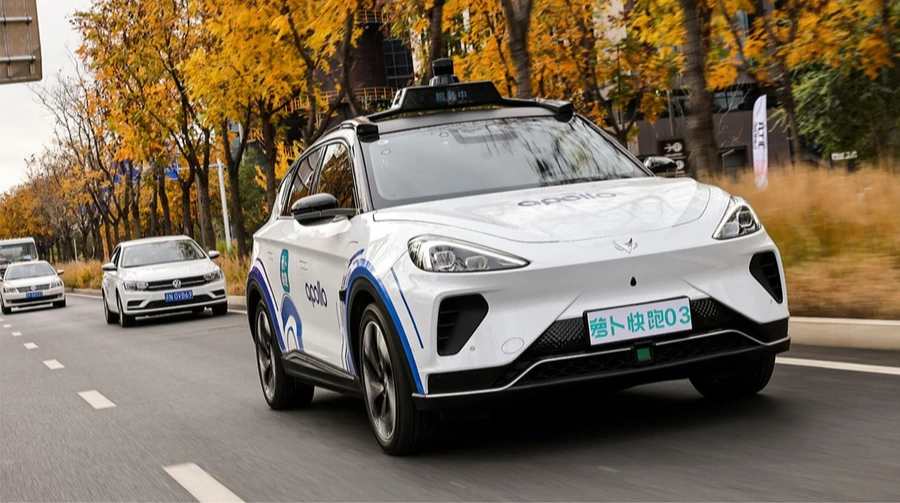
But the most strategic objective remains autonomous driving. Reuters notes that the Chinese plan aims for a massive deployment of autonomous vehicles by 2030 and an increased global influence of the Chinese auto industry.
Chinese roads to test the car of the future
China wants to develop automated driving in specific environments: highways, urban expressways, and certain urban roads.
This choice is important. Highways and expressways offer more predictable conditions than dense city centers: better-defined lanes, fewer pedestrians, and more repetitive driving scenarios. They thus provide a privileged ground to generalize advanced driver-assistance systems.
The selected urban roads will allow, however, to go further: complex traffic, intersections, pedestrians, two-wheelers, delivery vehicles, traffic lights, roadworks and unforeseen events.
Beijing thus aims to build a progressive ramp-up, starting from the most controllable environments before expanding uses.
Safety: the sensitive point, with a schedule now set
Autonomous driving remains a politically and technically sensitive issue.
An accident involving a vehicle equipped with automated systems can cause a rapid loss of public trust. That is why Beijing also wants to strengthen rules on vehicle production, road safety, onboard software, remote updates and critical components. The plan sets a clear requirement: automated driving systems must reach a safety level well above that of human drivers, and not merely equivalent.
This regulatory framework now has a concrete deadline. China’s national standards governing levels 3 and 4 of autonomous driving (conditional and highly automated driving) must come into effect from mid-2027, well before the overall 2030 deadline — a schedule designed to allow testing and adjustment of the legal framework before broad deployment.
China is also working on broader governance of these vehicles. Reuters recently reported that Beijing proposed amending its Road Traffic Safety Law to include a specific chapter on autonomous vehicles, with the possibility of holding manufacturers or importers responsible for certain violations committed when the vehicle operates in autonomous mode.
The message is clear: China wants to accelerate, but it knows that public trust will depend on safety, accountability and transparency.
An industry to discipline
The Chinese plan does not merely seek to encourage innovation. It also aims to restore order in a sector that has become highly competitive.
Authorities want to strengthen oversight of production capacities of vehicles and batteries, limit excessive investments, encourage industrial consolidation and eliminate inefficient capacities.
This orientation shows that Beijing wants to avoid an auto bubble fueled by local subsidies, a proliferation of many fragile manufacturers and a perpetual price war.
China wants champions capable of lasting, exporting and competing with the world’s major groups. The stated objective is to see several Chinese automakers among the top ten globally by sales volume — an objective already partially achieved: BYD, SAIC and Geely already feature there, though they remain well behind Toyota, Volkswagen and Hyundai in total volume. The plan’s challenge is thus less about creating this presence than consolidating it and reducing the gap with the historic leaders.
The battle is therefore no longer only technological. It is industrial, commercial and geopolitical.
Influence on international standards
Another essential aspect of the plan is crucial: China wants to weigh more on global automotive standards.
Whoever sets the technical standards often gains a lasting advantage. In connected cars, these standards concern batteries, software, data, cybersecurity, sensors, driver-assistance systems, charging protocols and safety rules.
This influence work has already begun concretely: China led the drafting of the world’s first technical regulation on autonomous driving, adopted in June 2026. This is tangible proof that Beijing no longer merely follows international rules but begins to write them.
Beijing therefore wants its companies to be present not only in markets, but also in bodies where the rules of the future are decided. China no longer wants to be merely the world’s automotive factory. It wants to become one of the centers defining global automotive.
An international offensive
The plan also foresees supporting Chinese manufacturers in their overseas development.
The authorities want to publish recommendations to help companies comply with local rules when exporting, investing or forming partnerships outside China.
This dimension is crucial. Chinese brands are expanding rapidly in Europe, in Southeast Asia, in the Middle East, in Latin America and in Africa. They no longer merely sell cheap models. They arrive with well-equipped, connected, competitive and sometimes technologically advanced electric vehicles.
The next step will therefore be the export of an ecosystem: cars, batteries, software, assisted driving, charging infrastructures, data and services.
What this means for the global industry
For European, Japanese, Korean and American manufacturers, the message is strong.
Chinese competition will no longer revolve solely around the price of electric vehicles. It will also revolve around software, batteries, range, assisted driving, over-the-air updates and the ability to offer large-scale connected vehicles.
This shift can weaken traditional manufacturers. Their historical strength rested on the internal combustion engine, mechanical quality, brands and sales networks. The new competition hinges more on batteries, software, data, artificial intelligence, and the speed of innovation.
In this field, China is moving very quickly.
And what about Tunisia?
For Tunisia, this Chinese strategy is to be watched closely.
The local market for electric cars remains limited, but global dynamics can accelerate the arrival of more affordable Chinese models. In the medium term, Tunisia could see more connected electric vehicles, equipped with advanced driver-assistance systems.
But this evolution raises several questions: charging networks, certification, maintenance, technician training, parts availability, battery warranties, cybersecurity, onboard data and liability in case of an accident.
The intelligent car is not just a vehicle. It is a connected object that collects, processes and transmits data. Importing countries will therefore need to rethink their regulatory framework before these technologies become mass-market.
For Tunisia, the challenge will be to benefit from falling prices and innovation without suffering total technological dependence.
Conclusion: China wants to dominate the next car
The Chinese plan for 2030 confirms a clear ambition: Beijing wants to dominate the next phase of the global automotive industry.
After the electric car, China aims for the intelligent car. After batteries, it wants to master software. After exporting vehicles, it intends to export standards, platforms and technologies — a task already underway with the first global regulation on automated driving, drafted under Chinese leadership.
The message to competitors is direct: the automotive battle of the coming years will no longer be fought only in factories. It will be fought in data, artificial intelligence, driving systems, international standards and connected infrastructures.
By 2030, and perhaps even sooner if the current trajectory continues, autonomous or semi-autonomous cars could thus become a mass-market product in China.
The country that transformed the electric vehicle into a global industry now wants autonomous driving to become the new face of its industrial power.