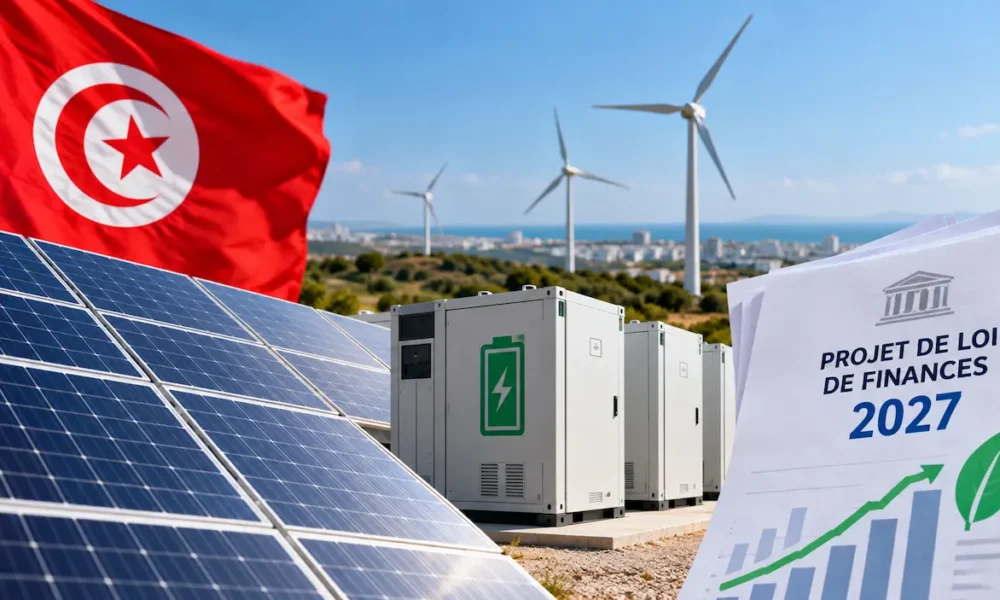
The draft finance bill for the year 2027 outlines new fiscal measures aimed at supporting the energy and environmental transition in Tunisia. These provisions notably include the exemption of electricity storage batteries from several import taxes, the reduction of customs duties on solar equipment, and the expansion of support mechanisms for the environmental upgrading of enterprises.
The Essentials
- Storage batteries : exemption from customs duties, VAT, and a professional levy on imports.
- Solar equipment : reduction to 10% of the import duty rate applicable to imports.
- Enterprises : expansion of the environmental upgrading scheme to operations aimed at reducing the carbon footprint and improving energy efficiency.
- Effective date : these measures remain subject to the adoption of the 2027 finance bill.
Storage batteries: an exemption from several taxes
Article 49 of the 2027 Finance Bill provides a tax and customs exemption for batteries intended for electricity storage.
This measure concerns batteries classified under tariff heading 8507, which would be exempt, upon import, from customs duties, value-added tax (VAT) and the professional levy allocated to the Competitiveness Development Fund in the sectors of industry, services and crafts.
However, the benefit of this exemption would be conditioned on the technical opinion of the competent services of the ministry in charge of Industry.
This provision aims to lighten the fiscal cost of equipment used to store electricity, especially in the development of installations using renewable energy.
Solar energy: import duties reduced to 10%
Article 50 of the same bill proposes to reduce to 10% the rate of import duties payable for solar sensors classified under tariff heading 8541.
This modification concerns the import duty tariff approved by Law No. 89-113 of December 30, 1989, as amended and supplemented by subsequent texts.
The stated objective is to reduce the customs burden on the solar equipment concerned, in order to support the development of this energy sector.
However, this measure should be distinguished from a full exemption: the project provides for a 10% duty rate, not a removal of these duties.
Enterprises: expanded support for the environmental transition
Beyond energy equipment, the 2027 finance bill also includes provisions relating to improving the environmental performance of businesses.
Article 51 thus proposes to amend the first paragraph of Article 12 of Law No. 2005-106 of December 19, 2005, the Finance Act for 2006, as amended and supplemented.
This amendment aims to incorporate environmental upgrading operations carried out by companies with the aim of:
- Reducing their carbon footprint.
- Improving their energy efficiency.
- Ensuring their compliance with national and international environmental standards.
The widening of the scope of these interventions would help support companies in their environmental improvement efforts, particularly those undertaken to reduce their energy consumption and carbon emissions.
It also aims to promote the adaptation of the Tunisian productive fabric to environmental requirements, in a context where standards related to the carbon footprint occupy an increasingly prominent place in international economic exchanges.
Measures still under parliamentary review
These provisions align with the directions of the 2027 Finance Bill regarding energy transition, improving energy efficiency, and reducing the environmental impact of economic activities.
Their practical scope will, however, depend on their final adoption and, where applicable, the regulatory modalities required for their implementation.
The committees of the Assembly of the Representatives of the People are expected to soon begin examining the 2027 Finance Bill, transmitted to Parliament by the government after its approval in the Council of Ministers.