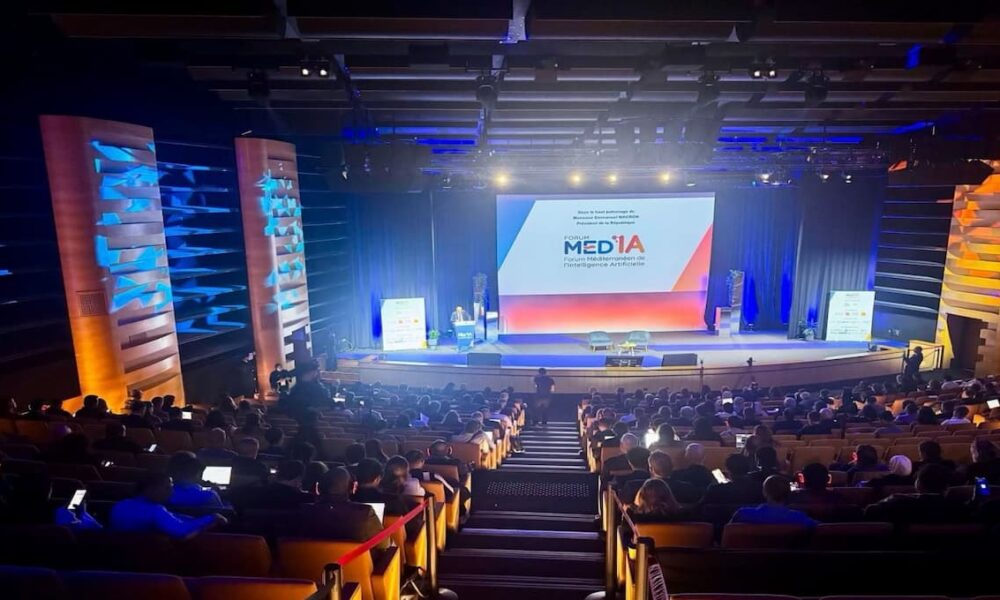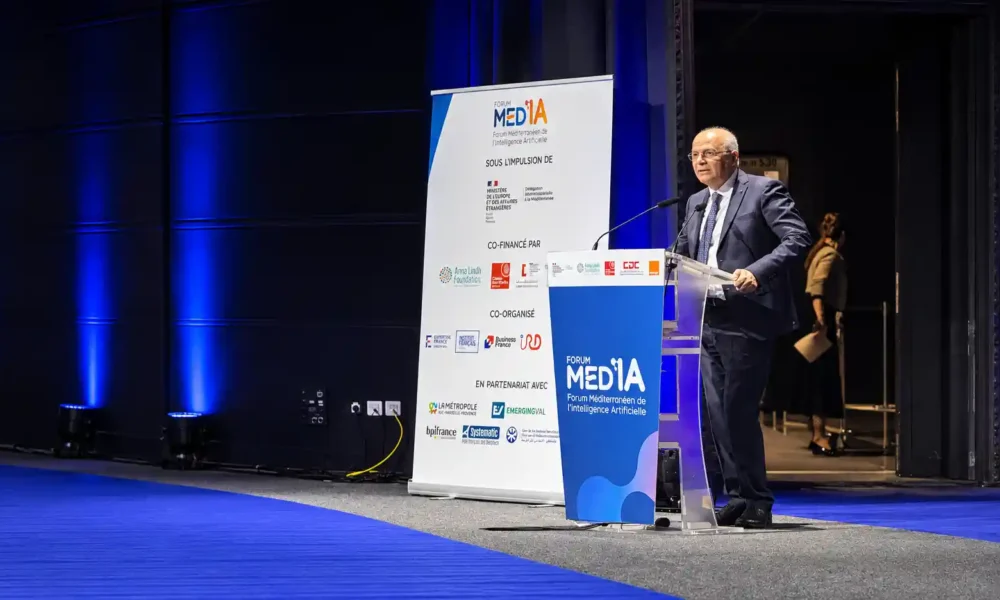
In Marseille, Tunisia reaffirmed its ambition to contribute to the construction of a Mediterranean artificial intelligence, ethical and oriented toward the needs of the population.
*Speaking on November 5, 2026 at the Mediterranean Forum on Artificial Intelligence (FMIA), the Ambassador of Tunisia to France, Dhia Khaled, highlighted Tunisian competencies and called to transform cooperation between the two shores into concrete projects.
During this third edition, organized at the Palais du Pharo, the diplomat argued for a Mediterranean that is not only a space for exchanges, but also for research, innovation and technological creation. Tunisia, he stated, intends to play an active and constructive role there.
The Essentials
Talents : the ambassador relies on Tunisian researchers, engineers, startups, and universities.
Cooperation : the Sila initiative should foster joint projects and the development of innovative companies.
Goal : responsible, inclusive AI that is useful to youth as well as to economic sectors.
Tunisia’s Competencies at the Heart of Mediterranean Ambition
The ambassador underscored the country’s assets: a qualified human capital, a dynamic scientific community, recognized digital skills, and an evolving entrepreneurial fabric. In his view, these resources provide a solid basis to participate in the emergence of a Mediterranean AI ecosystem.
He also stressed the international dimension of this expertise. Tunisian engineers, researchers and entrepreneurs operate in Tunisia, in France, or across both countries. Several players from this ecosystem were present at the forum, illustrating possibilities for cooperation and technological mobility.
Dhia Khaled expressed his pleasure at seeing Tunisian startups, starting from modest projects, succeed in their international development, notably in France. He presented the mobility of skills as a key driver of creation and innovation.
Tunis 2025, a Step in Regional Cooperation
The diplomat returned to the previous edition of FMIA, held in Tunis on 20 and 21 November 2025. This second edition gathered more than 3,000 participants, according to the organizers’ assessment, bringing together institutions, researchers, startups, investors and companies from both shores.
According to Dhia Khaled, the Tunis meeting allowed the identification of several partnerships, some of which are already operational. He sees it as a new impulse for Mediterranean cooperation in artificial intelligence.
After Marseille in 2024 and Tunis in 2025, this third edition in Marseille aligns with the will to continue exchanges and translate them into durable collaborations.
Sila: An Opportunity for Tunisian Startups and Research
The ambassador highlighted Sila, the France-Mediterranean initiative for artificial intelligence, as one of the frameworks likely to structure this cooperation. Funded by the French Ministry for Europe and Foreign Affairs and implemented by Expertise France, it concerns five southern shore countries: Tunisia, Algeria, Morocco, Egypt, and Lebanon.
This initiative aims notably to bring entrepreneurial and scientific ecosystems closer together, to support startups with high potential, and to encourage their development beyond their home market.
For Dhia Khaled, Tunisia can contribute to this dynamic by mobilizing its institutions, its universities, its researchers, and its entrepreneurs. He urged prioritizing complementarity of skills, knowledge sharing, and long-term partnerships.
Ethical AI Serving the Needs of the Population
Health, sustainable agriculture, education, the energy transition, natural resource management and responsible governance are among the domains where the ambassador wishes to see joint projects emerge.
He defended a sovereign, responsible, inclusive, and durable artificial intelligence, respectful of values, cultural specificities, and development priorities of Mediterranean societies. In this context, he referred to UNESCO’s work on AI ethics.
His message is especially addressed to the youth: artificial intelligence should not remain a technology reserved for a few actors, but become an accessible instrument for value creation and opening up new perspectives.
From Statements to Concrete Projects
For the Tunisian representative, participation in the forum must go beyond protocol and yield results: strengthened scientific and technological partnerships, collaborative projects, support for startups in their growth and internationalization, new investment opportunities and technology transfer.
“The Mediterranean cannot be merely a space for the circulation of ideas and technologies; it must become a space for creation, co-innovation and production of solutions tailored to Mediterranean realities,” he declared.
In a global context that he deemed worrying, Dhia Khaled called for making AI a bridge between the region’s countries and a lever for bringing their populations closer together.