Can jellyfish really stop a nuclear power plant? In Gravelines, in the north of France, the answer is now yes — and for the second consecutive year.
An influx of jellyfish into the seawater intake pumping facilities of the Gravelines Nuclear Power Plant triggered, on the night of Monday, August 10, 2026, the shutdown of three of its six reactors. Units 3 and 4 shut down automatically, while reactor 2 was shut down preemptively. The power of reactor 1 was also reduced to 50%. Reactor 5 was already unavailable for maintenance, leaving only reactor 6 operating normally.
EDF assures that the event had no impact on the safety of the plant, the safety of personnel or the environment. The problem occurred in the non-nuclear part of the facility, at the water intake system used to provide cooling water.
But the incident draws particular attention because it affects the largest nuclear power plant in Western Europe and because an almost identical episode had already struck Gravelines in August 2025.
How can jellyfish stop a nuclear reactor?
The mechanism is less mysterious than it seems.
The six Gravelines reactors, each with a capacity of 900 MW, use the North Sea as a cooling source. Water is drawn in from a canal and then circulated through the facilities allowing the heat produced by the plant to be removed before being discharged into the marine environment. The total installed capacity of the site thus reaches 5.4 GW.
The volumes involved are considerable: in 2024, the plant used nearly 6.3 billion cubic meters of seawater to cool its six reactors. More than 99.9% of this water was subsequently returned to the aquatic environment, according to EDF.
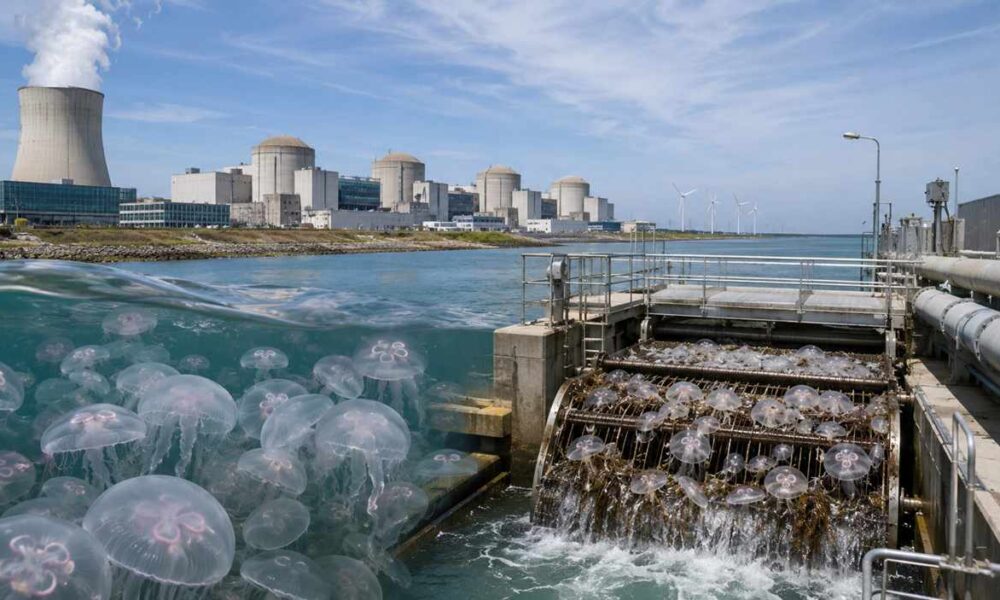
Before entering the circuit, this water passes through filtration systems designed to retain algae, debris and marine organisms.
The problem arises when an exceptionally dense bloom of jellyfish arrives simultaneously.
The creatures are drawn toward the pumping stations and accumulate on the filters. When the quantities become too large, the water flow can be disrupted. The plant’s protection systems then automatically order the shutdown of the reactor to preserve its cooling capacity.
In other words, the jellyfish do not enter the nuclear reactor. They disrupt the water source necessary for its operation.
Tons of jellyfish to remove
This time again, the number of animals arriving at Gravelines exceeded what the installations could absorb.
EDF had, however, strengthened its system since the 2025 incident. Fixed cameras were installed in the water intake channels and at the level of the filtering drums to quickly detect accumulations. The electricity company has also formed partnerships with fishermen and sea-rescue organizations tasked with reporting jellyfish blooms.
An initial alert had actually been issued during the preceding weekend and fishing boats had been deployed to try to reduce the density of the bloom before it reached the plant.
That was not enough.
Once the jellyfish accumulated in the installations, EDF had to use suction trucks to remove them. On Tuesday, August 11, the company indicated that no new significant bloom was arriving at the site and was considering a gradual resumption of production.
Three reactors have already resumed or continued to operate
The situation has indeed begun to normalize.
Reactor No. 2, shut down preemptively on August 10 at 23:06, was reconnected to the French electrical grid on Thursday, August 13 at 02:43.
According to the latest update published by EDF, units 1, 2 and 6 are operating, while reactors 3 and 4 remain shut down following the jellyfish arrival. Maintenance work must be completed before their reconnection. Unit 5 remains unavailable for its ten-year inspection.
It is therefore no longer a situation where only one of the six reactors was producing electricity, as in the early hours of the incident.
Gravelines produces the equivalent of 60% of the electricity needs of Hauts-de-France
The significance of the event also lies in the site’s weight in the French energy system.
With its six 900 MW reactors, Gravelines constitutes the largest nuclear power plant in France and Western Europe by installed capacity among currently operated plants.
In 2025, it produced 32.27 TWh of electricity, equivalent to about 60% of the annual electricity needs of Hauts-de-France.
The simultaneous shutdown of several units therefore represents several gigawatts temporarily removed from the grid.
The situation did not, however, trigger an electricity shortage in France, notably because summer consumption is lower than winter peaks and the country continued to export electricity.
Exactly the same problem in August 2025
What gives the case another dimension is its repetition.
Between August 10 and 11, 2025, reactors 2, 3, 4 and then 6 of Gravelines had already shut down automatically following a massive arrival of jellyfish in the pumping stations. The other two units were then already unavailable, temporarily causing the site’s production to halt completely.
The event had pushed EDF to revise its procedures.
Video surveillance, sea observation, cooperation with fishermen, preventive interventions: the system put in place after 2025 allowed this year to better anticipate the arrival of the animals, but not to prevent outages completely.
The phenomenon is not entirely new to Gravelines: the plant had already experienced a jellyfish-related disruption in 1993. Other coastal plants around the world have also faced this type of problem.
Why do jellyfish seem to be becoming a more frequent problem?
That is the most interesting question in the long term.
It would be an overstatement to attribute the Gravelines bloom directly to climate change alone. Scientists explain that jellyfish proliferation results from several factors that can combine: water temperature, arrival of invasive species, decrease in certain predators, modification of coastal ecosystems and overfishing.
Warming waters can nevertheless create conditions more favorable to certain species and extend their breeding or presence period.
This is what worries operators of coastal facilities: what once might have appeared as an exceptional incident could become a risk that needs to be incorporated more systematically into the design and operation of infrastructure.
Jellyfish, heat and drought: a difficult summer for French nuclear power
The Gravelines incident also takes place in an unusually difficult context for the French nuclear fleet.
The heatwave and the drought have forced EDF to reduce or interrupt production at several reactors located on rivers. When river water becomes too warm or their flow too low, plants must limit their activity to respect environmental thresholds applicable to their discharges.
As of August 13, six French reactors were shut down and others were operating at reduced power due to high temperatures or lack of water.
According to Thibault Laconde, a climate risk specialist quoted by Le Monde, the share of French nuclear power unavailable for environmental reasons approached 20%, at a level likely to set a record.
The situation did not threaten the country’s electricity supply, but it highlights a paradox: nuclear power plants emit very little CO₂ during operation, yet they are not independent of the climate that surrounds them.
A plant located on a river depends on its temperature and flow. A coastal plant like Gravelines has access to a much more abundant water resource, but may face other biological risks, such as algae or jellyfish.
EDF is already preparing its plants for a different climate
For EDF, these events are now part of a broader reflection on adapting the French nuclear fleet.
According to Le Monde, the electricity company plans to invest around 9 billion euros over fifteen years in adapting its facilities to the consequences of climate change.
In Gravelines, the repetition of jellyfish invasions shows concretely what this adaptation can mean: better observing the sea, anticipating the movements of marine organisms, strengthening filtration systems and planning procedures capable of rapidly protecting the installations.
The episode thus has something of an anecdotal nature in its appearance — jellyfish stopping nuclear reactors — but much less in what it reveals.
Two consecutive summers, almost exactly a year apart, the largest nuclear power plant in Western Europe has seen a substantial portion of its production disrupted by the same natural phenomenon.
Nuclear safety has not been called into question: the automatic shutdowns show that the protections in place worked.
The real question now lies elsewhere: if episodes of extreme heat and disruptions to marine ecosystems become more frequent, how many events formerly considered exceptional will large infrastructures need to learn to treat as ordinary risks?