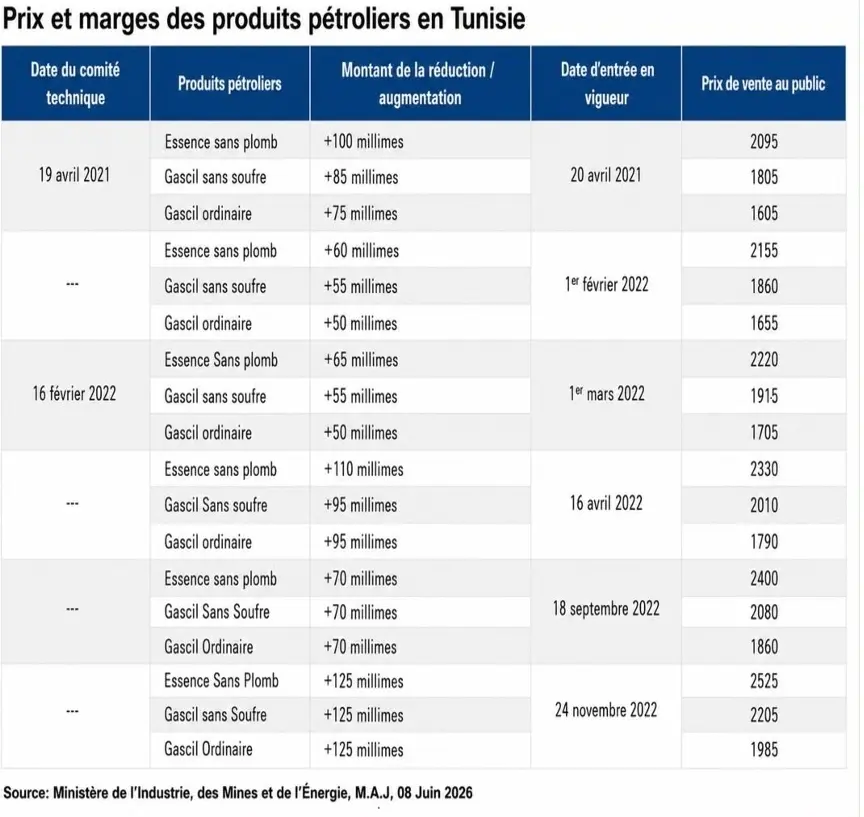
In Tunisia, the price of gasoline and fuels is not determined by a free-market mechanism. It results from an administered system in which the state plays a central role, periodically setting pump prices based on several key variables: the evolution of international oil prices, the dinar exchange rate, import costs, and the balance of public finances.
The price of unleaded gasoline in Tunisia is around 2.53 dinars per liter, while diesel is around 2.21 dinars per liter, that is roughly €0.75 for gasoline and €0.65 for diesel according to the common 2026 conversions. These levels reflect a relative stability in nominal prices, but conceal a more complex position: that of indirect adjustment through public subsidy and sensitivity to external shocks.
Dependence on international markets
Tunisia imports a large portion of its energy needs, which makes it particularly exposed to fluctuations in the global crude oil market. The price per barrel, denominated in dollars, is the primary adjustment variable for national energy costs.
In a context of heightened volatility, marked by geopolitical tensions in the Middle East, uncertainties about global supply, and OPEC+ production adjustments, Brent prices regularly swing, generating constant pressures on importing economies like Tunisia.
To this is added a determining factor—the exchange rate. Any depreciation of the dinar against the dollar increases the cost of energy imports, even if the barrel price remains stable. Thus, the formation of fuel prices in Tunisia depends not only on oil, but on a function combining international markets, monetary policy, and budgetary arbitrage.
Maghreb: substantial price disparities
Regional comparison highlights substantial disparities in the Maghreb, revealing energy models that are deeply different.
In Libya, where subsidies are extremely strong and the state directly controls distribution, the price of gasoline is among the lowest in the world, around €0.02 to €0.03 per liter, virtually symbolic.
In Algeria, another producing country, a liter of gasoline is around €0.30 to €0.35, while diesel is around €0.24, levels heavily supported by oil rents and an administered price system.
In Morocco, which has limited oil resources and liberalized its market, prices reflect global prices more closely. Gasoline reaches about €1.30 to €1.45 per liter, while diesel is around €1.25 to €1.35, depending on market fluctuations.
In this landscape, Tunisia occupies an intermediate position, with prices around €0.70 to €0.80 per liter for gasoline, reflecting both a partial subsidy mechanism and a stronger budget constraint than neighboring producing countries.
Fuel, a product political as much as economic
The price of fuel in Tunisia cannot be analyzed solely from the market angle. It is a tool of social stability and a public policy instrument.
Historically, authorities have maintained an indirect subsidy system to limit shocks to purchasing power. This strategy aims to cushion global increases, but it generates a significant budgetary cost, especially during periods of high oil prices.
Beyond the data shown at the pump, the liter of gasoline or diesel in Tunisia results from a specific cost structure, where the final consumer pays not only the value of crude oil but a set of economic, fiscal, and logistical components.
Based on estimates from price formation mechanisms and energy data, the average structure of a liter sold in Tunisia can be decomposed as follows.
Approximately 45% to 55% of the final price corresponds to the cost of imported crude oil. This share varies directly with Brent’s international prices and constitutes the most volatile component. Any rise in the barrel price is immediately reflected in this portion of the price.
Approximately 15% to 20% of the price is linked to refining costs, imported refined products as Tunisia imports part of its finished fuel needs, as well as maritime transport and internal distribution costs. This component is influenced by global logistical costs and the margins of energy operators.
A significant portion, estimated between 10% and 20%, corresponds to public support and subsidy mechanisms. The state intervenes to smooth international variations to avoid too abrupt increases at the pump. This intervention takes the form of an implicit or explicit subsidy depending on budgetary periods.
Finally, about 10% to 15% of the final price corresponds to tax and parafiscal charges as well as the distribution margins of operators. Compared with other countries, direct taxation on fuels remains relatively modest in Tunisia, but it is considered a fundamental component of the final price.
The system rests on a logic of deferred adjustment. When international prices rise sharply, the state absorbs part of the shock to avoid immediate transmission to consumers. Conversely, global price declines do not always fully translate to the pump in order to preserve budgetary balance.
This system creates a permanent compromise between two conflicting imperatives: protecting the consumer and ensuring the sustainability of public finances.
An impact on inflation and competitiveness
Fuel occupies a strategic place in price formation in Tunisia. Its impact on inflation manifests at two levels. First, a direct impact related to the cost of filling up for households. Then a broader indirect impact, through transport and logistics costs that ripple through the prices of goods and services.
For households, fuel today represents much more than a mobility expense. It directly influences the household budget through several channels.
The first is obviously the daily travel cost for motorists. For a household traveling about 1,500 kilometers per month with an average consumption of 7 liters per 100 kilometers, consumption reaches about 105 liters per month. At the current price of gasoline, this represents an expense close to 265 dinars per month, i.e., more than 3,000 dinars per year, excluding maintenance and insurance.
But the most important impact is indirect. Fuel is a key input in the road transport, retail distribution, agriculture, and logistics sectors. Any significant increase in energy costs tends to be passed on to the prices of goods and services consumed daily.
The state is faced with an arbitration. Any rise in fuel prices improves public finances by reducing the burden of implicit subsidies, but it weighs immediately on purchasing power and can fuel social tensions, while maintaining stable administered prices protects households but increases the budgetary cost borne by the state, in a context of limited fiscal margins.
Fuel prices directly influence the competitiveness of the economy. A high transport cost reduces margins for exporting companies, increases logistical costs, and limits the competitiveness of local products on international markets. However, an artificially low price, if financed by subsidies, can create budgetary imbalances and delay the necessary structural adjustments.
Fuel thus sits at the crossroads of several balances: social, budgetary, productive, and external. In this light, future reforms will necessarily incorporate broader thinking on energy efficiency, the development of public transport, and reducing dependence on imported hydrocarbons.
Data sources
National Institute of Statistics – Consumer price index and transport weighting.
Ministry of Industry, Mines and Energy (Tunisia) – policy for setting fuel prices.
International Energy Agency (IEA) – reports on global oil markets
IMF – World Economic Outlook (2026).
GlobalPetrolPrices – international comparative data on fuels.