The confrontation between Iran and the United States is entering a new phase of military escalation in the Persian Gulf and the Middle East. On the 75th day since the signing of the memorandum of understanding between Washington and Tehran and after 184 days of war, both sides announced new operations, while the Strait of Hormuz remains at the center of the balance of power.
Iran claims to have launched dozens of drones and ballistic missiles against facilities hosting American forces in the United Arab Emirates and Jordan, in retaliation for an American strike against the Iranian island of Lark. Washington, for its part, says it carried out a “limited and precise” operation against Revolutionary Guard forces that were preparing, according to the U.S. command, to lay mines in the strait.
The essentials
- Regional extension : Iran says it struck positions hosting American forces in Jordan and the United Arab Emirates, in response to the American attack on the island of Lark.
- Jordan : the Revolutionary Guards say they used ballistic missiles and drones against the bases at King Hussein and Al-Azraq. Washington says no major damage was recorded and that the missiles were intercepted.
- Emirates : Iran’s armed forces say they launched dozens of drones against the Al-Minhad base. Emirati authorities confirm intercepting a drone from Iran over their territorial waters.
- Hormuz : Washington says it has removed mines from the strait, while Tehran continues to claim control over passage procedures and reports that a tanker struck two mines.
- Oil : the escalation pushed prices up by about 3%, with Brent rising back above $90 per barrel.
Iran says it struck the Al-Minhad base in the United Arab Emirates
The Iranian army announced that it had used dozens of drones to target helicopter positions as well as American forces stationed at the Al-Minhad base, in the United Arab Emirates.
Tehran presents this operation as a response to the American attack on Lark Island, located in the strategic Strait of Hormuz area.
The UAE’s Ministry of Defense confirmed it detected and engaged a drone over Emirati territorial waters, noting that the aircraft came from Iran.
However, the information released does not allow independently to establish the extent of any damage to the Al-Minhad base.
Ballistic missiles and drones against two bases in Jordan, according to Tehran
The Revolutionary Guards also claim to have struck the air bases of King Hussein and Al-Azraq, in Jordan, which they describe as facilities used by American forces.
According to their communiqué, the operation mobilized ballistic missiles and drones and would have destroyed infrastructure as well as aircraft parking areas.
The Iranian Foreign Ministry asserts that these bases had served as launch points for American operations against Iran.
The American version is substantially different. Fox News, citing an American official, reports that the Iranian attacks against American forces in Jordan caused no major damage and that all missiles were intercepted.
The figures released by both sides remain therefore contradictory.
Washington confirms a new strike on Lark Island
The U.S. Central Command, CENTCOM, confirmed carrying out an operation against Revolutionary Guards units near the Strait of Hormuz.
Washington calls the intervention a “limited and precise” action against Iranian forces that, according to the American command, were involved in mining activities posing an imminent threat to navigation.
An American official had previously indicated that two Iranian launchers had been targeted on Lark Island. According to Washington, these systems were preparing to fire projectiles carrying naval mines toward the strait.
The Revolutionary Guards announced deaths and injuries among their fighters and civilians following this strike, without providing a detailed tally.
Tehran regards the operation as a violation of its sovereignty and promises to respond to any new attack.
A tanker reportedly struck two mines south of Hormuz
In another incident particularly sensitive for maritime traffic, the Revolutionary Guards’ navy says that a tanker caught fire after hitting two naval mines south of the Strait of Hormuz.
According to the Iranian version, the vessel was attempting to take a route Tehran considers “illegal.”
The Revolutionary Guards warned shipping companies that ships not respecting navigation procedures imposed by Iran could face a similar fate.
They urge shipowners to adhere to routes and instructions established by Iranian forces and to not heed calls from the U.S. military to take alternate routes.
These claims have not been independently confirmed in the released materials.
Trump says the United States controls Hormuz
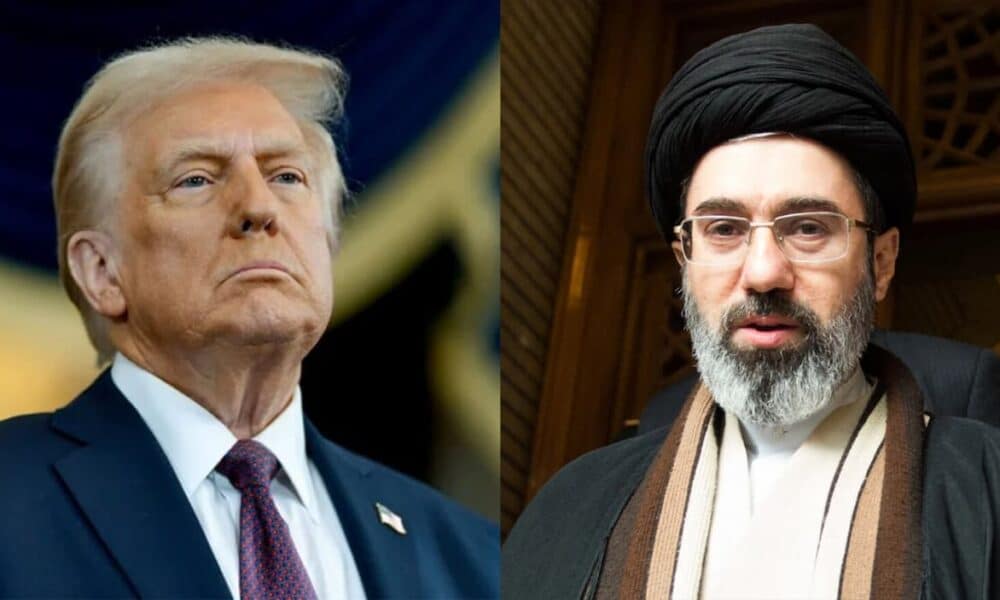
Donald Trump, for his part, has adopted an especially aggressive tone.
In an interview with Fox News, the American president said that the United States had removed all mines present in the Strait of Hormuz, with what he described as very limited help from other countries.
According to him, Washington already has a strong grip on the strategic passage and would enjoy a “nearly complete” control after an American victory in the war.
The American president also defended the intervention against Iran by invoking the nuclear risk.
He says it would have been impossible to permit Tehran to obtain the atomic weapon, arguing that Iran could have used it against Israel, Gulf countries, Europe, or the United States.
Trump notably stated that if Iran had possessed a nuclear weapon, “the Middle East would have almost disappeared” and that Israel would have been particularly threatened.
He also argues that Iran has become a “failed state” under the impact of port blockades and American financial pressures.
Tehran says it shot down an MQ-9 drone
The Revolutionary Guards also announced that their air defenses had shot down an American MQ-9 drone in the airspace over the Strait of Hormuz.
No information available allows independent verification of this claim.
Iranian President Massoud Pezeshkian reiterated that Iran does not seek war, while warning that his country would not remain without reaction to the attacks.
He believes that an escalation of regional instability would not benefit any country and would expose the entire region to new risks.
Brent surpasses $90
The new military escalation around the Strait of Hormuz quickly reverberated through energy markets.
Oil prices rose by about 3%, while Brent topped $90 per barrel, after the announcement of the American strike against Lark Island.
This reaction reflects market sensitivity to any potential disruption of traffic through the strait, a strategic chokepoint for global oil transportation.
Iran says oil operations continue at Kharg
The head of Iran’s National Oil Company also said that the situation remained calm on Kharg Island, Iran’s main oil export hub.
He called Donald Trump’s publication about the island “ridiculous” and says that oil operations there have not been interrupted.
According to him, the refilling and rehabilitation works for tanks and quays are proceeding normally.
Several projects underway would show progress rates between 20% and 30%.
$7.5 billion in oil revenues in four months, according to Tehran
The Fars News Agency, citing the Iranian Ministry of Petroleum, also reports that the Central Bank of Iran received $7.5 billion in oil revenues during the first four months of the year.
This amount would be 1.5 times the revenues collected during the same period of the previous year.
Iranian authorities estimate that this trend could continue until January, despite the ongoing American blockade.
These figures come from Iranian authorities and should be distinguished from American estimates of the effectiveness of the oil blockade.
Washington plans new sanctions every week
American pressure does not stop at the military arena.
The U.S. Treasury Secretary told Reuters that the blockade of Iranian ports had reduced Chinese oil imports from Iran.
Washington is now preparing new secondary sanctions, which are to be announced weekly and target primarily banks involved in Iran-related transactions.
The official says financial institutions must understand that they cannot hold Iranian funds or facilitate the Iranian government’s financial activities without facing sanctions.
Escalation now spreading to several countries
The confrontation is thus no longer limited to Iranian territory and the Strait of Hormuz.
The latest announcements show simultaneously operations or attack attempts concerning Iran, the United Arab Emirates, Jordan, and the waters of the Strait of Hormuz.
The United States says it is acting to protect commercial navigation and to prevent further mining operations. Iran, by contrast, presents its strikes as defensive responses to American operations carried out against its territory.
With attacks claimed against facilities hosting American forces in several countries, a tanker hit by two mines according to Tehran, and Brent now above $90, the Strait of Hormuz remains more than ever at the center of a confrontation whose military and economic consequences extend far beyond Iranian borders.