Tensions are rising again between Washington and Tehran around the Strait of Hormuz. As 76 days have elapsed since the signing of the memorandum of understanding between the two countries and 185 days since the outbreak of the war, military exchanges are resuming while both sides continue to express their willingness to return to the diplomatic framework, but under conditions.
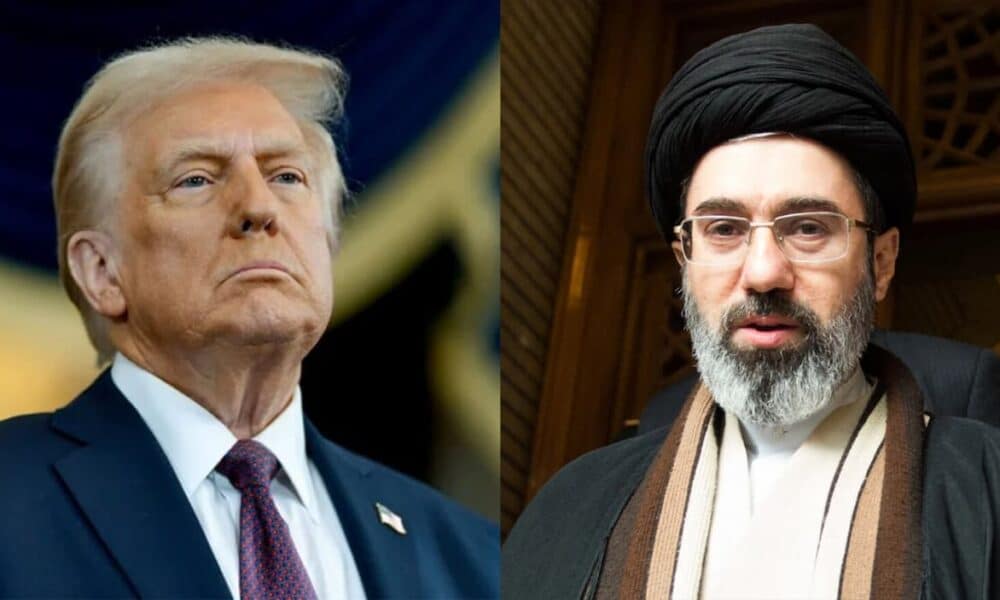
U.S. President Donald Trump warned that the United States would strike Iran “hard” and would respond to the Iranian attack targeting American forces in Jordan.
On its side, Iranian President Massoud Pezeshkian said Tehran was ready to immediately implement its commitments if Washington returned to honoring those set out in the memorandum of understanding.
The Essentials
- Donald Trump weighs limited and periodic American strikes around the Strait of Hormuz to prevent Iran from reconstituting certain radar and missile capabilities.
- The Iranian President Massoud Pezeshkian says he is ready to immediately honor the memorandum of understanding if Washington also returns to its commitments.
- A tanker was hit by three projectiles of unknown origin about 30 km east of Khasab, in the Sultanate of Oman. No casualties were reported.
- Trump claims that around 30 ships pass through Hormuz each night, a figure presented as a U.S. statement rather than independently verified data.
- Meanwhile, Washington intensifies economic pressure on Tehran, while the Iranian central bank rejects any scenario of an economic collapse.
Trump studies limited and periodic strikes
According to Axios, Donald Trump is examining with his top advisers a plan providing for limited and periodic military strikes in the area of the Strait of Hormuz.
The objective would be to prevent Iran from reconstituting radar capabilities and missile systems that could be used against ships transiting through this strategic sea lane.
The scenario being studied by Washington comes after a new sequence of clashes between the two countries, and as the security of navigation in the Strait remains at the center of the standoff.
Donald Trump nevertheless states that the situation in Hormuz is now “excellent,” insisting that around 30 ships pass through the strait each night. He also said that China had remained neutral regarding the situation in this area.
This American estimate should, however, be treated as a White House claim: visible maritime tracking data show traffic as more limited, though some vessels may navigate with their transponder inactive.
A tanker hit by three projectiles
The risks to navigation remain real. The UK Maritime Trade Operations (UKMTO) reported that a tanker had been struck by three projectiles of unknown origin as it was traversing outbound through the Strait of Hormuz.
The incident occurred about 17 nautical miles, or roughly 30 kilometers, east of Khasab, in the Sultanate of Oman.
No casualties or environmental consequences were reported.
U.S. Vice President JD Vance said that Washington was currently working to guarantee the free flow of trade through Hormuz. According to him, Iranian leaders would be willing to disrupt flows of oil and gas without adequately considering the strategic consequences.
Pezeshkian conditions return to the agreement
On the diplomatic front, Massoud Pezeshkian continues to present the memorandum of understanding as the possible basis for de-escalation.
The Iranian president stated that Washington’s compliance with its commitments lasted only two weeks after the signing of the document.
“If America returns to honoring its commitments under the memorandum of understanding, we will do likewise immediately,” he said.
Pezeshkian also argues that Iran has a history of respecting its international accords and commitments, unlike the United States, in his view.
During a meeting with Pakistani Prime Minister Shehbaz Sharif, the Iranian president confirmed that his country remained ready to implement the memorandum on condition that the other party also respects its commitments.
The Pakistani prime minister, for his part, remarked that the memorandum reached in Islamabad was currently the most practicable path to lasting peace and stability.
Tehran simultaneously hardens its military rhetoric
On the military front, the Iranian Revolutionary Guard Corps announced that their air defense had shot down an MQ-9 adversary drone to the east of the Strait of Hormuz.
The spokesperson for the Iranian Armed Forces also reaffirmed Tehran’s objective of seeing American forces leave the region, stating that turning the Strait of Hormuz into “American territory” would, in his view, remain an unattainable objective.
This rhetoric illustrates the current paradoxical situation: Washington and Tehran continue to refer to the same diplomatic memorandum while simultaneously strengthening their military positions around Hormuz.
Washington also seeks to intensify economic pressure
The confrontation is also playing out on the economic front.
During the G20 Finance Ministers’ meetings in Asheville, North Carolina, Washington urged other members of the group to join its campaign of economic pressure against Iran.
The discussions also addressed global growth prospects, worsening public debt, and the strengthening of public-private partnerships.
In Tehran, the governor of the Iranian central bank rejected claims of a possible economic collapse of the country.
He stated that the recovery of Iranian assets and currency reserves continued and that the country had sufficient internal reserves.
According to him, Iran has “enough foreign currency,” despite the new sanctions regularly imposed on the country. He also argued that the depreciation of the national currency stemmed more from the psychological climate surrounding the war and sanctions than from economic fundamentals.
Hormuz remains at the heart of the balance of power
The developments in recent hours thus show that the Strait of Hormuz remains the main point of friction between Washington and Tehran.
The United States seeks to guarantee maritime circulation and is considering maintaining a strike capability capable of preventing the reconstitution of Iranian military capabilities in the area. Tehran says it is ready to fully return to the memorandum of understanding, but only if the United States reciprocally respects its commitments.
Between maritime incidents, military threats, economic sanctions, and statements in favor of resuming the agreement, the confrontation remains contained within a particularly fragile balance.
Keywords: Iran, United States, Donald Trump, Massoud Pezeshkian, Strait of Hormuz, American strikes Iran, Iran–United States war, tanker Hormuz, memorandum Washington Tehran, sanctions against Iran, Islamic Revolutionary Guard Corps, JD Vance, oil prices