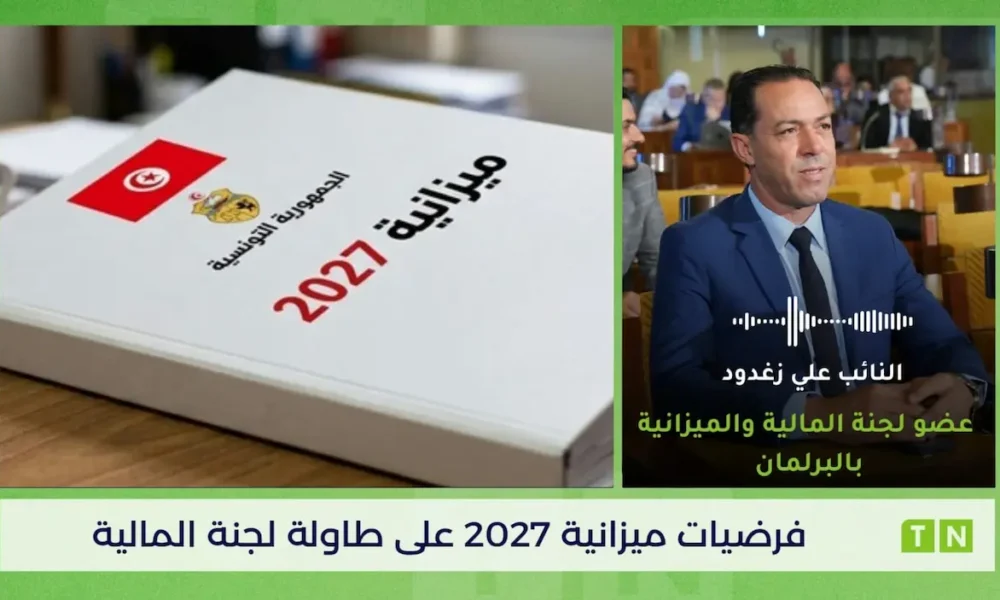
Tunisia intends to continue, in 2027, its efforts to consolidate economic growth, to curb inflation, and to stabilize the dinar, while accelerating the implementation of public projects to improve their economic and social returns.
According to a document from the Ministry of Finance devoted to the assumptions and the broad directions of the state budget project for 2027, the government also aims to ensure compliance with all state commitments, notably the repayment of public debt within the planned deadlines.
Des hypothèses liées à l’évolution de l’économie mondiale
The budget project for 2027 is based on the assumption of an improvement in external demand, driven by global growth to 3.4% in 2027, versus 3% expected in 2026.
The growth in the euro area should also rebound to 1.2%, compared to 0.9% in 2026. In the same time period, global inflation should fall to 3.9%.
The project also relies on an assumption of an average Brent crude oil price between $75 and $80 per barrel, while continuing efforts to curb the budget deficit and strengthen transparency and governance in the management of public finances.
Renforcer les recettes non fiscales
The preparation of the 2027 budget project rests on several strategic objectives in the field of public finances.
These include continuing to control the budget deficit, increasing the mobilization of own resources across all budgetary resources, and accelerating the digitization of the tax and financial system.
The government also intends to strengthen non-fiscal revenues and increase their share in the state’s own resources. Strengthening transparency and governance in the management of public funds is also among the priorities, notably through the establishment of regular control and performance evaluation systems.
Soutenir les entreprises et établissements publics
The project also aims to support and promote public enterprises and establishments, by introducing mechanisms designed to ensure the continuity of their activity, strengthen their competitiveness, and enable them to regain their economic and social prominence.
A particular emphasis will be placed on regional development, notably through strengthening the corporate social responsibility of enterprises and public establishments.
The objective is also to accelerate the realization of development projects planned in the regions, notably the development of industrial zones, the reinforcement of water and electricity supply networks, as well as the provision of basic equipment and services.
These measures should contribute to improving the business climate, attracting new investments, and supporting economic and social development in the country’s various regions.
Une année charnière pour le plan de développement 2026-2030
The preparation of the State budget project for 2027 constitutes an important step in the implementation of the 2026-2030 Development Plan, of which 2027 will be the second year.
Through this project, the State intends to move from defining the strategic framework to accelerating the realization of projects and the on-the-ground realization of reforms, according to the Finance Ministry’s document.
The Prime Minister’s Circular No. 2, dated 14 April 2026, emphasizes that the preparation of the budget project should reconcile the requirements of financial sustainability with the need to support economic and social growth, through policies aimed at consolidating public finances and promoting sustainable development.
Le projet attendu au Parlement avant le 15 octobre
The services of the Ministry of Finance are currently working on drafting the Finance Bill and the State budget project for 2027.
These two texts will then be submitted to the Presidency of the Government for examination in the Council of Ministers, before their transmission to the Assembly of the Representatives of the People.
In accordance with constitutional deadlines, the project must be transmitted to Parliament no later than October 15, 2026.