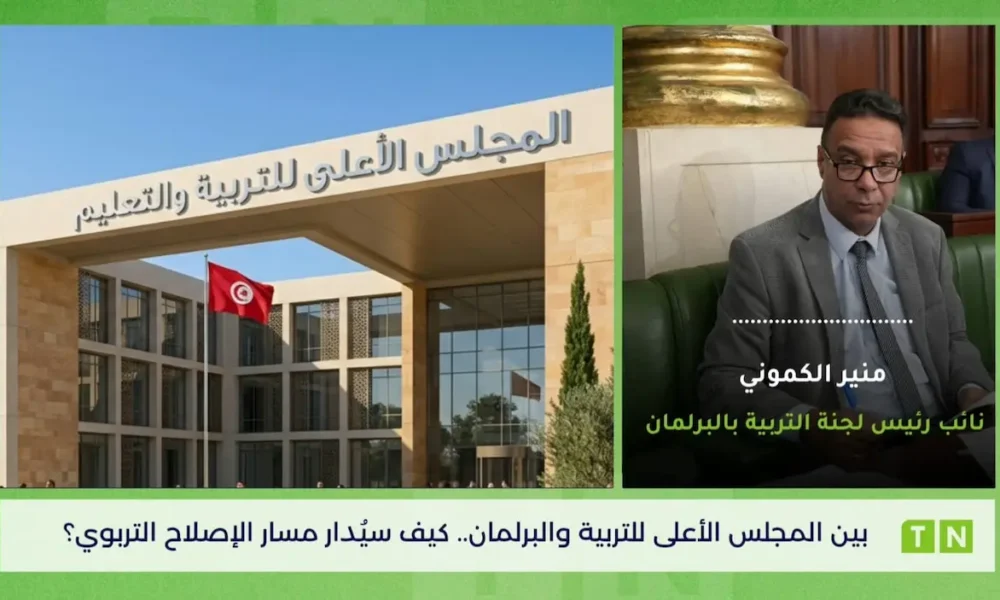
The organic law relating to sports structures should be among the priority texts as parliamentary work resumes, according to Mounir Kamouni, vice-president of the Commission on Education, Vocational Training, Scientific Research, Youth and Sports at the Assembly of the Representatives of the People.
In an interview granted to Tunisia Digital, he indicated that the commission had already reached an important milestone in examining this proposal, after a series of hearings conducted with several stakeholders involved in the sports sector.
Expanded hearings on sports structures
Mounir Kamouni explained that the commission had broadened its consultations due to the importance of the text and the nature of the reforms it envisions, particularly regarding the organization of clubs and sports societies.
The hearings notably involved the authors of the initiative, the Tunisian National Olympic Committee, the Tunisian Association of Sports Law, and the Paralympic Sports Association.
The commission also heard several experts as well as representatives of the Tunisian Union for Industry, Trade and Craft and the Tunisian Order of Certified Public Accountants.
This diversity of participants should, according to the vice-president of the commission, allow for examining the different dimensions of the project before continuing its legislative journey.
A study day planned for mid-October
The commission also plans to organize, in mid-October, a study day devoted to the bill relating to sports structures.
The conclusions of this meeting should help further improve the text before completing the various stages of its parliamentary review.
Mounir Kamouni recalled that amendments can always be introduced during the subsequent stages, including during the plenary session.
“The plenary session remains sovereign. Our aim is that the final version of this law lives up to the expectations and the efforts that have been devoted to it,” he said.
Education toward a comprehensive revision of the 2002 law
On the educational front, the Education Commission is considering a different approach. Several proposed laws related to this sector could be examined within the framework of a broader revision of the 2002 Orientation Law on Education and Schooling.
“We want the educational reform to be comprehensive,” stressed Mounir Kamouni.
According to him, establishing the Higher Council of Education should foster more dialogue, interaction, and cooperation with Parliament within the framework of the proposed reform process.
An advisory role for the Higher Council of Education
The vice-president of the commission noted that the Higher Council of Education is a consultative, not a legislative body.
One of the challenges, therefore, according to him, is to ensure coordination between the legislative function exercised by Parliament and the consultative role of the Higher Council of Education.
In this context, the commission has chosen not to decide on several laws directly related to the education sector for now, though hearings have already been organized with their authors.
School time, mental health and the single school day in focus
Among the proposed items are a text relating to school time, as well as initiatives concerning mental health and the single school day.
According to Mounir Kamouni, these dossiers intersect several provisions of the 2002 Orientation Law. The commission thus believes they could be addressed more coherently within a general revision of this text rather than separately.
The deputy estimated that the 2002 Orientation Law should now be updated, while underscoring the commission’s willingness to drive this reform through a participatory approach involving the various stakeholders in the education sector.