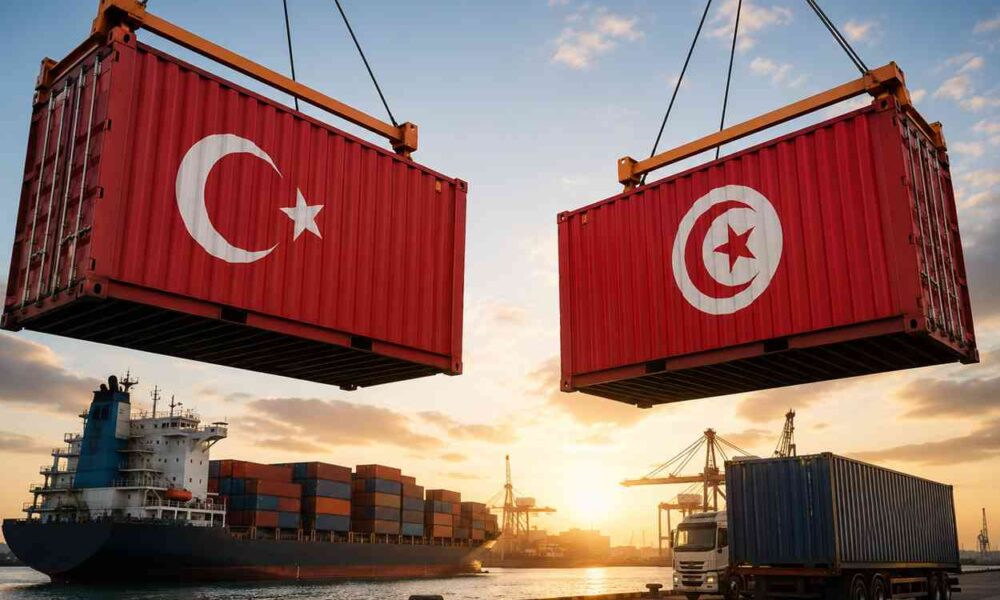
Turkish exports to Tunisia surpassed 720 million dollars in the first seven months of 2026, up 9.9% year-on-year, according to data from the Turkish Exporters Assembly (TIM) compiled by the Anadolu Agency.
This growth fits within Turkey’s expanding trade in Africa but takes on a particular dimension in Tunisia: a large share of the flows concerns products used by sectors that Tunisia itself produces and exports, notably textiles.
In July alone, Turkish exports to Tunisia reached about 101 million dollars, up only 0.3% year-on-year. A nearly flat monthly performance that contrasts with the 9.9% growth recorded since the start of the year.
From Turkish textiles to a country that exports textiles
The composition of trade sheds further light on the commercial relationship between the two countries. According to 2024 data from the Observatory of Economic Complexity (OEC), among the main Turkish exports to Tunisia were heavy woven cotton, for 76.5 million dollars, cars, for 53.2 million, and other knitted fabrics, for 38.8 million dollars.
Two of the main listed items therefore come from the textile sector, which is precisely one of Tunisia’s industrial and export pillars.
Turkish presence in the supply chain of the sector is far from marginal. According to data from the Turkish Ministry of Trade reported by Anadolu, Turkey accounts for 35.6% of Tunisian cotton imports and 18.6% of imports of cotton fabrics blended with synthetic or artificial fibers.
However, these flows should not be interpreted solely as competition. Imported fabrics can also serve as inputs for Tunisian garment and clothing companies, a significant share of whose production is destined for the European market.
The challenge is therefore twofold: ensuring competitive supply for the local industry while preserving Tunisia’s ability to generate more value added within its own textile chain.
In the other direction, the main products exported by Tunisia to Turkey in 2024 included, according to the OEC, crude oil, blended fertilizers and electrical equipment. The structure of Tunisian exports thus appears significantly different from that of Turkish exports to the Tunisian market.
An imbalance that sits within a broader Tunisian deficit
The growth in imports from Turkey occurs as Tunisia’s trade balance worsens.
According to the National Institute of Statistics (INS), Tunisia’s trade deficit reached 14.958 billion dinars in the first seven months of 2026, up from 11.904 billion dinars during the same period in 2025.
The import coverage ratio by exports has fallen to 73.1%.
In this context, Turkey ranks among suppliers whose sales to Tunisia are rising: Tunisian imports from Turkey grew by 10% over the period, according to INS.
However, the rise in Turkish sales is not sufficient to explain the overall deterioration of Tunisia’s external balance. It remains heavily affected by the energy bill, which is one of the main contributors to the trade deficit.
Tunisia behind the main North African markets
The weight of the Tunisian market becomes clearer when compared with the other major North African destinations for Turkish goods.
In the first seven months of 2026, Morocco absorbed 2.43 billion dollars of Turkish products, up 11.7%. Exports to Egypt, for their part, rose 26.1%, surpassing 2.3 billion dollars.
Egyptian acceleration is particularly visible in July: Turkish exports to the country jumped by 49.3%, to 426.2 million dollars, making Egypt the leading African destination for Turkey that month.
Libya imported 1.59 billion dollars worth of Turkish goods over seven months, a rise of 2.3%.
Algeria moved against the trend: Turkish exports to it fell by 18.8%, to 1.09 billion dollars.
With a little over $720 million, Tunisia thus remains a market significantly smaller than Morocco, Egypt, Libya, and Algeria for Turkish exporters in the period considered.
Africa accounts for about 9% of Turkish exports in July
Across the continent, Turkish exports to Africa reached $13.3 billion between January and July 2026, up 12.6%.
The dynamism accelerated in July, with $2.3 billion, a rise of 16.3% year on year.
This growth must be viewed in the context of Turkey’s overall external trade. In July, Turkey’s total exports reached around $25.6 billion. By calculation, Africa accounted for nearly 9% of Turkey’s exports that month.
The continent thus represents a rapidly growing market for Ankara, but does not yet constitute the core of its external trade.
Tunisia: figures to put into perspective
14.958 billion dinars: Tunisia’s trade deficit for the first seven months of 2026.
73.1%: import coverage ratio by exports.
+10%: increase in Tunisian imports from Turkey over the period.
The rise in Turkish purchases fits into the broader deterioration of the external balance, but is not the main cause: the energy bill remains a major determinant of Tunisia’s trade deficit.
Logistics, Construction and Trade Diplomacy
Osman Aksoy, president of the Coordination Council of Turkey-Africa Business Councils within DEİK, the Turkish Confederation of External Economic Relations, identifies three main drivers behind this growth.
The first is logistics. Turkish Airlines now serves more than 60 African destinations, complemented by maritime freight links.
The second rests on the deployment of Turkish construction companies in ports, routes, airports, housing and infrastructure. These projects, in turn, boost demand for Turkish equipment, machinery and materials.
The third lever is trade diplomacy, through institutional relations, business missions and economic forums organized between Turkey and African countries.
For Tunisia, the next step could be industrial
For Ankara, the African strategy should not stop at the sale of goods.
Banu Küçükel, president of the Turkey-Tunisia Business Council within DEİK, believes the two countries have opportunities for cooperation in several sectors, notably textiles, automotive subcontracting, chemistry, machinery and equipment, energy and other industrial activities.
The Turkish organization highlights models of joint production and export to third markets, combining Turkish industrial and technological capacity with Tunisia’s advantages of access to European and African markets.
For textiles in particular, this complementarity could take the form of linking Turkey’s capability to supply fabrics and raw materials with Tunisia’s apparel industry oriented toward Europe.
The economic question for Tunisia thus extends beyond merely import levels. The challenge is to determine what share of this relationship could be transformed into productive investments, local production, jobs, industrial integration and technology transfers.
The 9.9% growth in Turkish exports to Tunisia shows that trade continues to intensify. The remaining question is whether the next step will enable Tunisia to capture more value through industrial partnerships and access to new markets, or whether it will mainly translate into increased outlets for Turkish producers.