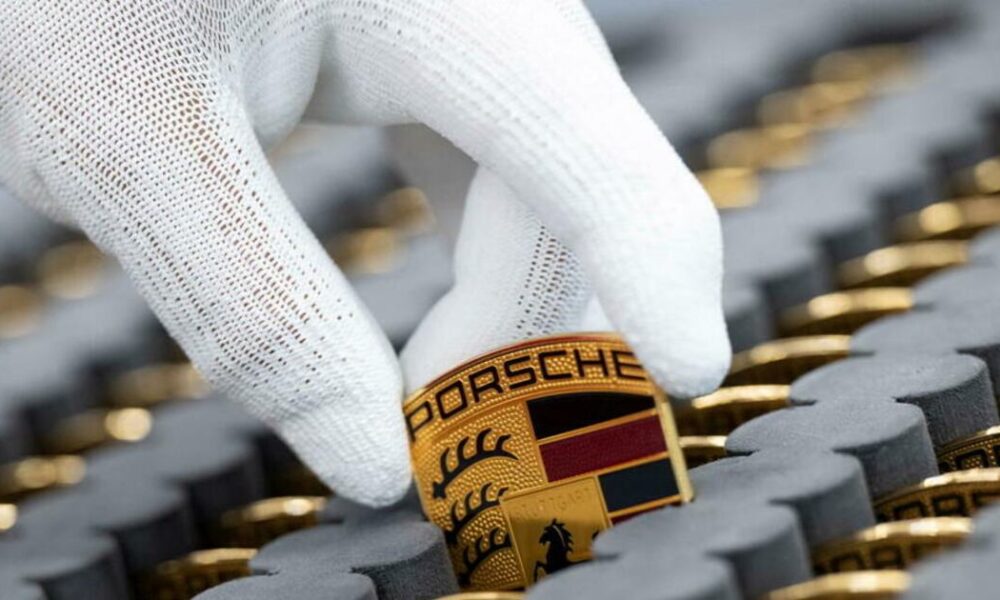
The historic restructuring of Volkswagen is taking on a new dimension. After raising to 100,000 the number of planned job cuts within the group, the German automaker is now studying around 4,100 additional workforce reductions in its ‘Sport Luxury’ division, which corresponds to Porsche.
A new pressure on the Stuttgart-based manufacturer, confronted with the collapse of its sales in China, the cost of its strategic pivot, and profitability that has deteriorated sharply.
- Volkswagen is studying around 4,100 additional job cuts at Porsche.
- They would add to the 9,000 job cuts already agreed at Porsche by 2035.
- The group-wide plan now foresees up to 100,000 job cuts, i.e., 50,000 more than previously planned.
- Volkswagen expects around €10 billion of exceptional charges on its 2026 results.
- For Porsche, the automotive operating result fell from €5.286 billion in 2024 to €90 million in 2025.
- Porsche deliveries in China dropped from 95,671 vehicles in 2021 to 41,938 in 2025.
4,100 additional jobs in sight
According to the German business daily Handelsblatt, documents related to the decision taken in early September by Volkswagen’s Supervisory Board foresee a reduction of around 4,100 employees in the group of brands “Sport Luxury.”
In Volkswagen’s current organization, this category corresponds to Porsche. Bentley and Lamborghini belong to the “Progressive” brand group along with Audi and Ducati.
The documents cited by the newspaper identify an overhead-savings shortfall of about €700 million.
Volkswagen estimates that Porsche must improve its result by €3.8 billion by the end of the decade. On overhead costs alone, the savings target amounts to €1.8 billion, but measures totaling only €1.1 billion are currently identified.
The document specifies that these new measures should come “in addition to existing agreements.” The 4,100 jobs mentioned would therefore not replace the reductions already agreed at Porsche: they could potentially be added to them.
Porsche had already planned 9,000 job cuts
The effort would be substantial for the maker of the 911.
In July, Porsche’s management and the workers’ representatives agreed on the elimination of 5,000 additional jobs, on top of 4,000 reductions already decided.
The existing agreements therefore cover about 9,000 jobs by 2035, roughly a fifth of the workforce.
The 4,100 posts now mentioned by Volkswagen could push the effort even further if Porsche actually implements them.
This institutional nuance is important: Volkswagen, the parent company and majority shareholder, can recommend these measures, but cannot impose them directly on Porsche AG, the listed company with its own governance.
Volkswagen moves from 50,000 to 100,000 job cuts
The Porsche file sits within a much broader restructuring.
Early September, Volkswagen’s supervisory board approved the group’s largest transformation plan in its history, founded in 1937.
The agreement provides for 50,000 additional job cuts, bringing the total number of jobs affected across the group to around 100,000.
The fate of four German sites remains open, with Volkswagen weighing various options for plants that must progressively shed the models currently assigned to them.
The manufacturer cites a combination of factors: industrial overcapacities, competition from Asian groups, US tariffs, a slowdown in the European market, and a retreat of its activities in China.
A restructuring that could cost €16 billion
The social effort itself represents a substantial cost.
According to Reuters, Volkswagen estimates the potential cost of headcount reductions and possible plant closures or reconversions at around €16 billion.
Around €10 billion would be reserved for costs associated with eliminating up to 60,000 jobs worldwide.
This figure should not be confused with the €10 billion of exceptional charges announced by Volkswagen on Friday for its 2026 results.
These include, notably, the impairment of its stake in Porsche, provisions linked to headcount reductions, restructuring, and the deterioration of the Chinese market.
Alone, the write-down of Volkswagen’s stake in Porsche amounts to about €6 billion.
Volkswagen’s margin falls to 1%
The consequence is dramatic for the German giant’s financial outlooks.
Volkswagen now foresees an operating margin of at most 1% in 2026.
The group had previously anticipated a range between 4% and 5.5%.
Volkswagen now targets revenue of around €315 billion this year.
The automaker also warns of further possible deterioration in the economic environment, notably in China, and of a faster shift of demand toward electric vehicles, on which its margins remain currently lower than those achieved on some internal combustion models.
Porsche: from €5.3 billion to just €90 million
Porsche’s deterioration is even clearer in its 2025 accounts.
In the automotive segment alone, its operating result fell from €5.286 billion in 2024 to €90 million in 2025.
The automotive operating margin also dropped from 14.5% to only 0.3%.
Across the entire Porsche AG group, which also includes other activities, its 2025 operating result stands at €413 million and the margin at 1.1%.
Porsche had regained an operating margin of 7.8% in the first half of 2026. But the new measures under consideration show that Volkswagen still views the structural level of costs as not sufficiently aligned with the decline in volumes and the new market conditions.
China, from growth engine to main problem
China alone accounts for a large part of the reversal.
In 2021, Porsche delivered a record 95,671 vehicles there. The country was then its top global market.
In 2025, deliveries fell to 41,938 units, a drop of more than 56% in four years.
And the trend worsened in 2026: in the first half, Porsche delivered only 14,501 vehicles in China, down 32% from a year earlier.
The maker faces a slowdown in the luxury segment but above all extremely aggressive Chinese competition, particularly in electrics, where local groups quickly roll out new models at often lower prices.
The electric gamble had to be recalibrated
Porsche is also paying the cost of adjusting its propulsion strategy.
After betting heavily on a rapid rise of the all-electric, the maker has revised its timetable in light of weaker-than-expected demand on several markets.
Its strategy now clearly relies on three technologies kept in parallel: internal combustion, plug-in hybrid, and electric.
The new CEO Michael Leiters wants to refocus Porsche on the most profitable models, reduce complexity, cut costs, and strengthen the brand’s exclusivity.
The detailed presentation of its strategy “Sportwagenschmiede 2035” is expected during an investor day scheduled for October 7.
The stock market punishes Volkswagen and drags German automotive
Markets immediately punished the renewed deterioration in outlooks.
On Friday, Volkswagen’s ordinary shares closed down 8.31% in Frankfurt, while the preferred shares fell 5.58%.
Porsche AG fell about 3.34% and Porsche SE by 4.85%.
Nervousness spread to other German automakers: BMW and Mercedes-Benz were also heavily punished during the session.
The European automotive index closed down by more than 3%, a sign that investors no longer view Volkswagen’s and Porsche’s difficulties as a completely isolated problem.
Why Tunisia must follow this restructuring
For Tunisia, this crisis in the German automobile industry is not entirely distant. Tunisia’s automotive components sector accounts for about 120,000 jobs and €3.9 billion in exports, of which 37% are destined for Germany, the sector’s leading market.
A sustained reduction in production volumes by German manufacturers can thus progressively spread to the suppliers in their supply chains, including those established in Tunisia. No direct impact on a Tunisian plant has been announced at this stage.
A crisis that extends far beyond Porsche
The 4,100 additional jobs mentioned at Porsche are thus less an isolated event than a new chapter in a much deeper transformation of the German automotive industry.
Volkswagen now seeks to reduce up to 100,000 jobs, reassess several industrial sites, and absorb billions of euros in charges, while Porsche tries to rebuild a business model weakened by China and the recalibration of its electric strategy.
The group’s challenge is no longer just to cut costs: it is to restore a level of profitability compatible with an industry where European volumes stagnate, where Chinese manufacturers gain ground, and where technologies evolve faster than the historic industrial structures.
Volkswagen is considering around 4,100 additional job cuts at Porsche, added to the 9,000 already agreed. But the real scale change is at the group level: the restructuring plan now covers up to 100,000 jobs.
Porsche concentrates part of the difficulties, with its automotive operating result dropping to €90 million in 2025 from €5.286 billion a year earlier and with China sales halving since 2021.
For Tunisia, heavily integrated into German automotive supply chains, this transformation deserves close monitoring.
Sources : Handelsblatt, Reuters, Volkswagen Group, Porsche AG, Tunisian Automotive Association.