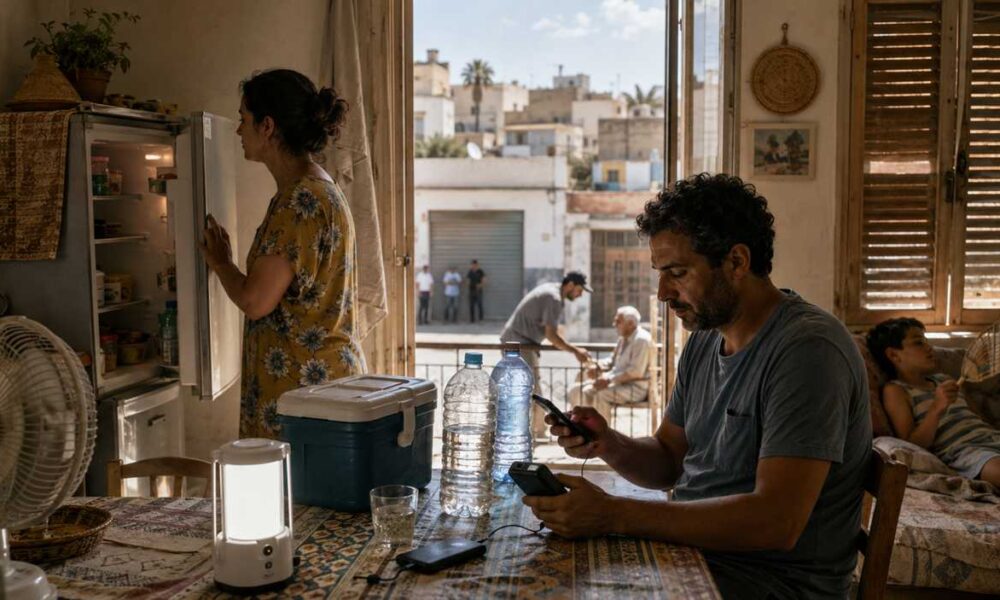
Load shedding has become part of Tunisia’s daily life this summer. Rather than endure it, let’s get organized. Here are useful actions, domain by domain: some cost nothing, others require a small amount of equipment, but all rest on the same rule — anticipate before the power goes out.
During hot days, STEG identified the period between 1:00 PM and 5:00 PM as particularly tense and urged consumers to reduce their usage then. This window therefore deserves heightened vigilance, without excluding cuts at other times, notably in case of technical failure or unforeseen imbalance.
The general principle
Organize meals, charging, travel, and sensitive tasks as much as possible before the onset of the most tense period. A predictable outage should become a manageable inconvenience, not an improvised emergency.
Food: preserving the refrigerator and freezer
A refrigerator with its door kept closed generally keeps foods safe for about four hours. A full freezer can maintain cold for about 48 hours, versus about 24 hours when it is only half full.
The first reflex is therefore simple: do not open doors unnecessarily, even to check the temperature. Each opening accelerates warming.
You can fill the empty spaces in the freezer with water bottles, leaving enough space for their expansion. Once frozen, they add to the cold mass and can serve as ice packs in a cooler.
Do not rely on the trick of a piece placed on a cup of frozen water: it may show that partial thaw has occurred, but it does not inform on the temperature reached by the foods or the duration they stayed in a dangerous zone.
After a prolonged outage, frozen foods can generally be kept or refrozen if they still contain ice crystals or if they have remained at a temperature at or below 4 °C.
When in doubt, do not take a risk
Meats, fish, eggs, dairy products, and cooked leftovers that have stayed above 4 °C for more than two hours must be discarded. Smell, color, or taste do not always reliably indicate a dangerous food.
For meals, favor cooking in the morning and keep some products that do not require cooking or refrigeration: unopened canned goods, bread, fruit, dried fruit, biscuits, UHT milk, canned legumes, and drinking water.
If you cook with gas, make sure the room remains well ventilated and never leave a flame unattended.
Heat: staying without air conditioning
An outage can occur precisely when outdoor temperatures are at their highest. Close shutters, blinds, and windows when the outside air becomes warmer than the inside. Open up to air out as soon as the outdoor temperature drops, usually in the evening or at night.
Choose the coolest room in the home, often located to the north, on the ground floor, or away from the roof, and gather the most vulnerable people there during the critical hours.
Slightly humidify the skin, place a cool towel on the neck, take a lukewarm shower, or keep the feet in a basin of water to improve comfort. A damp sheet in front of a slightly open window can also help when the outside air is dry and cooler.
Drink regularly without waiting to feel thirsty. Avoid intense physical exertion, alcohol, and very heavy meals during the hottest hours.
Recognizing a heat-related emergency
Headache, dizziness, nausea, weakness, intense thirst, and heavy sweating may signal heat exhaustion.
Confusion, incoherent speech, loss of consciousness, seizures, or very high body temperature may indicate heat stroke. Call emergency services immediately and start cooling the person.
Infants, the elderly, chronically ill people, and isolated individuals can become dehydrated quickly. A call or visit during the hottest hours can prevent a serious situation.
Computing and remote work: avoid losing your work
Enable automatic backup of your documents. A local copy synchronized with an online service such as Google Drive, OneDrive, or iCloud helps limit losses, even when the Internet connection is temporarily interrupted.
A properly sized UPS can provide the time needed to save your work and shut down the computer properly. Some models also protect equipment against voltage fluctuations.
Its autonomy depends on its power, battery condition, and the number of devices connected. Do not plug high-energy devices like air conditioners, heaters, or laser printers into a small UPS.
During the outage, unplug desktop computers, televisions, modems, and sensitive equipment. When the power returns, wait a few minutes before replugging them gradually.
For remote work, charge laptops, phones, and external batteries before the critical period. Keep 4G or 5G tethering as a backup if the router stops functioning.
Whenever possible, schedule important meetings, heavy transfers, and tasks requiring a stable connection during the morning.
Gates, rolling shutters and security systems
Most gates, garage doors, and motorized rolling shutters have a manual emergency mechanism: a crank, pull cord, lever, or unlock key.
Locate this device now and learn how to use it by following the manual or the installer’s instructions. Do not discover its operation in the dark when you need to close a business or drive out a vehicle.
Also check the battery status of alarms, cameras, intercoms, and access control systems. Keep a rechargeable flashlight near the entrance, in an accessible place.
Elevators: a simple rule
When outages are announced or repeated, prefer the stairs, especially during the most tense period and for unaccompanied children.
If you get stuck, press the alarm button, use the intercom, or call the syndic and the rescue services. Never try to open the doors or exit alone between floors.
What property managers should check
- the operation of the alarm button;
- the emergency lighting;
- the availability of the maintainer’s number;
- the automatic return device of the cabin, when it exists.
Health: thermosensitive medicines and medical devices
The shelf life of insulin outside the refrigerator varies by product. Many presentations can be stored for several weeks at temperatures not exceeding 25 to 30 °C, but the manufacturer’s instructions remain the reference.
During heat waves, use an insulated pouch or an appropriate cooler. Never place insulin directly against a block of ice and do not use it if it has been frozen.
Also check the storage conditions for other thermosensitive medications with the pharmacist or in their packaging insert.
When a person depends on a ventilator, an oxygen concentrator, a home dialysis device, or any other vital electrical device, the plan must be prepared before the outage with the doctor, the supplier, or the manufacturer.
For an electrical medical device
- know the device’s actual battery life;
- check the time needed to recharge it;
- use only a compatible and approved power supply;
- identify a facility or a powered fallback location;
- do not wait for the battery to run out before seeking help.
It is useful to inform STEG of the presence of vital equipment, but this notification should never be considered as a guarantee of continuity or priority restoration.
Do not use an uninterruptible power supply, battery, or generator not validated by the device’s supplier. An improper power source can cause malfunction or damage the device.
Businesses, cafes and restaurants: limiting losses
Note the exact start and end times of each outage. Regularly check the temperature of professional refrigerators and freezers with an independent thermometer.
Do not sell at reduced prices ice creams, meats, dairy products, or foods whose cold chain has become uncertain. A potentially dangerous product should be removed from sale.
Some payment terminals run on battery and via the mobile network, but a prolonged outage can interrupt electronic payments. Plan a backup solution, inform customers, and keep enough cash for cash payments.
Before buying or renting a generator, have a professional assess the required power. A freezer, a coffee machine, an air conditioner, and lighting do not have the same starting needs.
Generator: essential rules
- operate it only outdoors;
- keep it away from doors, windows, and vents;
- never use it inside a dwelling, a garage, a cellar, or a stairwell;
- do not refuel it when it is running or hot;
- never connect it directly to the electrical panel with improvised wiring.
Powering a business or building installation requires a transfer switch of an appropriate rating, installed by a qualified electrician. An improvised connection can cause a fire, electrocution, or dangerous backfeed for network technicians.
Weddings and parties: checking the backup power supply
Before booking a venue, ask whether it has a functional generator, what power it provides, which equipment it can power, who is responsible for starting it, and when it was last tested.
Having a generator is not enough: it must be maintained, properly sized, fueled, and used under safe conditions.
For a home party, do not rent equipment without informing the professional of the power needs for sound, lighting, and other equipment.
Also plan an independent lighting solution: rechargeable LED lamps, battery-powered projectors, and light markers to secure exits and stairs.
Water: the reflex in buildings
In buildings equipped with an electric pump, a power outage can also interrupt the water supply.
When a risk of load shedding is announced, fill a few bottles of drinking water and a container for kitchen, hygiene, and toilets.
A reasonable reserve is enough. Excessive storage can uselessly deprive other residents of water and clutter the living space.
Car and travel
Avoid driving with an almost empty tank. Some gas stations may no longer dispense fuel during an outage if they lack a backup power supply.
When outages repeat, confirm appointments with doctors, dentists, barbers, or at an administration before traveling. Allow extra time for traffic jams or non-working traffic lights.
Do not cross an intersection whose lights are off as if you had the right of way. Slow down significantly and apply caution and priority rules appropriate to the situation.
The neighborly reflex
During a blackout, check on neighbors who are elderly, ill, disabled, or isolated. A building in which everyone knows who to call or visit during the crisis handles it more easily.
Building or neighborhood WhatsApp groups can be useful to quickly determine whether the outage affects the entire area, report a blocked elevator, or announce power restoration.
However, avoid sharing unconfirmed schedules or rumors presented as official announcements.
Your rights and procedures with STEG
STEG toll-free number
To report a fault or a dangerous situation, STEG provides the toll-free number 80 100 444. Prepare your customer reference and, if possible, check whether the outage also affects neighboring areas.
When equipment has been damaged by a network anomaly, a request for investigation and compensation can be filed with the district or the relevant STEG agency within 48 hours of the incident.
The file must include, in particular:
- a written request;
- the subscription reference or a consumption bill;
- the precise date and time of the incident;
- the list of damaged equipment;
- an invoice or a repair estimate;
- photographs and, if possible, testimony from affected neighbors.
Compensation is not automatic. It depends on the investigation and the establishment of an anomaly attributable to the STEG network. But without a file submitted on time, no request can be reviewed.
In a word
Preparation does not remove load shedding, but it limits its consequences.
A refrigerator left closed, a charged battery, a identified manual mechanism, a properly protected medicine, or a vulnerable neighbor called at the right moment can make a considerable difference.
Those who plan their meals, work, travel, and recharges before the most tense period will get through outages as a nuisance. Those who wait for the power to go off to react risk suffering them as losses, blockages, or emergencies.
The guiding thread
The difference lies not only in money or luck. It mainly lies in anticipation.